Upsolve Data Models: Helping AI Truly Understand Your Business Metric Definitions

Upsolve Data Models grounds AI Agent answers in unified, versioned business metric definitions instead of guesswork.
The biggest trust barrier in enterprise AI analytics isn't whether the AI can answer questions — it's whether those answers are reliable. The root cause: business concepts like "active users" or "MRR" have inconsistent definitions across teams, leaving AI to guess. Upsolve Data Models builds a semantic infrastructure layer between AI Agents and the data warehouse, letting users register data models, metric definitions, and business vocabulary once so all Agent responses are grounded in that shared context. It also supports version control for metric definitions and nightly column value refreshes to keep AI current. The approach echoes dbt Semantic Layer and Cube but is explicitly designed for AI Agent use cases. The product recently launched on Product Hunt with 74 upvotes, though community feedback remains limited and real-world integration depth still needs validation.
The Old Problem with Data Analytics: Why AI Answers Are Always "Plausible but Wrong"
When enterprises adopt AI for data analysis, they often run into an uncomfortable reality: AI can generate SQL queries and answers that look reasonable on the surface, yet frequently gets the definitions of key metrics wrong. What exactly counts as an "active user"? How should "monthly recurring revenue" be calculated? Which time window defines "customer churn"? These business concepts can have multiple conflicting definitions across different teams and documents, and without a unified context, AI has no choice but to guess.
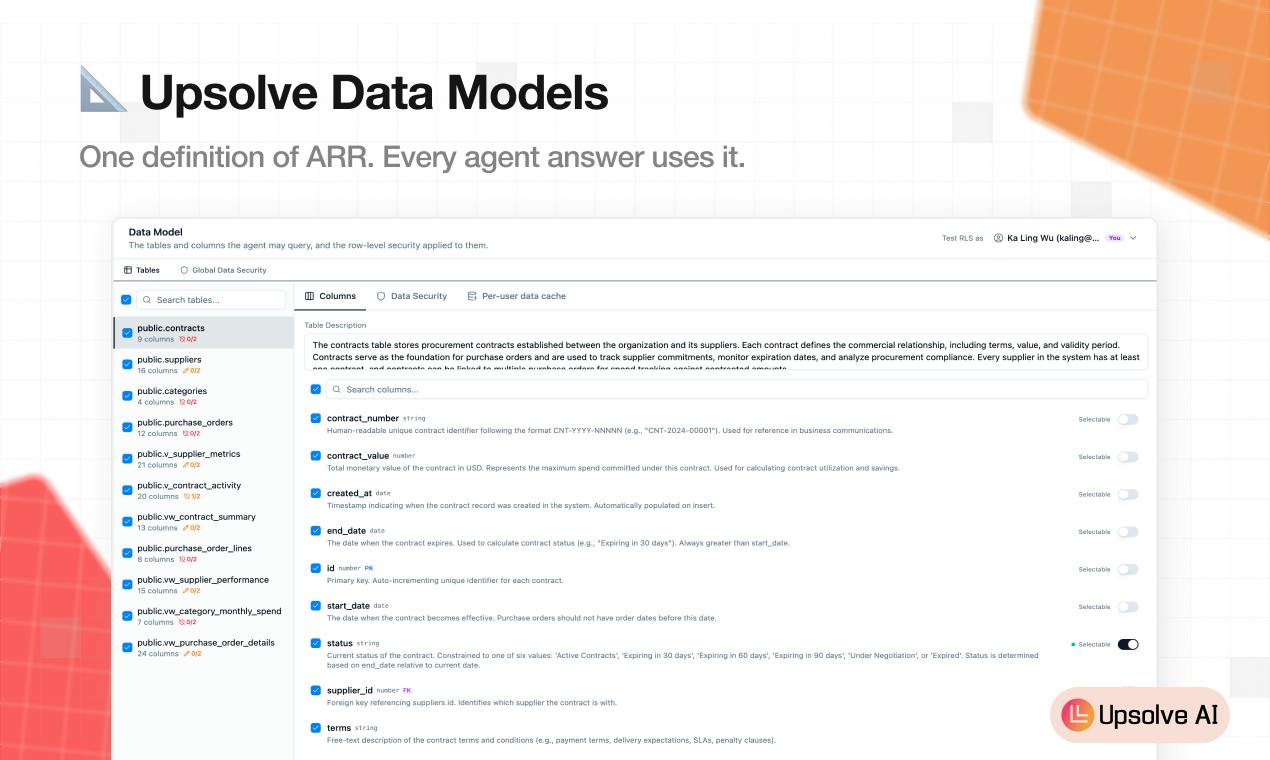
Upsolve Data Models aims to solve this problem at its root. The core idea is straightforward — teach your data models, metric definitions, and business vocabulary to the AI once, and every subsequent AI Agent response will be grounded in that shared definition rather than improvised on the spot. The product recently launched on Product Hunt, earning 74 upvotes and ranking 18th, listed across the Analytics, Developer Tools, and Artificial Intelligence categories.
Three Key Mechanisms: Register, Version, and Nightly Refresh
Register Once, Apply Everywhere
Upsolve's first design principle is "register once." Users register their internal data model structures, precise metric definitions, and business glossaries into the system to form a unified semantic layer. All subsequent Agent responses are then "grounded" in this set of definitions. This means no matter who asks a question or how they phrase it, the AI always uses consistent metric definitions — eliminating the classic problem where the same "sales revenue" figure shows up as three different numbers across different reports.
Version Control for Metrics, Just Like Code
The second standout feature is treating metric definitions like code under version control. Business definitions are never static — as company strategy evolves, the criteria for a "qualified sales lead" may change, or the threshold for a "paying user" may be raised. Upsolve puts these definitions under version control so every change is traceable. This is especially important for data governance: when a quarterly report shows an unexpected anomaly, the team can trace back whether the underlying data changed or whether the definition itself was modified.
Bringing business definitions under version control is, at its core, applying Data Governance practices to semantic layer management. Data governance addresses the availability, integrity, security, and consistency of data assets — and standardizing metric definitions has historically been one of the hardest parts to implement, because it depends on organizational consensus rather than purely technical solutions. The value of versioning goes beyond auditability: when a metric definition referenced by downstream AI Agents changes, the version history also serves as an audit trail, helping compliance teams confirm which definition was in use when a given report was generated. This aligns with the philosophy behind dbt putting SQL transformation logic into Git: turning implicit, scattered business knowledge into explicit, controlled engineering artifacts.
Nightly Column Value Refreshes Keep Answers Current
The third mechanism is the nightly refresh of column values. Data is alive — enumerated values and category labels grow continuously as the business evolves. Through automatic nightly refreshes, Upsolve ensures the AI is working with the latest data distributions rather than stale snapshots. As the product puts it, answers stay correct as data changes — directly addressing the common problem where AI analytics tools become outdated the moment they're deployed.
Positioning: Semantic Infrastructure for Developers and Data Teams
In terms of category, Upsolve Data Models looks more like a semantic infrastructure layer sitting between the raw data warehouse and AI Agents, rather than a reporting tool for end users. It takes the "business knowledge" that typically lives scattered across employees' heads, Confluence docs, and SQL comments — and turns that implicit asset into explicit, structured information that AI can actually use.
This direction is closely aligned with the "Semantic Layer" and "Metrics Layer" concepts that have gained traction in the data space in recent years. Products like dbt's Semantic Layer and Cube are tackling similar problems, but Upsolve differentiates itself by explicitly targeting AI Agent use cases, emphasizing "grounding" — using trusted definitions to constrain LLM outputs and reduce hallucination risk.
The Semantic Layer is an abstraction layer in data architecture that sits between the data warehouse and the consumption layer. Its core function is to map physical table fields to business-understandable metrics and dimensions with consistent definitions. The Metrics Layer is a subset of the Semantic Layer, focused on treating "metrics" as first-class citizens — including calculation logic, filter conditions, and time granularity — to ensure semantic consistency across tools and teams. dbt Semantic Layer is built on the MetricFlow engine, allowing metrics to be declaratively defined on top of dbt models, with downstream BI and AI tools accessing them through a unified interface. Cube provides an independent semantic layer service with caching and multi-tenancy support. Upsolve's differentiation in this ecosystem is that its design goal has always been to serve AI Agents rather than BI dashboards — making "grounding" (constraining LLM outputs with trusted definitions) its core value proposition, rather than simply providing a consistent query interface.
Value Delivered — and What Still Needs Validation
For teams actively deploying AI data assistants, Upsolve addresses a genuine pain point. The biggest trust barrier with AI analytics tools isn't whether the AI can answer a question — it's whether the answer can be trusted. A unified, versionable, continuously refreshed definition system is precisely the foundation that trust requires.
That said, based on currently available information, a few questions remain worth watching: How high is the initial cost of entering definitions? How deeply does it integrate with existing data stacks like Snowflake or BigQuery? What are the performance and cost implications of nightly refreshes at scale? These can only be evaluated through real-world use. With only 3 comments on Product Hunt, community feedback is still limited, and the product's actual maturity level awaits validation from a broader user base.
For practitioners focused on deploying AI in enterprise data contexts, Upsolve Data Models represents a pragmatic trend: rather than making AI "smarter," the better starting point is making it "more fluent in business context."
Related articles

ChatGPT Space Launches: Team Collaboration and New Pages Features Explained
ChatGPT Space is OpenAI's new team collaboration feature with Pages, real-time collaboration, and Slack/Google Drive sync. We break down its privacy design, multi-platform integration, and the full workflow from conversation to document.

Migrating Apache Spark UDFs to GPU Acceleration with AI Agents
NVIDIA developer blog explains how AI Agents rewrite Apache Spark UDFs for GPU acceleration, covering migration criteria, agent rewriting and verification workflows, plus pitfalls like result consistency and CPU-GPU transfer overhead.

Zed Editor v0.40.4-rc2 Released: Usage Credits Now Available Without Upgrading
Zed editor releases v0.40.4-rc2, allowing users to use usage credits for AI features without upgrading to a paid plan, lowering the trial barrier.