US Commerce Department Blacklists Megaspeed as Jensen Huang Retakes Control of Nvidia
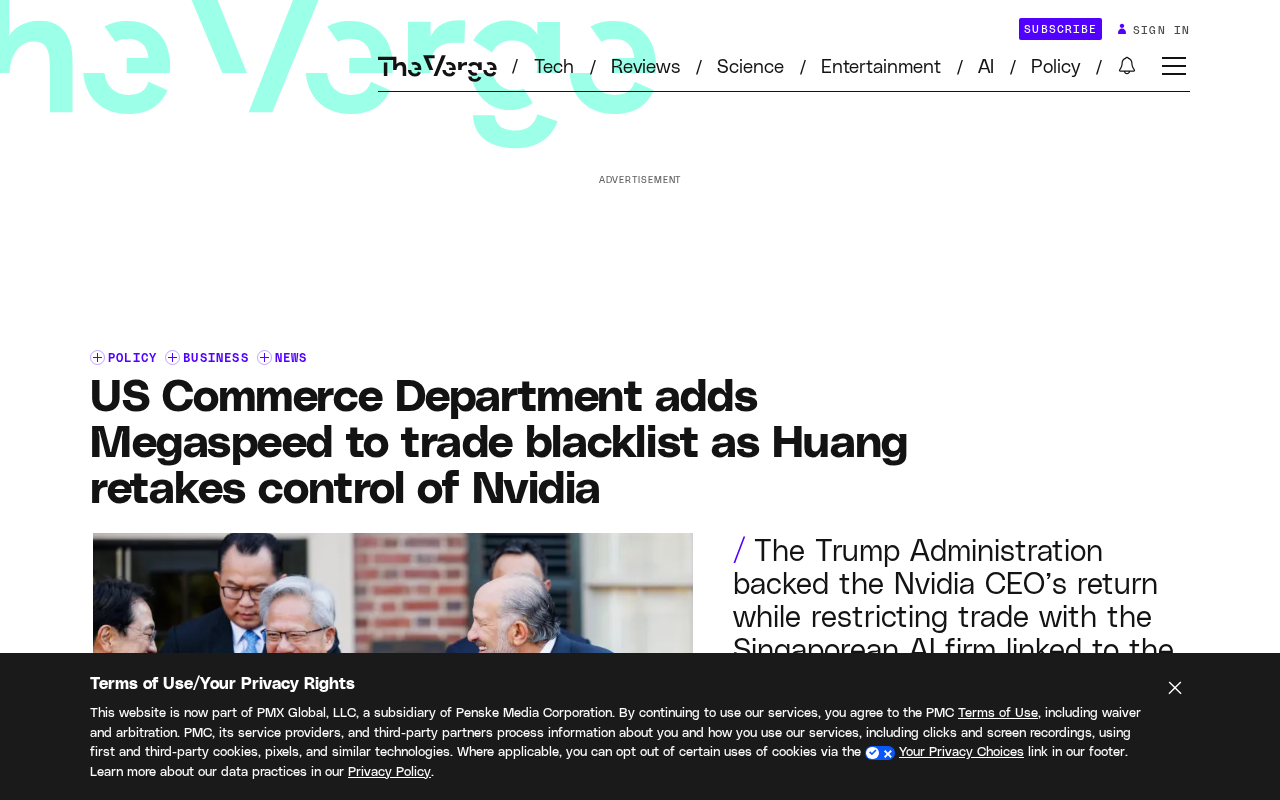
US Commerce Department adds Singapore-based AI cloud provider Megaspeed to the Entity List, extending export controls to the computing power distribution layer.
The US Commerce Department has added Singapore-based AI cloud service provider Megaspeed to the Entity List on national security grounds, prohibiting US companies from trading with it without a license. Commerce Secretary Lutnick pushed the decision under external pressure, and the event occurred almost simultaneously with Jensen Huang's return to lead Nvidia with Trump administration support. The article argues this marks an extension of US export controls from chip manufacturing and equipment to the AI cloud services layer, with end-use scenarios of computing power becoming a new regulatory focus. For AI cloud service companies dependent on US chips, compliance risk has risen significantly, and the incident could also weaken Singapore's appeal as a regional AI hub.
The US Commerce Department has added Singapore-based AI cloud service provider Megaspeed to the Entity List, prohibiting American companies from trading with the firm on national security grounds. The decision comes as Nvidia CEO Jensen Huang retakes control of the company with backing from the Trump administration. Though the events appear isolated, they reflect the complex interplay between AI chip export controls and geopolitical maneuvering.
The Core Issue: Why Megaspeed Was Added to the Entity List
According to prior reporting by Semafor, Commerce Secretary Howard Lutnick faced mounting pressure to place Megaspeed on the list. The Entity List is a key tool of US export controls — companies on it cannot procure goods and technology from US suppliers without a license.
Megaspeed's business model centers on providing AI cloud services, placing such firms at a critical node in the chip supply chain. Blacklisting the company means the US is further tightening its grip on the channels through which AI computing power flows. Although the report did not disclose specific details, the phrase "national security risk" typically points to concerns that advanced chips could be diverted to sanctioned regions.
The timing of the decision is telling — it occurred almost simultaneously with Jensen Huang's return to the helm at Nvidia.
Entity List — maintained by the US Commerce Department's Bureau of Industry and Security (BIS), it is a core control instrument under the Export Administration Regulations (EAR). Entities on the list require US suppliers to obtain a license in advance before exporting items subject to the EAR (including hardware, software, and technology), and a "presumption of denial" review standard typically applies. The criteria for inclusion are that BIS has reasonable grounds to believe the entity is involved in or may be involved in activities that threaten US national security or foreign policy interests — for example, assisting the proliferation of weapons of mass destruction, supporting the military modernization of sanctioned countries, or circumventing existing export controls. Because listing requires no judicial process and companies lack adequate channels to defend themselves, the Entity List is often seen in practice as a form of administrative sanction. For the AI chip industry, the list's impact lies not only in directly cutting off US-origin technology supplies but also in its "secondary effects" — partners worldwide proactively distance themselves from listed entities out of fear of associated risks.
Jensen Huang's Return and the Delicate Balance of Policy Direction
Jensen Huang's return to the CEO role at Nvidia with the Trump administration's support provides important context for understanding the Megaspeed case. On one hand, Nvidia, as the flagship of America's AI chip industry, has leadership stability that the government monitors closely; on the other hand, the Commerce Department's action against Megaspeed at this moment demonstrates that the continuity of export control policy does not loosen due to corporate personnel changes.
The sources of pressure on Lutnick were not disclosed in detail, but it can be inferred that congressional hawks or industry competitors may have pushed for the decision. Huang's return has been interpreted by some observers as a signal of easing relations between Nvidia and the government, but Megaspeed's addition to the list shows that this easing has clear boundaries — on national security issues, the Commerce Department maintains a hardline stance.
Potential Impact on the AI Chip Supply Chain
As an AI cloud service provider added to the Entity List, Megaspeed's direct consequence is that the company's access to US technology is blocked. The broader impact is that this sends a signal to the market: US scrutiny of AI computing power outlets is extending to the cloud services layer.
In the past, export controls focused mostly on chip manufacturing and equipment. Adding a cloud service provider to the list means the regulatory scope has expanded to the end-use scenarios of computing power. For AI cloud service companies dependent on US chips, compliance risk has risen significantly. Chipmakers like Nvidia also need to more carefully assess end uses when supplying such customers.
The incident could also affect Singapore's attractiveness as a regional AI hub. The AI cloud services ecosystem in Megaspeed's home base may face reassessment by customers and investors due to regulatory uncertainty.
Why cloud service providers have become a new target of export controls: Traditional export controls regulate items themselves — whether chips, equipment, and software obtain licenses when crossing borders. But AI computing power is special: once advanced chips are deployed in data centers, computing power can be provided remotely to users worldwide via cloud services, and the chips themselves no longer physically move. This means that if only chip exports are controlled without scrutinizing cloud services, users in sanctioned regions could still bypass controls by renting overseas cloud computing power. In recent years, the US Commerce Department has gradually extended its regulatory logic from "item control" to "activity control" — focusing on the end users and use scenarios of computing power rather than merely hardware flows. Cloud service providers have thus become a key node in the regulatory chain: they are both major purchasers of chips and distributors of computing power, naturally occupying a "gatekeeper" position. Adding cloud service providers to the Entity List essentially moves compliance responsibility forward to the computing power aggregation stage, requiring them to assume end-user review obligations. This trend has far-reaching implications for the global AI cloud services ecosystem, as most cloud service providers find it difficult to fully ascertain the true purposes of end customers.
Corporate Fate in the Geopolitical Chess Game
Megaspeed's addition to the Entity List is essentially another concrete manifestation of AI technology competition at the geopolitical level. The US, through export control tools, seeks to control the global flow of advanced computing power, and cloud service providers — because of their role in aggregating and distributing computing power — have become a new regulatory focus.
Jensen Huang's return to Nvidia and Megaspeed's sanctioning occurring simultaneously shows that corporate leadership changes and policy enforcement are two parallel tracks. Nvidia needs to operate within a compliance framework, while the Commerce Department advances its regulatory agenda according to its own logic. The tension between the two will be an important variable for the AI chip industry going forward.
For industry participants, the lesson of this event is that competition in AI computing power is no longer limited to chip performance and price — compliance capability and geopolitical sensitivity are becoming part of core competitiveness.
One-line Summary
US Commerce Department adds Singapore-based AI cloud provider Megaspeed to the Entity List, extending export controls to the computing power distribution layer.
Paragraph Summary
The US Commerce Department has added Singapore-based AI cloud service provider Megaspeed to the Entity List on national security grounds, prohibiting US companies from trading with it without a license. Commerce Secretary Lutnick pushed the decision under external pressure, and the event occurred almost simultaneously with Jensen Huang's return to lead Nvidia with Trump administration support. The article argues that this move marks an extension of US export controls from chip manufacturing and equipment to the AI cloud services layer, with end-use scenarios of computing power becoming a new regulatory focus. For AI cloud service companies dependent on US chips, compliance risk has risen significantly; chipmakers like Nvidia also need to more carefully assess end uses when supplying. The incident could also weaken Singapore's appeal as a regional AI hub, demonstrating that compliance capability and geopolitical sensitivity are becoming core competitiveness in the AI chip industry.
Related articles
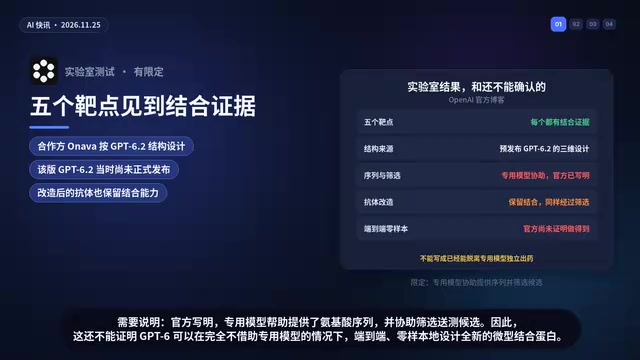
GPT-6 Designs Proteins, Claude Creations Become Apps with One Click, DeepMind Releases New Benchmark
OpenAI says GPT-6 can design protein 3D structures, Anthropic lets Claude creations install as desktop apps, DeepMind's HIP benchmark tests stability on simple questions, Google Workspace opens agent MCP interfaces.
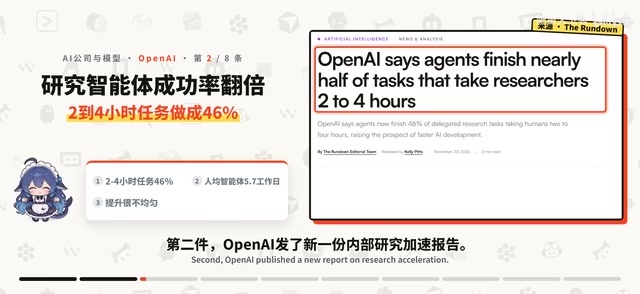
OpenAI Weekly Roundup: GPT-6.2 Rolls Out to ChatGPT, GPT-6 Designs Proteins
OpenAI's week: GPT-6.2 rolls out to ChatGPT, GPT-6 claims independent protein design, agent research share surges, perplexity proposed as a shared metric, and internal safety concerns surface.

Is the Crypto Industry About to "Turn Blue"? The Truth Behind Tech and Politics' Shifting Allegiances
Vergecast discusses whether the crypto industry will shift from the right to the Democrats, revealing the pragmatic nature of tech's politics and the costs of a crypto pivot.