US Energy Permitting Reform Speeds Up: The Tug-of-War Between Data Centers and Clean Energy

Congress advances a bipartisan energy permitting reform bill to speed up project interconnection and permitting, sparking debate over clean energy and environmental review.
Congress is advancing a large-scale, bipartisan energy permitting reform bill aimed at shortening permitting and interconnection timelines for energy projects, bringing new generation and transmission capacity online faster, and potentially reducing residential electricity bills. However, the same acceleration mechanism applies equally to clean energy and high-pollution projects, making environmental concerns prominent. The bill also lists data centers as an associated issue and may limit regulation of new data centers, though specific boundaries are unclear. AI-driven power demand growth is an unavoidable variable in energy policy.
US Energy Permitting Reform Speeds Up: The Tug-of-War Between Data Centers and Clean Energy
Congress is advancing a large-scale permitting reform bill aimed at shortening the grid interconnection and permitting timelines for energy projects. The bipartisan legislation is seen as potentially bringing energy projects online faster and possibly helping to lower residential electricity bills to some degree. At the same time, controversy is emerging around data center power demand and the boundaries of regulation.
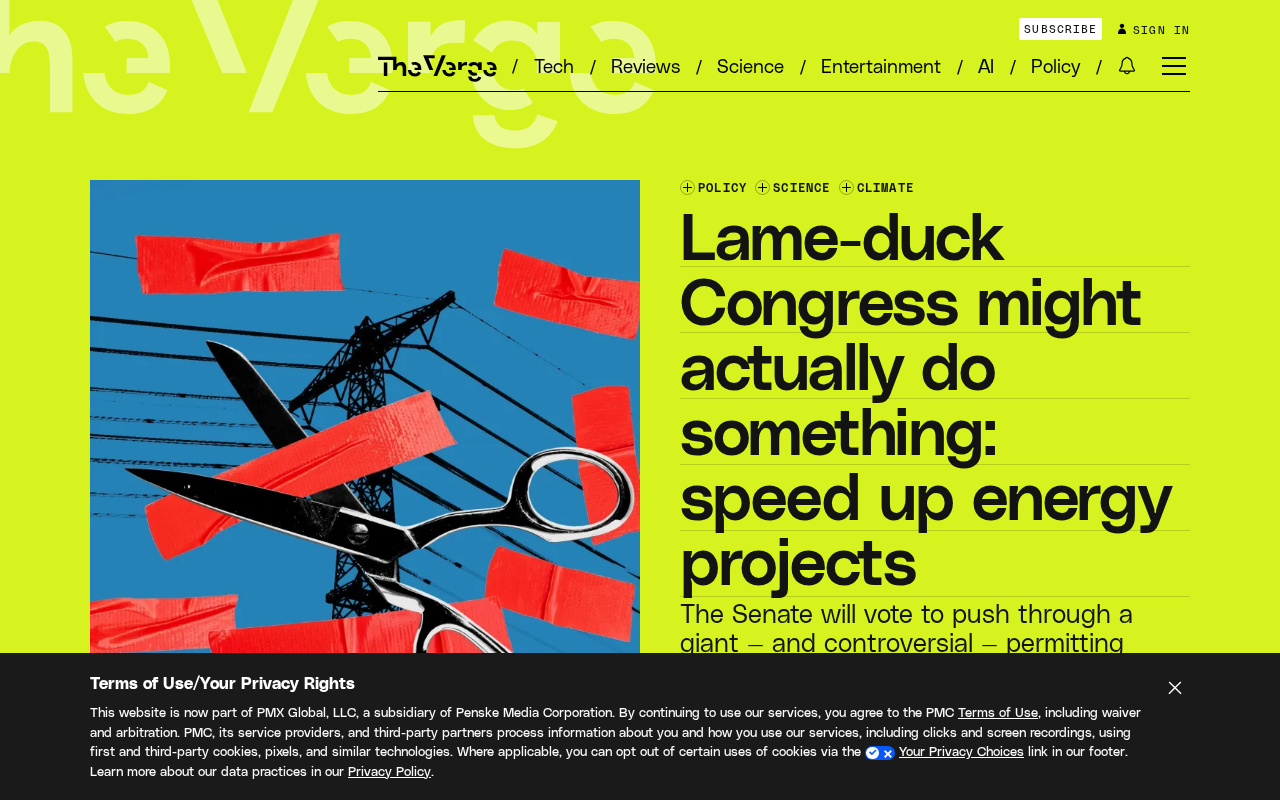
The Bill's Core Goal: Compressing the Permitting Process
According to the original report, the permitting bill is substantial in scope, aiming to help energy projects connect to the grid faster and obtain permits more quickly. For energy developers long constrained by lengthy permitting processes, this could mean a significant reduction in the time cost of bringing projects to fruition.
The report also notes that the bill could help ease the electricity bill burden on Americans to some extent. The logic is not complicated: when new generation and transmission capacity comes online faster, supply-side constraints ease and price pressure diminishes accordingly. However, the report does not provide quantitative conclusions on how much prices might actually fall.
Interconnection is one of the primary bottlenecks for energy projects in the US. In the United States, new generation projects must submit interconnection requests to their regional grid operators (such as PJM, MISO, CAISO, and other RTOs/ISOs), going through multiple stages including feasibility studies, system impact studies, and facilities studies before obtaining interconnection agreements. For a long time, this queue used a "first-come, first-served" ordering mechanism, resulting in a massive backlog, with some projects waiting more than five years. The Federal Energy Regulatory Commission (FERC) issued Order No. 2023 in 2023 to push for a shift to a "first-ready, first-served" cluster study model to clear the backlog. It is against this backdrop that the permitting reform bill seeks to further compress interconnection and permitting time costs at the legislative level.
Clean Energy Catalyst or Pollution Project Accelerator
The most closely watched duality of the bill is that it could serve as a catalyst for a large number of clean energy projects while also potentially accelerating high-pollution projects. The same acceleration mechanism applies equally to different types of energy projects, making the environmental assessment complex.
Supporters focus on the overall improvement in supply capacity, while opponents worry about weakened environmental review. This tension is not new in permitting reform debates, but the scale of this bill makes the divisions more pronounced.
Environmental review of large energy projects in the US is primarily governed by the National Environmental Policy Act (NEPA). The law requires federal agencies to conduct environmental assessments (EA) or environmental impact statements (EIS) for major federal actions that may significantly affect the environment, with the latter being a lengthy process that typically takes years. One of the core issues in the permitting reform debate is whether to set statutory deadlines for NEPA review, limit the scope of litigation, or expand the applicability of "categorical exclusions." Supporters argue this would eliminate project delays, while opponents fear environmental review would be substantially weakened. This divide determines whether the acceleration mechanism's impact on different types of projects is symmetrical: if review deadlines are compressed, high-pollution projects and clean energy projects would face the same "fast lane," and environmental risks would rise accordingly.
Data Centers: The Hidden Variable on the Demand Side
The report specifically mentions that the bill could limit regulation of new data centers. The information in the original source is truncated at this point, only indicating that data centers are generating substantial demand, but the specific details of their claims are not fully presented.
What is confirmed is that data centers have been explicitly listed as one of the issues associated with this legislation. The growth in power demand driven by AI computing expansion is becoming an unavoidable variable in energy policy discussions. While faster permitting helps ease supply pressure, how to balance regulation of new data center loads remains an unresolved question.
Data center power demand is a disruptive variable in US energy planning in recent years. According to estimates from institutions such as the International Energy Agency (IEA), the share of US electricity consumption accounted for by data centers is rising rapidly, with computing expansion from AI training and inference as the main driver. Data center loads are characterized by high density, strong continuity, and concentrated interconnection timing, placing significant pressure on local grids. Grid operators in some regions have begun imposing stricter reviews or delaying interconnection for large loads. This is why data centers have been included as an associated issue in the permitting reform bill: on one hand, faster permitting helps new supply meet load growth; on the other hand, if regulation of new data centers is restricted, it could weaken grid planning's ability to manage the demand side, creating a policy asymmetry between supply and demand.
The Practical Considerations Behind Bipartisan Support
The fact that the bill has bipartisan support itself demonstrates that permitting efficiency has become a cross-party consensus issue. The speed at which energy projects come online affects electricity prices, supply reliability, and industrial competitiveness—concerns that transcend traditional partisan divides.
From a policy signal perspective, the US is attempting to use process reform to address structural bottlenecks in energy supply. Whether the bill ultimately passes and how effective the acceleration will be in practice remain to be seen.
Key Questions to Watch
- Whether the impact of permitting acceleration on clean energy versus high-pollution projects is symmetrical
- The specific boundaries of data center regulatory limits have not been clarified in the source material
- The magnitude of electricity bill reductions lacks quantitative support and is more of a directional judgment
- The bill is still in the advancement stage, and the final text may still change
One-line Summary
Congress is advancing a bipartisan energy permitting reform bill to speed up project interconnection and permitting, sparking debate over clean energy and environmental review.
Paragraph Summary
Congress is advancing a large-scale, bipartisan energy permitting reform bill aimed at shortening permitting and interconnection timelines for energy projects, bringing new generation and transmission capacity online faster, and potentially reducing residential electricity bills to some extent. However, the same acceleration mechanism applies equally to clean energy and high-pollution projects, making environmental concerns prominent. The bill also lists data centers as an associated issue and may limit regulation of new data centers, though the specific boundaries are not fully presented in the source material. The growth in power demand driven by AI computing expansion is becoming an unavoidable variable in energy policy discussions. The bill is still in the advancement stage, and the final text and implementation effects remain to be seen.
Related articles
 Tech Frontiers
Coldframe: A Honeypot Disguised as a Supermarket Freezer Controller
Coldframe is a honeypot disguised as Danfoss AK-SM 800A and Dixell XWEB freezer controllers, built as a single Python file that detects CVE-2025-41450 attempts and is identified as real devices on Shodan.
 Tech Frontiers
GRFNet: A Lightweight PyTorch Model Designed for Multichannel Time-Series Classification
GRFNet is a lightweight PyTorch model for multichannel time-series classification, originating from EEG decoding research. With only 3,847 parameters, it is based on the ROCKET architecture, combining random convolution kernels with learnable spatial filters, supports arbitrary input lengths, and will soon be evaluated on the PhysioNet dataset.
 Tech Frontiers
CUDA-Accelerated Rocket League Simulator: A Player-Made Hardcore Experiment
A Reddit post shows a "100% Accurate" Rocket League simulator accelerated with CUDA. We analyze its technical context, CUDA's value in game physics simulation, and the significance and limitations of such community projects.