US Federal Agencies Ban DeepSeek: National Security Concerns Escalate

The US orders federal civilian agencies to remove DeepSeek products and derivative services, escalating AI supply chain security reviews.
The US federal government has required civilian agencies to remove products from Chinese AI company DeepSeek and third-party services built on its technology from their systems, citing national security concerns. The ban adopts a penetrating regulatory approach, covering services that indirectly rely on DeepSeek technology, and may prompt third-party providers to proactively divest related dependencies. The article argues that this move continues the US trend of increasingly strict scrutiny of Chinese tech companies, with core concerns centered on data security and algorithm transparency, and may accelerate the divergence of Chinese and American AI ecosystems and challenge the neutrality of open-source models. The actual impact depends on enforcement intensity and whether the private sector and states follow suit.
Event Overview
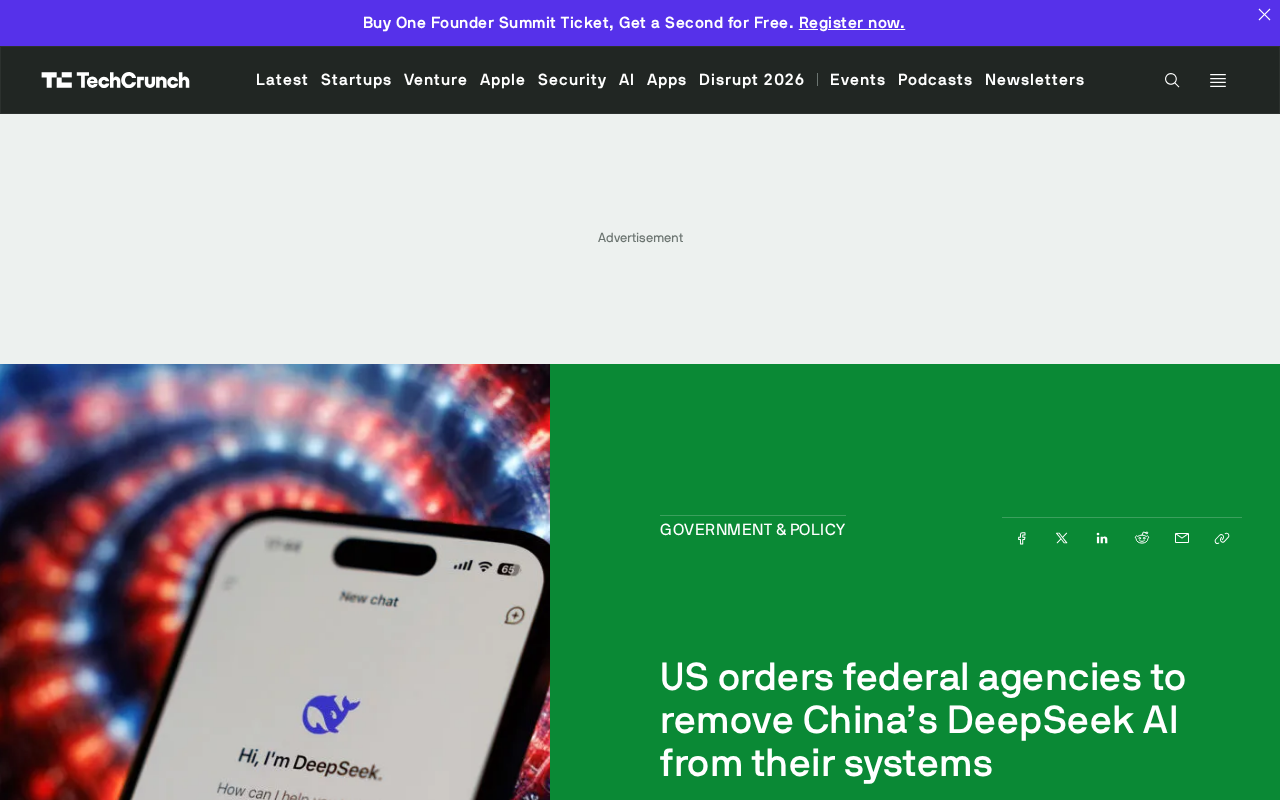
The US government has ordered federal civilian agencies to remove products from Chinese AI company DeepSeekAd, as well as third-party services built on its technology, from their systems, citing national security concerns. This directive marks a further tightening of US regulatory scrutiny over the infiltration of Chinese AI technology.
According to RSS sources, the order applies to federal civilian agencies and requires the removal of DeepSeek-related products and derivative services. Although the original text did not disclose specific technical details or an implementation timeline, the move continues the trend of increasingly strict scrutiny of Chinese tech companies by the US in recent years.
Scope and Impact of the Ban
Covered Entities
The ban targets not only DeepSeek's direct products but also "third-party services built on its technology." This means that even if a federal agency has not directly procured DeepSeek models, any service whose underlying technology relies on DeepSeek is also subject to removal. This penetrating regulatory approach reflects deep US anxiety over AI supply chain security.
Penetrating regulation (also called "supply chain penetration review") is a common regulatory approach in export controls and cybersecurity reviews in recent years: the regulatory target is not limited to directly procured end products but traces down the supply chain—any link that depends on restricted technology or suppliers may bring related services across the entire chain under control. In the US legal context, similar logic can be seen in the ICTS (Information and Communications Technology and Services) review mechanism established by Executive Order 13873, and the FCC's replacement program for equipment from companies on the "Covered List." For AI services, because models are often integrated into upper-layer applications in the form of APIs, fine-tuning, embeddings, etc., regulators find it difficult to identify dependencies solely by product name, so they need to define boundaries through technical tracing. This also means compliance costs will be passed down to system integrators and cloud service providers.
Potential Impact on DeepSeek
As an emerging force in China's AI sector, DeepSeek's models have gained some attention in the open-source community and enterprise market. Although the US federal market is not its core revenue source, the ban may have a demonstration effect, influencing procurement decisions by other countries and private enterprises. At the same time, to avoid compliance risks, third-party service providers may proactively divest their reliance on DeepSeek technology, creating a chain reaction.
Behind the National Security Concerns
The core logic behind the US placing DeepSeek on the banned list is data security and algorithm transparency. When processing sensitive information, AI models may involve cross-border data flows and model interpretability issues. The US government tends to believe that reliance on foreign AI technology carries potential risks of data leakage and backdoors, especially in scenarios involving government affairs.
This concern is not isolated. The US has previously taken similar restrictive measures against multiple Chinese tech companies, covering areas such as communications equipment and short-video applications. DeepSeek being brought under the same regulatory framework shows that AI technology has been regarded as a key battleground in national security competition.
Algorithm transparency and model interpretability: In government application scenarios, AI systems need to meet auditability and accountability requirements. Model interpretability refers to the ability to explain why a model produces a specific output, including training data sources, parameter behavior, and decision basis. For closed-source models or models of unknown origin, regulators find it difficult to verify whether there are backdoors, covert data return, or abnormal behavior under specific trigger conditions. The AI Risk Management Framework (AI RMF) released by the US National Institute of Standards and Technology (NIST) lists "transparency and interpretability" as one of the core attributes of trustworthy AI. This is also why reviews often require suppliers to disclose model architecture, data flows, and update mechanisms—requirements that constitute substantial compliance thresholds for foreign vendors.
Implications for the AI Industry Landscape
Accelerating Technological Decoupling
The US federal agencies' ban will further drive the divergence of the Chinese and American AI ecosystems. Chinese AI companies may face stricter compliance reviews when expanding into overseas markets, while US companies will also assess geopolitical risks more cautiously when choosing technology suppliers. This trend may give rise to two relatively independent sets of technical standards and market systems.
Challenges to the Open-Source Model
Some of DeepSeek's models adopt an open-source strategy, but open source does not mean borderless. This ban shows that even if the technology is public, its country of origin can still become a barrier to market access. This raises new questions for the AI development model that relies on open-source community collaboration: can technological neutrality be maintained under geopolitical pressure?
The tension between open-source licensing and export controls: Open-source models are usually released under permissive licenses such as MIT or Apache 2.0; the licenses themselves do not restrict the user's country or purpose, but licenses cannot override national-level import bans or procurement restrictions. In other words, open source solves the copyright licensing problem, not the market access problem. Export control rules from the US Department of Commerce's Bureau of Industry and Security (BIS), foreign investment reviews by the Treasury Department, and procurement security requirements of various agencies may all take effect independently of open-source licenses. In addition, once model weights are made public, they are difficult to retract, and regulation tends to constrain "usage scenarios" rather than "technology diffusion" itself—this is also the structural dilemma facing open-source AI in a geopolitical environment.
Reactions and Follow-up Observations
DeepSeek has not yet made a public response to the ban. Industry analysts point out that the scope of the ban on US federal civilian agencies is relatively limited, and the actual impact depends on enforcement intensity and the degree to which the private sector follows suit. It is worth watching whether US state governments and private enterprises will follow the federal directive, and whether other countries will take similar measures.
From a broader perspective, global collaboration in AI technology is facing an increasing number of non-technical barriers. For AI practitioners, understanding the impact of geopolitical factors on technology selection has become an unavoidable topic.
Conclusion
The directive for US federal agencies to remove DeepSeek products is the latest case of national security review in the AI field. It reminds us that competition in AI technology has gone beyond mere performance comparisons to dimensions such as supply chain security, data sovereignty, and compliance governance. For Chinese AI companies, how to address compliance challenges in overseas markets while pursuing technological innovation will be a long-term issue.
Related articles

Workbuddy for Absolute Beginners: How a Desktop AI Agent Fits Into Real Workflows
A beginner's guide to the Workbuddy desktop AI agent: installation, claiming credits, file management, and building automated workflows—compared with CodeX for fit and cost, helping professionals shift from AI question-askers to AI managers.

OpenAI's New Agent Stack: Computer Use, Decisions API, and Ultra-Fast Workflows
OpenAI Dev Day unveiled a new agent stack: Computer Use outperforms humans, Decisions API delivers ultra-low-latency classification via Luna, Agents API opens the same Computer Use capabilities, and GPT-6.1 Sol costs only one-seventh of Astra. Core updates, benchmark data, and developer insights.

Liang Wenfeng Open-Sources DeepInfo Inference Framework, Takes On U.S. Ban
DeepSeek open-sources its DeepInfo inference framework after its models, featuring GPU/CPU cross-pipelining, small-model prediction with large-model verification, and full Huawei Ascend and NVIDIA chip support—facing the U.S. federal ban head-on. This article analyzes its significance for AI deployment and open-source strategy.