US Intervention in Venezuela: The Gamble Between Oil and Democracy

The US captured Maduro and fast-tracked an oil deal while political reform stalled, leaving Venezuelans disillusioned.
In January 2026 the US struck Venezuela and captured Maduro, initially winning 92% public support. But the interim government kept old-regime figures, reform stalled, and popular opposition leader Machado was excluded from talks. Meanwhile the US secured a 35% stake in top private producer NABEP and 20% of output at cost under a "largest-ever" oil deal. By 2026, 83% of Venezuelans no longer believed Trump wanted their country to improve.
From Maduro's Capture to the Oil Deal: The Full Story of US Intervention in Venezuela
On January 3, 2026, the United States launched a military strike on Venezuela, capturing then-President Nicolás Maduro and his wife Cilia Flores and bringing them back to the US to face narco-terrorism charges. The operation marked a sharp escalation of US intervention in Venezuela and opened an uncertain transitional period for the oil-rich country.
The End of the Maduro Era
Maduro took office in 2013, continuing Chávez's left-wing populist politics. But Venezuela's economy soon fell into trouble: the private sector collapsed, nationalized enterprises were inefficient, and corruption and mismanagement ran rampant. The 2014 plunge in international oil prices dealt a heavy blow to Venezuela's oil-export-dependent economy. The country's economy is estimated to have shrunk by about three-quarters over a decade, and nearly 8 million Venezuelans—roughly one-fifth of the population—fled their homeland.
The Maduro government held onto power through electoral fraud and repression, repeatedly cracking down violently on nationwide protests. In the 2024 election, despite evidence that the opposition had won, Maduro declared himself re-elected. The US immediately ramped up pressure, launching Operation Southern Spear in November 2025 to strike Caribbean vessels suspected of links to Venezuelan narco-terrorism.

Operation Southern Spear is a military deployment launched by the Trump administration in November 2025, nominally targeting vessels suspected of drug trafficking in the Caribbean Sea and eastern Pacific Ocean, aimed at Venezuela-related networks designated by the US as "narco-terrorist" organizations. The operation integrated naval vessels, the Coast Guard, and intelligence assets to intercept and strike suspicious vessels, causing multiple casualties. The US says it is acting under counter-narcotics and counter-terrorism authority, while critics question the legality of using lethal force in international waters without judicial process and worry that its real purpose is to pave the way for subsequent direct military action against Venezuela. After Maduro's capture, the operation became a springboard for the US to escalate from maritime pressure to land intervention, and it also raised sovereignty concerns among many Latin American countries.
Brief Hope and Slow Political Reform
After Maduro's capture, data from Caracas polling firm Meganalises showed that 92% of Venezuelans thanked Trump for removing Maduro, and 90% wanted the US to become Venezuela's main ally. That optimism, however, did not last long.
Maduro's vice president, Delcy Rodríguez, was sworn in as interim president but retained several key figures from the Maduro regime. US Secretary of State Marco Rubio was put in charge of a three-step plan of "stabilization, recovery, and democratic transition," but political reform progressed slowly. The US sponsored dialogue between the regime and part of the opposition, yet excluded the most popular opposition leader, 2025 Nobel Peace Prize laureate María Corina Machado, from key election negotiations. No official timetable was set for reforming the electoral system, only individual cabinet changes were made, and major reforms have yet to appear.
The Oil Deal: Who Benefits?
In stark contrast to the slow political reform, the US quickly pushed through an oil agreement. Venezuela holds the world's largest oil reserves—about 300 billion barrels of proven reserves, more than 17% of the global share. Before the 2019 sanctions, Venezuela and the US oil industry had a decades-long symbiotic relationship.
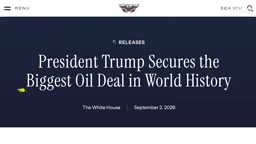
The US-Venezuela oil deal was billed as "the largest oil deal in world history," but its structure and beneficiaries raise questions. The US government acquired up to a 35% stake in NABEP, Venezuela's largest domestic private oil producer, which currently produces about 200,000 barrels per day, 20% of Venezuela's total output. Under the agreement, the company must supply 20% of its output to the US at cost—far below market price.
Experts point out that the deal faces multiple complications. Venezuela's constitution stipulates that oil belongs to the state and that ownership is non-transferable. The agreement was reached before a democratic system was established, avoiding legal and legislative scrutiny. In addition, the locations of the oil fields to be developed have not yet been determined, which could cause environmental impacts on protected areas and indigenous territories.
NABEP (often abbreviated as NABEP) is the largest private oil producer in Venezuela; unlike international companies such as Chevron and Repsol, its assets and operations are rooted mainly in Venezuela itself. Against the backdrop of long-term mismanagement and underinvestment at Venezuela's state oil company PDVSA, NABEP has maintained output of about 200,000 barrels per day—roughly one-fifth of national production—through relatively flexible operations and joint-venture arrangements. Precisely because of its key position in the private sector, the US directly acquired a 35% stake in the company under the agreement and locked in 20% of output at cost, giving Washington de facto control over Venezuela's oil resources quickly without full nationalization or lengthy concession negotiations. This arrangement also circumvented the Venezuelan constitutional restriction that oil ownership belongs to the state and is non-transferable.
Democratic Prospects and Public Disappointment
Although Maduro has been removed, the economic hardship of ordinary Venezuelans remains severe. Many feel that "the dictator was driven out, but the dictatorship was kept." The latest 2026 Meganalises poll shows that although support briefly soared after Maduro's capture, 83% of Venezuelans now do not believe Trump wants their country to become better.
Venezuela's future depends on economic recovery, a transition to free and fair elections, and relations with the US. The US promised a better future, but whether it can deliver remains unknown.
María Corina Machado is the leader of the Venezuelan opposition movement Vente Venezuela and has long advocated free elections and democratic transition. She was barred from public office for organizing anti-Maduro protests and faced arrest threats and physical attacks before the 2024 election. In 2025 she won the Nobel Peace Prize, reaching the peak of her international standing, and is widely regarded as Venezuela's most influential opposition figure. However, when the US pushed for regime dialogue and election negotiations, it excluded Machado from key consultations, partly because she insists on a full reckoning with the legacy of Chavismo and refuses to compromise with the current regime—a stance that conflicts with Washington's strategy of prioritizing the oil deal and short-term stability. This move weakened the popular basis of the transition process and deepened Venezuelans' disappointment with "external arrangements" rather than "self-determined democracy."
One-line Summary
After the US military captured Maduro, it quickly advanced an oil deal while political reform stalled, disappointing Venezuelans.
Paragraph Summary
In January 2026, the US launched a military strike on Venezuela and captured Maduro, initially winning 92% public support. But after Vice President Rodríguez took over, key figures of the old regime were retained, political reform stalled, and the most popular opposition leader, Machado, was excluded from election negotiations. Meanwhile, the US quickly reached what it called the "largest oil deal in history" with Venezuela, acquiring a 35% stake in the largest private producer NABEP and locking in 20% of output at cost, sparking disputes over the constitution, the environment, and beneficiaries. By 2026, 83% of Venezuelans no longer believed Trump wanted their country to improve, and many felt that "the dictator was driven out but the dictatorship was kept," leaving both democratic prospects and economic recovery uncertain.
Related articles

How the Grok Team Hits 11,000 PRs a Month: Replacing Manual Review with Deterministic Constraints
Inside the Grok team's formula for 11,000 monthly PRs at a 0.5% rollback rate: Lint rules, type systems, and formal verification as deterministic constraints.

Is Spacetime Made of Something? Six Possible Answers from Quantum Gravity
Is spacetime made of something? This article surveys the main candidate answers from quantum gravity: spacetime may be fundamental, geometry quantized, causal relations prior to distance, spacetime an emergent state of matter, geometry derived from string theory, or no spacetime atoms needed at all.

After GTA 6, Where Does the Game Industry Go?
The Vergecast talks with Game File's Stephen Totilo about GTA 6's impact on gaming: billion-dollar budgets, console market struggles, cloud gaming tests, and the future of microtransactions—and whether it marks the end of an era.