USBridge-Remote: An Open-Source Remote Desktop Tool Based on the Moonlight Protocol

Open-source self-hosted remote desktop tool using Moonlight protocol for low-latency, high-FPS streaming.
USBridge-Remote is an open-source, self-hosted remote desktop tool that integrates the Moonlight protocol for low-latency, high-frame-rate streaming. It features native Wayland support, Tailscale-based P2P direct connections, and covers Windows, macOS, Linux, Android, and iOS. Combined with the USBridge-KVM 2.0 hardware, it provides a unified ecosystem for both in-band and out-of-band remote management.
The Pain Points and Breakthroughs of Remote Access Tools
For a long time, commercial remote desktop tools like TeamViewer and AnyDesk have dominated personal and enterprise remote access needs. However, their limitations have become increasingly apparent: mandatory registration, restricted free-tier features, reliance on third-party cloud infrastructure, privacy concerns, and hefty licensing fees for commercial use.
Data Sovereignty is an especially sensitive issue in remote access scenarios. Commercial tools typically require connections to be relayed through—or at least authenticated by—the vendor's cloud servers, meaning the vendor can theoretically access users' connection metadata: connection times, IP addresses, device information, and in some implementations, even the transmitted content itself. The 2023 security incident involving TeamViewer (where its internal network was compromised by the APT29 group) further intensified enterprise concerns about third-party dependencies. The Self-Hosting movement has consequently been gaining momentum in the tech community—from file synchronization (Nextcloud) and password management (Vaultwarden) to communication and collaboration (Matrix), a wealth of open-source solutions are replacing commercial SaaS services. Self-hosting remote access tools is a natural extension of this trend.
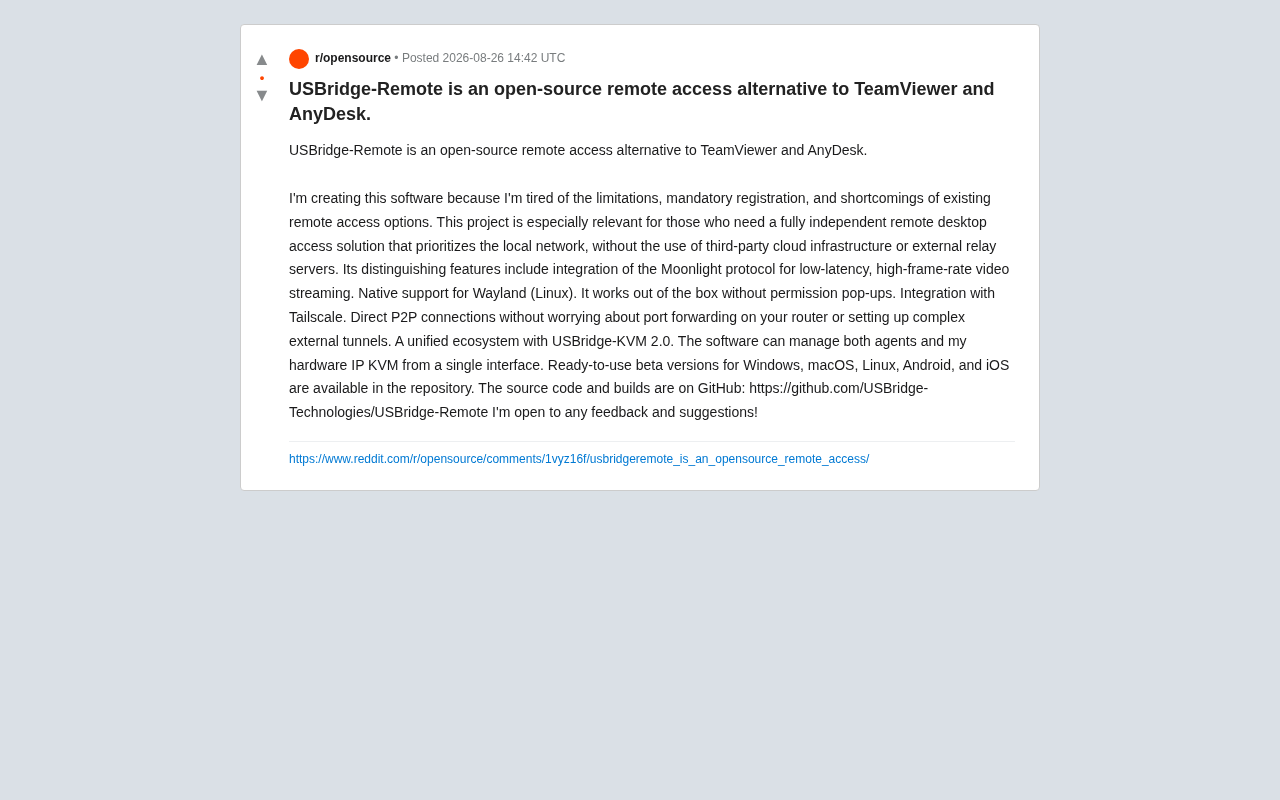
Recently, an open-source project called USBridge-Remote debuted on Reddit. The creator explicitly stated that the software was born out of being "tired of the limitations, forced registrations, and various shortcomings of existing remote access solutions." The project emphasizes a "fully independent" remote desktop experience, prioritizing local network access without relying on any third-party cloud or relay servers.
For users who value data sovereignty and want to break free from cloud lock-in, a fully self-hosted, open-source, and auditable solution like this holds natural appeal.
Core Technical Highlights
Moonlight Protocol: Low-Latency, High-Frame-Rate Streaming
The most noteworthy technical choice in USBridge-Remote is its integration of the Moonlight protocol. Moonlight was originally an open-source protocol designed for game streaming, renowned for its extremely low latency and high-frame-rate video transmission. Bringing it into the remote desktop arena means users can achieve a near-local, fluid experience when operating remote machines—invaluable for graphics-intensive work, video editing, and even remote gaming. This is something traditional remote desktop tools have often struggled to deliver.
The technical lineage of the Moonlight protocol is worth exploring. It originated from NVIDIA's GameStream technology—NVIDIA initially developed GameStream to stream PC games to its own Shield devices, but the protocol itself was never open-sourced. The Moonlight project created an open-source client compatible with GameStream through reverse engineering. Later, with the emergence of Sunshine (an open-source streaming server), the entire streaming pipeline became fully open source. The protocol's core advantage lies in leveraging hardware encoding capabilities—using GPU-integrated encoders like NVENC (NVIDIA), AMF (AMD), or QSV (Intel) to compress and transmit frames in real-time using H.264/H.265/AV1 formats. End-to-end latency can be as low as single-digit milliseconds, while supporting output up to 4K at 120fps. Compared to traditional remote desktop protocols (such as RDP and VNC), which are primarily optimized for office scenarios and typically cap frame rates at around 30fps, Moonlight represents a qualitative leap in both visual fluidity and color fidelity—and that's precisely why USBridge-Remote chose it as its underlying transport protocol.
Native Wayland Display Protocol Support
In the Linux ecosystem, the migration from X11 to Wayland is an inevitable trend, yet many remote access tools still offer poor Wayland support or don't work with it at all. USBridge-Remote provides native Wayland support and emphasizes that it works "out of the box, with no permission pop-ups required." This addresses a long-standing pain point for Linux users and demonstrates the project's forward-looking adaptation to modern desktop environments.
To appreciate the value of this feature, it helps to understand the technical background of the X11-to-Wayland migration. The X Window System (X11) is over 30 years old. While powerful and broadly compatible, its architecture has serious security flaws—any X11 client can monitor and capture input events and screen content from other windows, making screen capture and keylogging trivially easy at the technical level. Wayland adopts a strict security isolation model where each application can only access its own window content and cannot capture other windows or global input without authorization. While this security design protects user privacy, it also poses significant challenges for remote desktop tools: traditional screen capture methods are completely broken under Wayland. Tools must request screen-sharing permissions through new standardized interfaces like PipeWire and xdg-desktop-portal, which typically require users to manually click through authorization dialogs. Currently, mainstream desktop environments like GNOME and KDE Plasma default to Wayland sessions, and Ubuntu has set Wayland as its default display server since 22.04 LTS. USBridge-Remote's claimed "no permission pop-ups" native Wayland support suggests it may employ a deeper level of integration at the lower layers, bypassing these interaction barriers.
P2P Direct Connections and Tailscale Integration
The project integrates Tailscale, supporting direct P2P connections without requiring port forwarding on routers or setting up complex external tunnels. This design preserves the independence of self-hosting while leveraging Tailscale's WireGuard-based foundation for simple, secure cross-network connectivity. For everyday users without networking expertise, this dramatically lowers the barrier to setting up self-hosted remote access.
Tailscale's technical implementation deserves a closer look. It's built on the WireGuard protocol—a modern VPN protocol whose Linux kernel implementation consists of only about 4,000 lines of code, presenting a minimal attack surface. It employs modern cryptographic primitives including the Noise protocol framework, Curve25519, and ChaCha20-Poly1305, delivering significantly better performance and security than its predecessors like OpenVPN and IPSec. On top of WireGuard, Tailscale adds critical NAT traversal capabilities: it uses DERP (Designated Encrypted Relay for Packets) relay servers to assist with node discovery and leverages STUN/ICE NAT traversal techniques to establish direct P2P connections between nodes whenever possible. According to Tailscale's official data, approximately 92% of connections ultimately achieve direct connectivity without going through relay servers. This means that even users behind double NAT or strict firewalls don't need to manually configure port forwarding or DDNS—once devices join the Tailscale network, they can directly access each other, with data traveling entirely point-to-point, ensuring both performance and privacy.
Cross-Platform Support and Ecosystem Integration
Beta Versions Covering Five Major Platforms
USBridge-Remote currently offers ready-to-use Beta versions on its GitHub repository covering Windows, macOS, Linux, Android, and iOS—all five major platforms. Whether for desktop work or mobile scenarios, users can handle remote access within a single unified solution. This cross-platform consistency is a significant advantage over some niche open-source alternatives.
A Unified Ecosystem with USBridge-KVM 2.0
Notably, USBridge-Remote is not a standalone software project—it forms a unified ecosystem with the creator's hardware IP KVM product, USBridge-KVM 2.0. Users can manage both software Agents and hardware IP KVMs from a single interface.
IP KVM (Internet Protocol Keyboard Video Mouse) is a hardware device that allows administrators to remotely control a computer's keyboard, video output, and mouse input over a network—essentially simulating a human operator at the physical level. The fundamental difference from software-based remote desktop solutions is that IP KVM connects directly to the target machine's video output port (HDMI/VGA) and USB ports, operating outside the operating system. As a result, IP KVM works even when the target machine has no OS installed, is at the BIOS/UEFI setup screen, is being reimaged, or has completely crashed to a blue screen. This capability is known as "Out-of-Band Management" in IT operations, as opposed to "In-Band Management" which relies on software agents running within the operating system. Enterprise servers typically come equipped with similar functionality through BMC (Baseboard Management Controllers) like Dell's iDRAC or HP's iLO, but these solutions are expensive and limited to server hardware. Open-source IP KVM projects (like PiKVM and USBridge-KVM) bring this capability to consumer and small business environments.
This hardware-software synergy opens up compelling possibilities: the software Agent handles scenarios where the operating system is running normally, while the hardware KVM provides out-of-band management for system crashes, BIOS-level operations, or bare-metal machines without an OS. Together, they cover the complete chain of needs from routine maintenance to low-level recovery.
Project Positioning and Usage Recommendations
The emergence of USBridge-Remote reflects yet another response from the open-source community to the closed, commercialized solutions dominating remote access. Its differentiated positioning is crystal clear:
- Privacy First: No reliance on third-party cloud or relay servers—data sovereignty stays in the user's hands
- Performance Leader: Leverages the Moonlight protocol for low-latency, high-frame-rate streaming, breaking through the experience bottleneck of traditional solutions
- Modern Adaptation: Native Wayland support that keeps pace with Linux desktop evolution
- Hardware-Software Integration: Forms a unified ecosystem with IP KVM hardware, covering both in-band and out-of-band management
Of course, as a project still in Beta, its stability, security auditing, community activity, and long-term maintenance capability remain to be proven over time. The creator also explicitly stated in the Reddit post that they "welcome any feedback and suggestions"—a classic signal of healthy open-source project growth.
For users who are tired of commercial remote desktop tool limitations and have a reasonable level of technical proficiency, USBridge-Remote is undoubtedly worth a try. The source code and builds are hosted on GitHub (USBridge-Technologies/USBridge-Remote)—interested readers are encouraged to experience it firsthand and contribute to its development.
Key Takeaways
Related articles

Chain of Thought Isn't Just for AI: How Humans Can Use CoT to Improve Thinking Quality
Chain of Thought isn't just a prompt trick for large models. Starting from a Hacker News discussion, this article analyzes why CoT works for human thinking too, breaks down actionable ways to transfer it, and highlights the key differences between human CoT and machine CoT.
Cloudflare Teams Up with OpenAI: Closi…
Cloudflare Teams Up with OpenAI: Closing the Loop from Vulnerability Discovery to Defense with AI
Cloudflare uses OpenAI Daybreak to investigate security vulnerabilities and generate reviewable remediation plans, while developers use Codex to boost coding efficiency and quality.

Orca Multi-Agent Orchestration in Practice: A Guide to Parallel Collaboration with Claude and Codex
Orca is Stable AI's free open-source agent workbench supporting 34 agents like Claude Code and Codex in parallel. Learn its Git worktree isolation, multi-model orchestration, and mobile management.