User Simulator Evaluation Unreliable? New Benchmark Captures All 10 Failure Categories

A meta-evaluation reveals existing user simulator metrics miss nearly half of failures; a new two-level fidelity suite is proposed.
This article presents a meta-evaluation of user simulator evaluation methods for interactive agents. Researchers injected 10 typical failure behaviors (goal tampering, constraint omission, premature stopping, etc.) to test existing metrics. Results showed that methods from three prior studies detected only 5-6 perturbations, with combined scores even favoring populations accepting incomplete work. The proposed suite combines utility with population-level and trace-level fidelity, successfully detecting all 10 perturbations. Validation on 351 real multi-turn conversations (348 users, 23 languages) showed population-level metrics miss individual-level goal errors, constraint omissions, and role deviations.
User Simulators Are Trending, But the Methods Used to Evaluate Them May Be Broken
In the evaluation of interactive agents, user simulators are highly anticipated—they can simulate real users in a scalable way, allowing agents to be tested across large numbers of multi-turn conversations. Yet a critical question has long been overlooked: how should the quality of these simulators themselves be evaluated?
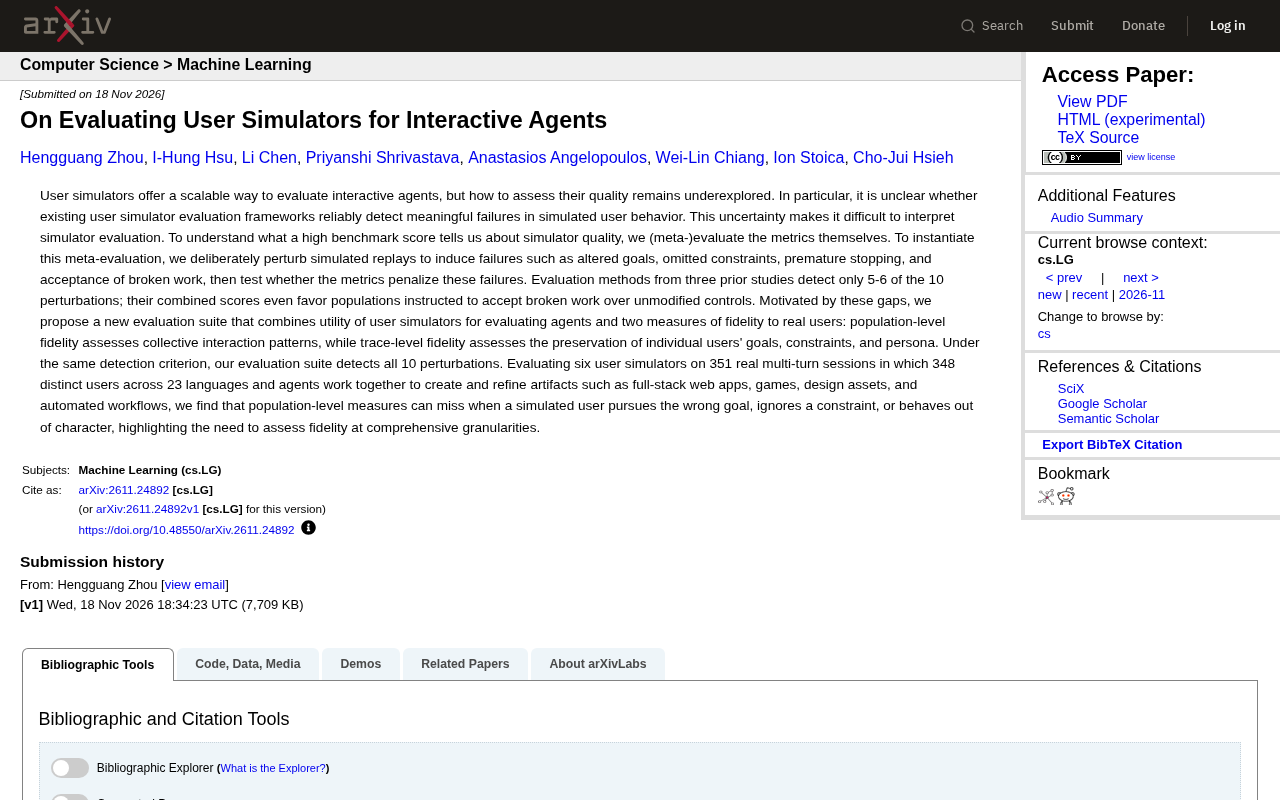
A study titled "On Evaluating User Simulators for Interactive Agents" points out that it remains unclear whether existing user simulator evaluation frameworks can reliably detect substantive failures in simulated user behavior. This uncertainty leads directly to an awkward situation: we see a high benchmark score but cannot tell whether it means the simulator is genuinely high-quality or whether the evaluation method itself has blind spots.
To address this, the researchers took a more fundamental approach—conducting a "meta-evaluation" of the evaluation metrics themselves.
How the Meta-Evaluation Works: Artificially Injecting 10 Failure Categories
The research team's approach was straightforward: if an evaluation method is truly effective, it should penalize simulated users when they exhibit obvious problems. Based on this logic, they deliberately perturbed simulated replays to create ten typical failure behaviors, including:
- Tampered goals: The simulated user pursues goals different from the original specification
- Ignored constraints: Explicitly stated user constraints are not respected
- Premature stopping: The interaction is hastily terminated before the task is completed
- Accepting incomplete results: Approving work products that are clearly flawed
The researchers then tested whether existing metrics could respond to these perturbations. The results were not encouraging: evaluation methods from three prior studies detected only 5 to 6 of the 10 perturbations. More ironically, their combined scores actually favored simulated user populations that were instructed to "accept incomplete work" over unmodified control groups.
This means that a seemingly high score may actually correspond to worse simulation quality.
Meta-evaluation refers to the systematic examination of evaluation methods themselves to determine whether they can reliably identify quality differences or failures in the objects being evaluated. In the context of user simulators, the core logic of meta-evaluation is: if a set of metrics claims to measure simulator quality, then when known defects are deliberately injected into the simulator, the metrics should correspondingly worsen. This approach is similar to "mutation testing" in software testing—verifying the detection capability of test cases by artificially introducing defects. Meta-evaluation is not concerned with how high a simulator scores under normal conditions, but with whether the evaluation tool is sufficiently sensitive and accurate in the face of "documented badness," thereby preventing the evaluation framework itself from becoming a source of blind spots.
A New Evaluation Suite: Utility + Two-Level Fidelity
To address these gaps, the researchers propose a new evaluation suite that combines two dimensions:
First, utility—the practical value of user simulators in evaluating agents; second, fidelity to real users, which is further split into two levels:
- Population-level fidelity: Examining whether the simulated user population matches the real user population in terms of collective interaction patterns
- Trace-level fidelity: Examining whether individual users' goals, constraints, and role specifications are fully preserved within the interaction trace
Under the same detection criteria, this new evaluation suite successfully detected all 10 perturbations, in stark contrast to baseline methods.
Fidelity in the context of user simulators refers to the degree of consistency between simulated users and real users in terms of behavior, goals, constraints, and interaction patterns. Splitting fidelity into population-level and trace-level corresponds to two different statistical granularities: population-level fidelity focuses on whether the simulated user population reproduces the collective interaction patterns of the real user population at the distribution level—such as task completion rates, dialogue turn distributions, or language diversity; trace-level fidelity focuses on whether a single interaction trace faithfully preserves the goals, constraints, and role specifications assigned to that simulated user. The two are complementary—population-level metrics are good at detecting systematic biases but may miss issues because individual errors cancel each other out; trace-level metrics can capture individual-level goal drift or constraint violations but are more computationally expensive. The two-level design is precisely intended to avoid the blind spots that come from single-granularity evaluation.
Real-World Validation: Findings from 351 Multi-Turn Conversations
To validate the new suite's practical performance, the researchers tested it on real data: 351 real multi-turn conversations involving 348 distinct users across 23 languages. These users collaborated with agents to complete and refine various artifacts, including full-stack web applications, games, design assets, and automation workflows.
In this process, the researchers evaluated six user simulators and discovered an important phenomenon: population-level metrics can miss cases where simulated users pursue incorrect goals, ignore constraints, or deviate from their role specifications. In other words, statistical consistency at the population level alone is not sufficient to guarantee the reliability of individual simulated interactions.
This finding directly echoes the researchers' core argument—fidelity needs to be evaluated at more comprehensive granularities, and trace-level and population-level assessments are both indispensable.
Interactive agents refer to AI systems capable of engaging in multi-turn conversations with users, adapting behavior based on context, and collaboratively completing tasks. Unlike single-turn question-answering, evaluating interactive agents requires examining their goal maintenance, constraint adherence, and role consistency across continuous dialogues, making user simulators a key infrastructure for scalable evaluation. User simulators are typically driven by large language models, generating simulated user behavior according to predefined goals, constraints, and role specifications, thereby enabling batch testing of agents without human involvement. However, simulators are themselves model-generated and may deviate from specifications or produce systematic biases—this is the fundamental reason why meta-evaluation of their fidelity is necessary.
Implications for Practitioners
The value of this work extends beyond academia. For teams that rely on user simulators to train or evaluate agents, it sends several clear signals:
First, do not blindly trust benchmark scores. Existing evaluation methods may have systematic blind spots, and high scores do not necessarily indicate high quality. Second, failure detection capability should be a hard requirement for evaluation frameworks. A good evaluation method must be able to identify typical problems such as goal drift and constraint omission. Third, population statistics and individual traces should be examined separately. Population-level consistency can mask severe individual-level deviations, especially in complex scenarios involving multiple languages and user types.
As infrastructure for scalable evaluation, user simulators' own quality is the starting point of the entire evaluation chain. If the starting point is unreliable, all subsequent conclusions about agent capabilities lose their foundation. This research reminds us: before pursuing larger-scale evaluation, first ensure that the evaluation tools themselves can withstand scrutiny.
One-line Summary
A meta-evaluation of user simulator evaluation methods finds that existing metrics miss nearly half of failures, and proposes a new two-level fidelity suite.
Paragraph Summary
This article presents a meta-evaluation study of evaluation methods for interactive agent user simulators. Researchers artificially injected 10 typical failure behaviors (such as goal tampering, constraint omission, and premature stopping) to test whether existing evaluation metrics could effectively detect them. Results showed that evaluation methods from three prior studies could identify only 5 to 6 perturbations, and combined scores even favored simulated populations that accepted incomplete work. To address this, the researchers proposed a new evaluation suite combining utility with population-level and trace-level two-tier fidelity, which successfully detected all 10 perturbations under the same criteria. Validation on 351 real multi-turn conversations (348 users, 23 languages) further demonstrated that population-level metrics miss individual-level goal errors, constraint omissions, and role deviations, emphasizing that fidelity evaluation must consider both population and trace granularities.
Related articles

Michael Nielsen Takes Down His Classic Neural Network Textbook, Sparking Community Discussion
Michael Nielsen's classic free textbook Neural Networks and Deep Learning has been taken offline, sparking discussion on Hacker News about the reasons and impact.

Inside the AI Training Data Market: The Trade-off Between Exclusivity and Discounts
G2i founder Gabe Greenberg reveals the dual-track pricing of the AI training data market: labs pay a premium for exclusive data or accept discounts that allow others to buy it.

SessionGraph: Unifying All Coding Agent Sessions in One Interactive Graph
SessionGraph aggregates coding agent sessions into an interactive graph, helping developers review, debug, and manage AI coding workflows across sessions. This article examines its positioning, value, and open questions.