Using AI-Assisted Programming to Rewrite macOS Drivers for Abandoned Drobo Storage Devices

Developer uses AI vibe-coding to reverse-engineer and rewrite macOS drivers for abandoned Drobo storage devices.
When Drobo went bankrupt, its users were left with expensive storage arrays that couldn't work on modern macOS. This article chronicles how a developer leveraged AI-assisted programming (vibe-coding) to reverse-engineer Drobo's proprietary communication protocol and rewrite its drivers using Apple's DriverKit framework, demonstrating both the potential and limitations of AI in low-level systems programming.
When Hardware Becomes an "Orphan": The Drobo User's Dilemma
When a hardware manufacturer goes bankrupt or stops supporting a product, devices that still work perfectly fine often end up in an awkward position—the hardware itself isn't broken, but without driver and software support, it simply can't function on newer operating systems. Drobo is a textbook example of this.
Drobo was once a beloved storage solution brand, known for its unique BeyondRAID technology that allowed ordinary users to build storage arrays with redundancy protection without requiring specialized knowledge. The key difference between BeyondRAID and traditional RAID (Redundant Array of Independent Disks) is that it allows users to mix drives of different capacities, brands, and even speeds. Traditional RAID requires all disks to have identical specifications and demands a certain level of expertise to configure, while BeyondRAID uses automated data distribution algorithms to intelligently spread data and parity information across all disks—users simply insert a drive to expand capacity. This "plug-and-play" experience made Drobo extremely popular among photographers, video producers, and small studios. However, BeyondRAID's proprietary nature also proved to be a double-edged sword—once the official tools became unavailable, users had virtually no way to read data stored on their Drobo using standard tools.
With the company's bankruptcy, its official software stopped receiving updates, and countless Drobo users faced a common problem: as macOS versions evolved, their expensive storage devices gradually turned into inaccessible "bricks."
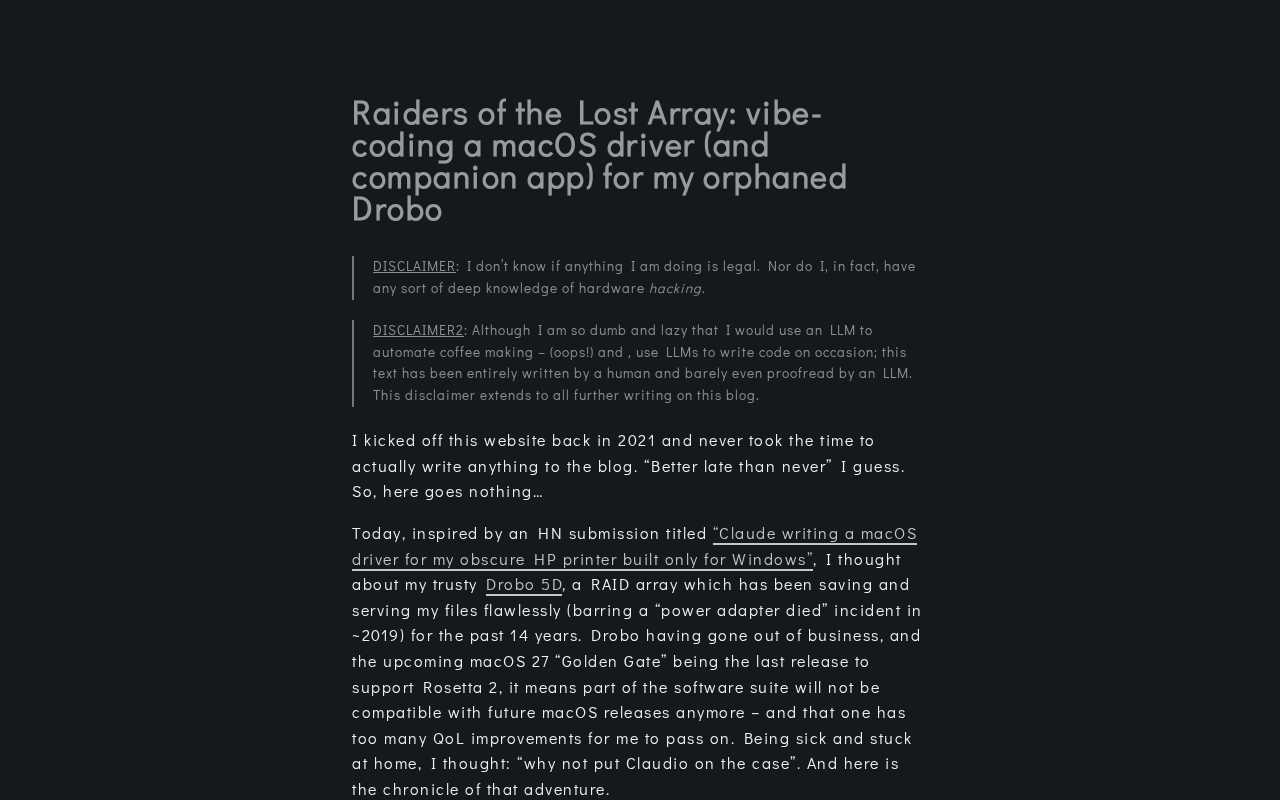
This article, titled "Raiders of the Lost Array" as a nod to Indiana Jones, documents a developer's complete journey of using AI-assisted programming (vibe-coding) to rewrite macOS drivers for their abandoned Drobo device.
Vibe-Coding: A New Paradigm for Driver Development in the AI Era
"Vibe-coding" is a concept that has recently emerged in the developer community, referring to developers using large language models and other AI tools to program in a more intuitive, conversational manner. The term was coined by OpenAI co-founder Andrej Karpathy in early 2025, describing an entirely new approach to programming: developers completely "go with the flow," describing their intentions in natural language to AI, letting AI generate the code, then simply running it, observing results, and course-correcting in natural language. Karpathy admitted that in this mode, he no longer carefully reads AI-generated code, but rather just "checks if it looks roughly right." The concept quickly sparked heated debate in the developer community—supporters argue it dramatically lowers the barrier to programming, while critics worry it produces "surface-level developers" who lack fundamental code comprehension. Using vibe-coding in a high-stakes domain like driver development perfectly illustrates the extreme challenges of this methodology—developers no longer need to master every technical detail from scratch, but instead progressively converge on a working solution through collaboration with AI.
Why Driver Development Is Particularly Suited to AI Assistance
Driver development has long been considered one of the highest-barrier domains in software engineering. It requires deep understanding of OS kernel mechanisms, hardware communication protocols, memory management, and low-level data structures. For a hobbyist developer, reverse-engineering a discontinued device's communication protocol alone would be nearly impossible.
Notably, macOS's driver architecture has undergone a major transformation in recent years, further increasing the difficulty of this work. Traditionally, third-party hardware drivers were loaded into the macOS kernel as Kernel Extensions (kexts), with the highest level of system privileges. However, starting with macOS 11 Big Sur, Apple began pushing the DriverKit framework, requiring third-party drivers to run in user space rather than kernel space. This shift dramatically improved system stability and security, but also meant that legacy kext drivers might fail to load on newer macOS versions. Drobo's official drivers were built on the old kext architecture, so when Apple tightened its kernel extension policies, these drivers completely stopped working on newer macOS versions. To get Drobo working again, a developer would need not only to reverse-engineer the communication protocol but also to migrate the driver to DriverKit—an entirely new framework—essentially requiring a complete architectural rewrite.
However, AI-assisted programming changes this equation. Large language models absorb vast amounts of systems programming knowledge, protocol documentation, and code examples during training, enabling them to help developers:
- Quickly understand unfamiliar system APIs and kernel programming interfaces
- Analyze raw data returned by devices and infer protocol structures
- Generate boilerplate code to reduce tedious repetitive work
- Provide debugging insights when encountering obscure errors
This makes it possible for individual developers with AI assistance to attempt work that would previously require a professional team months to complete.
The Challenge of Reverse-Engineering Drobo's Communication Protocol
Writing a driver for an abandoned device with no official documentation is essentially a reverse-engineering adventure. The developer needs to observe how the Drobo device communicates with the host, capture data packets, analyze patterns within them, and then reconstruct the communication protocol piece by piece.
Finding Patterns in Binary Data
As a storage array device, Drobo's core function is reporting disk status, capacity information, and array health to the host through a specific protocol. Understanding the complexity of this process requires knowledge of the multi-layered architecture of storage device communication. Drobo devices typically connect to the host via USB or Thunderbolt interfaces. At the protocol level, the bottom layer is the physical interface protocol (USB or Thunderbolt), the middle layer is USB Mass Storage Class or the SCSI command set, and the upper layer is the vendor-specific management protocol. Standard read/write operations go through the SCSI channel and typically don't require special drivers—the OS's built-in drivers handle them. But Drobo's array management—including viewing disk status, rebuilding arrays, and monitoring health—relies on vendor-specific SCSI commands or proprietary control channels. The core difficulty of reverse engineering lies precisely here: the developer needs to figure out the format of these non-standard commands, the meaning of parameters, and response structures, all of which can only be obtained through packet capture analysis and trial-and-error when no official documentation exists.
Once the official software became unavailable, this information became a pile of inscrutable binary data. With AI tools, developers can feed captured raw data to a model for analysis, letting AI help identify field boundaries, data types, and status flags. This "human-machine collaborative" reverse-engineering approach significantly reduces the difficulty of independently analyzing protocols. While AI's inferences aren't always correct, the directions and hypotheses it provides can dramatically accelerate the trial-and-error process.
The Practical Value and Limitations of AI-Assisted Programming
This case vividly demonstrates the dual value of AI-assisted programming in real-world engineering. On one hand, it lowers the barrier to entry in specialized domains, giving individual developers the ability to tackle technical tasks that were previously out of reach. On the other hand, it offers a new approach to the "e-waste" problem—when manufacturers abandon support, communities and individuals may be able to use AI tools to breathe new life into devices.
Boundaries That Require Clear-Eyed Assessment
Of course, vibe-coding isn't a silver bullet. Drivers run at the system's core layer, and any issues could lead to system crashes or even data loss. AI-generated code requires developers to have sufficient judgment to review and verify it—especially when dealing with low-level hardware operations, blindly trusting AI output is dangerous.
Additionally, reverse engineering itself occupies a legal gray area regarding authorization. The legal status of reverse engineering varies significantly across jurisdictions. In the United States, the Digital Millennium Copyright Act (DMCA) enacted in 1998 prohibits circumventing technological protection measures in principle, but its "interoperability" exception allows reverse engineering for the purpose of achieving software or hardware compatibility. The EU's Directive on the Legal Protection of Computer Programs similarly provides legal space for decompilation for interoperability purposes. Furthermore, the growing "Right to Repair" legislative movement in the U.S. in recent years has been creating a more favorable legal environment for independent repair and compatibility development. In 2024, multiple states passed Right to Repair bills requiring manufacturers to provide repair tools and documentation. In the Drobo case, since the company has gone bankrupt and the devices are discontinued, the legal risk of writing compatible drivers for personally owned devices is relatively low—but one must still be careful not to infringe on intellectual property that may have been inherited by an acquiring party.
Implications for Sustainable Hardware Ecosystems and Right to Repair
This story of reviving Drobo drivers transcends the purely technical, touching on an important issue in today's tech industry: hardware sustainability and users' "right to repair."
As more and more devices depend on manufacturers' cloud services and proprietary software to function, corporate business decisions directly determine the lifespan of these devices. According to the United Nations' Global E-waste Monitor report, the world generated a record 62 million tonnes of electronic waste in 2022, of which less than a quarter received formal recycling treatment. "Planned obsolescence" caused by software support termination is one of the major drivers of e-waste growth. Many hardware devices could physically continue operating for years or even decades, but are forced into retirement due to operating system updates, cloud service shutdowns, or manufacturers ceasing firmware updates. Smart home devices, network storage devices, and IoT hardware are particularly susceptible to this kind of "software death." The plight of Drobo users is a microcosm of this larger problem, and explains why open-source drivers and community maintenance are crucial for a sustainable tech ecosystem.
AI-assisted programming offers a ray of hope for breaking this dependency—it enables technically capable community members to potentially take over maintenance of abandoned products, extending hardware lifespans and reducing electronic waste.
The direction this case represents deserves attention: as AI tools grow increasingly powerful today, the capability boundaries of individual developers are being redefined, and technical domains that once belonged exclusively to professional teams are gradually opening up to a broader audience.
Key Takeaways
Related articles

Chain of Thought Isn't Just for AI: How Humans Can Use CoT to Improve Thinking Quality
Chain of Thought isn't just a prompt trick for large models. Starting from a Hacker News discussion, this article analyzes why CoT works for human thinking too, breaks down actionable ways to transfer it, and highlights the key differences between human CoT and machine CoT.
Cloudflare Teams Up with OpenAI: Closi…
Cloudflare Teams Up with OpenAI: Closing the Loop from Vulnerability Discovery to Defense with AI
Cloudflare uses OpenAI Daybreak to investigate security vulnerabilities and generate reviewable remediation plans, while developers use Codex to boost coding efficiency and quality.

Orca Multi-Agent Orchestration in Practice: A Guide to Parallel Collaboration with Claude and Codex
Orca is Stable AI's free open-source agent workbench supporting 34 agents like Claude Code and Codex in parallel. Learn its Git worktree isolation, multi-model orchestration, and mobile management.