Using AI to Make Smart TVs "Dumb" Again: A Geek's Self-Rescue Against Ads and Tracking

Users use AI agents to strip smart TV bloatware, fighting ads and tracking to reclaim device control.
Smart TVs' boot ads, tracking, and lag have frustrated users, prompting some tech enthusiasts to use AI agents to remove bloatware. AI agents can automatically identify ad traffic, streamline interfaces, control permissions, and persistently restore user settings after system updates. This trend reflects consumers' rethinking of "pseudo-smartness" and their pursuit of privacy and responsiveness. But the approach is hard to deploy, requires an always-on auxiliary device, and carries risks of manufacturer pushback and voided warranties—still a niche geek practice. For ordinary users, choosing brands with fewer ads or carefully disabling privacy options is more realistic.
From "Smart" to "Dumb": The Smart TV User's Dilemma
Smart TVs were supposed to make living room entertainment more convenient, but the reality often drives people crazy. Boot-up ads, pre-roll ads, ubiquitous tracking, and interfaces that get laggier the longer you use them have many users nostalgic for the non-smart era when you could "plug it in and just watch." According to RSS sources, a new trend is emerging: some users are turning to AI agents to strip out bloatware from their smart TVs and reclaim control.
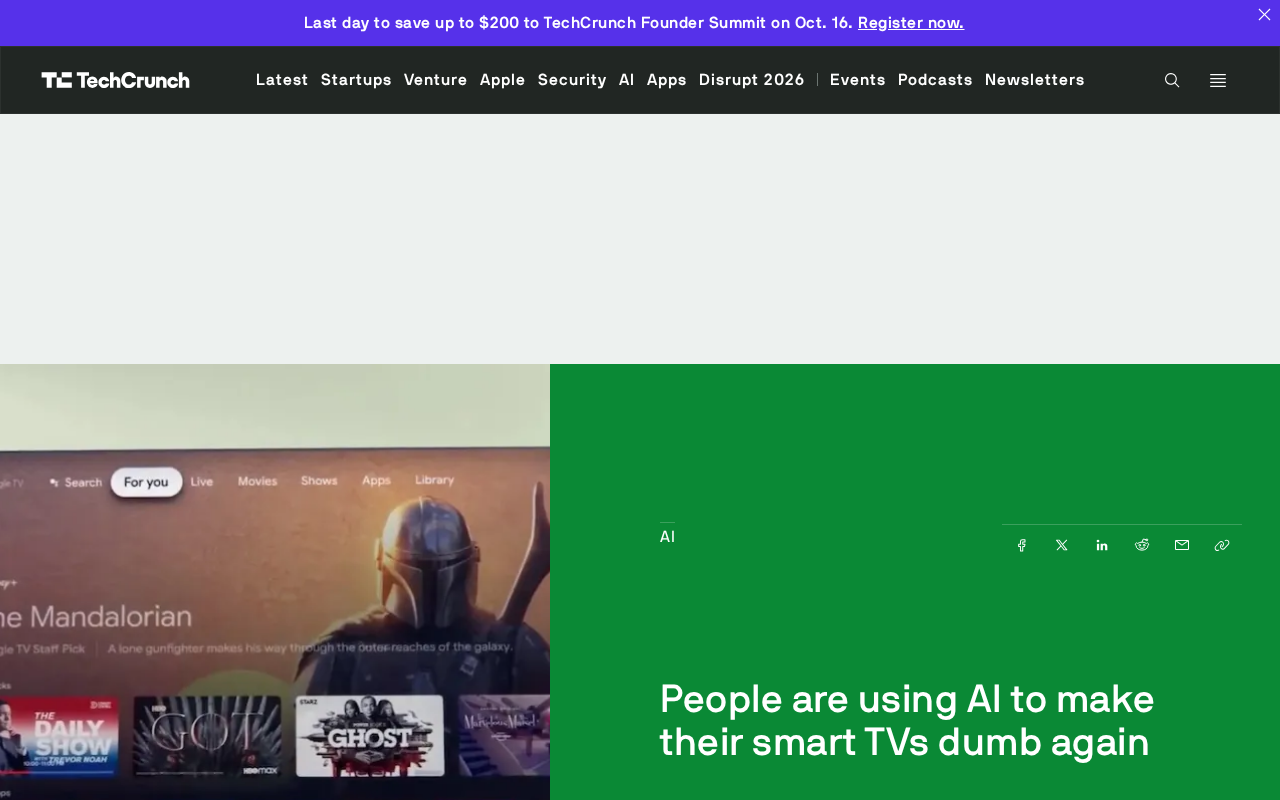
The root of the problem lies in the business model. TV hardware profit margins are thin, so manufacturers monetize through ads and user data. The result: users are forced to watch ads every time they turn on the TV, the system continuously collects viewing habits in the background, and even third-party apps keep requesting permissions. Traditional methods like modifying DNS or installing ad blockers often require a certain level of technical skill and are prone to breaking after system updates.
Bloatware refers to pre-installed applications and background services that come with a device out of the box and that users typically cannot directly uninstall. On smart TVs, this often includes manufacturer-customized recommendation engines, ad-push modules, data-collection agents, and a large number of third-party apps unrelated to core viewing functions. These components not only consume storage and memory resources but also run continuously in the background, causing slower boot times, UI lag, and increased power consumption. Unlike traditional PCs, smart TV systems are usually highly closed, with users lacking root access, so cleaning up bloatware requires external tools or network-layer interception—which is exactly where AI agents come in.
How Do AI Agents "Purify" the TV?
The intervention of AI agents offers a new solution to this problem. Unlike traditional rule-based tools, AI agents can understand user intent and automatically execute a series of complex operations.
Automated Identification and Interception
AI can analyze the TV's network traffic and system processes, identify ad requests and tracking domains, and automatically configure blocking rules. It can also learn user habits to distinguish which are essential system services and which are dispensable bloat components, enabling precise cleanup rather than a crude one-size-fits-all approach.
Interface Simplification and Permission Control
Beyond the network layer, AI agents can help users streamline the TV interface: hiding recommendation sections, disabling autoplay, turning off personalized ad tracking, and more. Through simulated clicks and automation scripts, AI can complete tedious setup steps on behalf of users, lowering the barrier to entry.
Continuous Battle Against System Updates
Smart TV system updates often reset user settings and restore ads and tracking features. The advantage of AI agents is that they can continuously monitor system changes and automatically re-apply user-preferred configurations after updates, forming a dynamic "immune" mechanism.
AI Agent Unlike common chatbots or single-turn Q&A models, an AI agent refers to a software entity capable of perceiving its environment, formulating plans, and autonomously executing multi-step operations. In the TV purification scenario, AI agents typically run on a Raspberry Pi or old computer, communicating with the TV over the local network and calling the TV's ADB debugging interface, router API, or DNS service to implement interception and configuration. Its key capability lies in the closed loop of "understand intent—decompose tasks—execute—verify": the user simply expresses "remove boot ads and keep settings," and the agent automatically completes traffic analysis, rule deployment, and post-update reconfiguration. This autonomy distinguishes it from traditional static rule-based tools, but it also means deployers need to grant it relatively high network privileges.
DNS blocking and ad blockers are common methods early users employed against smart TV ads: by modifying the TV's or router's DNS settings, ad domains are resolved to a null address, preventing ads from loading; ad blockers typically filter HTTP requests at the network layer. However, both methods have obvious limitations. DNS blocking can only cover domain-based requests and is ineffective against services that mix content and ads under the same domain; ad blockers require continuous rule-list maintenance, and smart TV system updates may reset DNS or introduce encrypted DNS (DoH) to bypass blocking. The improvement with AI agents is their ability to dynamically analyze traffic patterns, identify new tracking endpoints, and automatically rediscover and block them after system updates, compensating for the shortcomings of static rules.
The Deeper Signals Behind Geek Self-Rescue
This trend may look like tinkering by tech enthusiasts, but it actually reflects consumers re-examining the definition of "smart." When manufacturers equate "smart" with "internet-connected + ads + data collection," users are beginning to deconstruct this pseudo-smartness through technical means. What they seek is not a truly "dumb TV" but a display device that respects privacy, responds quickly, and isn't hijacked by commercial messaging.
From an industry perspective, the application of AI agents on TVs is still in its early stages. It requires a certain level of technical literacy to deploy and faces risks such as manufacturer countermeasures and legal gray areas. But its emergence offers a new approach to privacy protection in smart homes: rather than waiting for manufacturers to grow a conscience, it's better to arm yourself with AI and reclaim control of your devices.
Controversy and Limitations: Not for Everyone
That said, this approach remains niche. On one hand, deploying AI agents requires an always-on auxiliary device (such as a Raspberry Pi or old computer), adding cost and complexity; on the other hand, some manufacturers prohibit such modifications in their user agreements, which may void warranties. Additionally, over-cleaning system components may affect normal TV functions such as voice assistants or app stores.
For ordinary users, the more realistic option may be to choose brands with fewer ads and cleaner systems at purchase time, or to carefully disable privacy options during initial setup. AI agents "purifying" TVs is more like a demonstration by the geek community: when products deviate from user interests, technology can serve as a counterbalancing force.
Reference source: RSS news report "People are using AI to make their smart TVs dumb again"
Raspberry Pi is a low-cost, credit-card-sized single-board computer often used as an always-on auxiliary device in home networks. In AI agent TV purification solutions, a Raspberry Pi can run agent services, DNS filtering, and automation scripts 24/7, consuming only a few watts and typically costing tens of dollars. Compared to an old computer, it's quieter, more stable, and easier to deploy. However, it still requires users to have basic Linux operation, network configuration, and script debugging skills, as well as an understanding of their home network topology. For users without these skills, purchasing pre-configured devices or choosing TV brands with cleaner systems remains the more practical choice.
One-line Summary
Users are using AI agents to clean up smart TV bloatware, pushing back against ads and tracking to reclaim control of their devices.
Paragraph Summary
Smart TVs' boot ads, tracking, and lag have frustrated users, and some tech enthusiasts have begun using AI agents to strip out bloatware. AI agents can automatically identify ad traffic, streamline interfaces, control permissions, and persistently restore user configurations after system updates. This trend reflects consumers' rethinking of "pseudo-smartness" and their pursuit of privacy and responsiveness. However, deployment barriers are high, requiring an always-on auxiliary device, and there are risks of manufacturer countermeasures and voided warranties—currently still a niche geek practice. For ordinary users, choosing brands with fewer ads or carefully disabling privacy options is the more realistic choice.
Related articles

Workbuddy for Absolute Beginners: How a Desktop AI Agent Fits Into Real Workflows
A beginner's guide to the Workbuddy desktop AI agent: installation, claiming credits, file management, and building automated workflows—compared with CodeX for fit and cost, helping professionals shift from AI question-askers to AI managers.

OpenAI's New Agent Stack: Computer Use, Decisions API, and Ultra-Fast Workflows
OpenAI Dev Day unveiled a new agent stack: Computer Use outperforms humans, Decisions API delivers ultra-low-latency classification via Luna, Agents API opens the same Computer Use capabilities, and GPT-6.1 Sol costs only one-seventh of Astra. Core updates, benchmark data, and developer insights.

Liang Wenfeng Open-Sources DeepInfo Inference Framework, Takes On U.S. Ban
DeepSeek open-sources its DeepInfo inference framework after its models, featuring GPU/CPU cross-pipelining, small-model prediction with large-model verification, and full Huawei Ascend and NVIDIA chip support—facing the U.S. federal ban head-on. This article analyzes its significance for AI deployment and open-source strategy.