Using ChatGPT to Guide Fasting for Fat Loss: A Deep Dive into the Potential and Risks of AI-Powered Health Management

A deep analysis of using ChatGPT for fasting guidance — exploring AI health advice's potential and serious risks.
A recent Hacker News post documented one person's experience using ChatGPT to guide a water fasting regimen for fat loss. This article examines how AI served as a 24/7 health coach for planning, real-time Q&A, and data tracking, while highlighting critical risks including AI hallucinations, inability to monitor vital health markers, and the dangers of electrolyte imbalances and refeeding syndrome that require professional medical oversight.
When AI Becomes Your Health Advisor
As large language models become mainstream, more and more people are turning to ChatGPT as an advisor for all aspects of life — and health management is no exception. A recent post that sparked heated discussion on Hacker News detailed one experimenter's journey of using ChatGPT to guide a water fasting regimen for fat loss. This case study both showcases AI's potential for personalized health advice and exposes the risks of delegating medical health decisions to AI.
Water fasting refers to an extreme fasting method where only water is consumed and no calories are ingested for a set period. This practice has deep historical roots — from the "therapeutic hunger" of Hippocrates in ancient Greece to fasting traditions across major religions, humanity is no stranger to fasting. In the modern context, water fasting has regained attention largely thanks to Yoshinori Ohsumi, the 2016 Nobel Prize laureate in Physiology or Medicine, and his research on autophagy. Autophagy is a self-cleaning mechanism that cells activate under nutrient deprivation, degrading and recycling damaged proteins and organelles. Fasting is believed to trigger this process, potentially offering health benefits beyond fat loss. However, it's important to note that most autophagy research is still at the cellular and animal model level, with limited and inconclusive human clinical evidence. After approximately 48 hours of fasting, the body enters deep ketosis — the liver converts fatty acids into ketone bodies as an alternative fuel for the brain — and this metabolic switch itself poses a significant physiological challenge. This method is quite controversial in the fat-loss community, and when combined with AI-generated advice, the complexity and risks deserve a thorough examination.
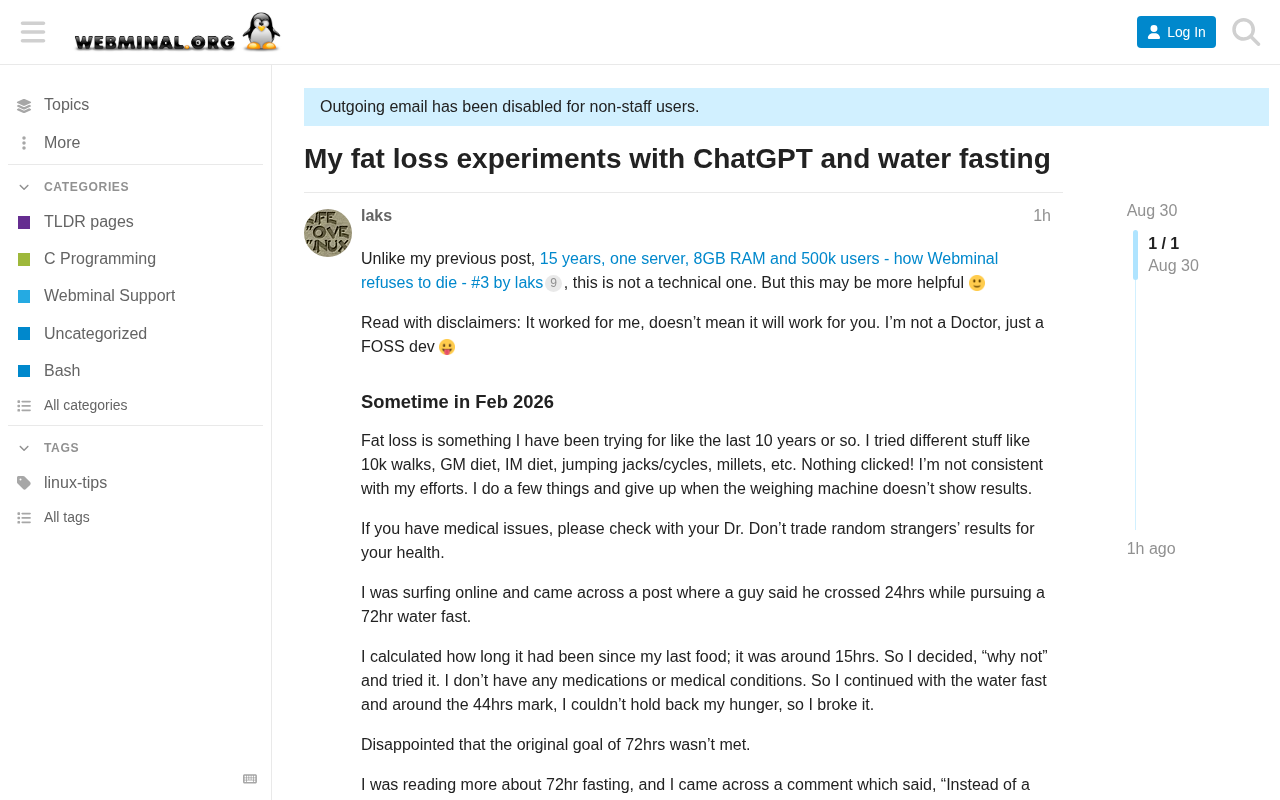
The Core Approach of ChatGPT-Assisted Fasting
At its essence, the experimenter used ChatGPT as a round-the-clock personal health coach. According to their account, the AI played several key roles throughout the fasting process.
Creating a Personalized Fasting Plan
The experimenter fed their height, weight, target fat loss, and other basic data into ChatGPT, asking the model to recommend fasting duration, refeeding schedules, and body signals to watch for during the fast. Compared to searching for fragmented information online, AI can quickly synthesize what appears to be a coherent plan — and this is precisely why many users favor it.
The phrase "appears to be coherent" deserves emphasis here. Large language models like ChatGPT work by making probabilistic predictions based on massive text datasets — they are fundamentally predicting "the next most likely word" rather than truly understanding the causal relationships in nutrition or metabolic physiology. This means that when it generates a fasting plan, it's actually stitching together high-frequency patterns related to fasting from its training data, rather than reasoning from physiological principles for an individual case the way a nutritionist would. There can be a critical gap between a plan that "looks professional" and one that is "genuinely safe."
Real-Time Q&A and Psychological Support During Fasting
The body experiences various reactions during fasting — dizziness, fatigue, hunger, electrolyte fluctuations, and more. The experimenter asked ChatGPT questions whenever issues arose, receiving instant explanations and coping advice. This "companion-style" interaction alleviated some of the anxiety of fasting alone and served as psychological support for staying the course.
It's worth noting that this psychological companionship effect is itself a double-edged sword. Behavioral science research shows that when people receive continuous positive feedback and encouragement, they're more likely to stick with a plan — but if the plan itself carries safety risks, then "helping you persist" may actually amplify the danger. In a traditional medical setting, a responsible doctor would recommend stopping the fast upon detecting abnormal signals. ChatGPT, lacking real perception of the user's physiological state, may inadvertently push users past safety boundaries with its encouraging responses.
Data Tracking and Plan Review
Throughout the experiment, AI was also used to record and analyze daily weight changes and physical sensations, and to fine-tune subsequent plans accordingly. This data-driven iterative approach is the most appealing aspect of AI-assisted health management.
However, there's an easily overlooked problem: the data users report to AI is mostly subjective — things like "felt okay today" or "a bit dizzy but not too bad." The truly critical health indicators during fasting — serum potassium levels, blood glucose, ECG changes — cannot be accurately assessed through self-perception alone. Many electrolyte imbalances present almost no obvious symptoms in their early stages; by the time palpitations or muscle cramps appear, the situation may already be quite dangerous. The "fine-tuning" AI performs based on subjective descriptions is essentially decision-making on incomplete information, far less reliable than medical judgments based on laboratory test results.
The Value and Boundaries of AI Health Advice
This case study shows that ChatGPT does provide some genuine value in health management:
- Lowering the barrier to information access: Consolidating scattered health knowledge into structured recommendations
- Always-available Q&A: No appointments needed — ask anytime, get answers anytime
- Behavioral motivation and psychological companionship: Helping users stick to their plans
However, all of this value rests on a dangerous assumption — that users take it for granted that AI's advice is safe and personalized. In reality, water fasting is an intervention with significant physiological impact. Prolonged fasting can trigger electrolyte imbalances, hypoglycemia, cardiac arrhythmias, and other serious problems, with particularly elevated risks for those with pre-existing conditions.
Specifically, the greatest concern during fasting is electrolyte imbalance. Normal cellular function depends on the precise balance of electrolytes like sodium, potassium, magnesium, and phosphorus. During fasting, with no dietary source of electrolyte replenishment and changes in renal excretion patterns, serum potassium levels can drop rapidly (hypokalemia), directly affecting the heart's electrical conduction system and potentially causing fatal arrhythmias in severe cases. An even more insidious risk emerges during the refeeding phase after the fast ends — so-called refeeding syndrome. When a body that has been in prolonged starvation suddenly resumes eating, the sharp spike in insulin secretion drives phosphate, potassium, and magnesium from the blood into cells, causing serum concentrations of these electrolytes to plummet. This syndrome was first systematically documented in concentration camp survivors released after World War II, and in severe cases can cause heart failure and respiratory failure. This is not a theoretical risk — it's a real danger well-documented in clinical literature — and it's precisely the area where ChatGPT is least equipped to make accurate assessments, because it has no way of knowing what a user's actual electrolyte levels are.
As a language model, ChatGPT's outputs are probabilistic predictions based on training data, not genuine medical diagnoses. It cannot monitor your blood markers, sense your body's true state, or make professional judgments in emergencies. When it offers advice like "you can continue fasting," it fundamentally lacks a real basis for assessing an individual's health status.
Why the Tech Community Is Cautious About AI Health Advice
You may not have noticed, but the discussion of this post on Hacker News skewed notably cautious. Hacker News (HN) was founded in 2007 by Paul Graham, co-founder of Y Combinator, and its core user base consists of software engineers, startup founders, and technology researchers. The community has long been known for rational, in-depth technical discussion, maintaining both openness to emerging technology and a healthy dose of skepticism — as early as GPT-3's initial release, the HN community was already systematically discussing the limitations and potential harms of large language models.
The comment section was full of skepticism about the reliability of AI health advice and concerns about the safety of water fasting itself. Users in the tech community tend to understand the limitations of large language models better than the general public — these models can "confidently fabricate information" (known as hallucination), and without professional verification, this characteristic can have serious consequences in the health domain. Hallucination, in the AI context, specifically refers to large language models generating factually incorrect or entirely fabricated information with a tone of high confidence. This phenomenon stems from the models' underlying architecture — Transformer models don't distinguish between "verified facts" and "statistically common text patterns" when generating text. In everyday conversation, a hallucination might be a harmless error; but in health advice scenarios, a fabricated dosage recommendation or an incorrect safety threshold judgment could directly endanger a user's life. What makes this even more challenging is that ordinary users have virtually no way to determine from AI's responses alone which content is accurate and which is "hallucinated" — AI doesn't flag its own uncertainty.
This community reaction is itself a valuable signal: even among people most familiar with AI technology, there is significant wariness about applying it to high-stakes health decisions.
How to Use AI Rationally for Health Management
This experiment offers several important takeaways.
First, AI is a supplementary tool, not a medical replacement. For scenarios involving extreme interventions like prolonged fasting, professional medical evaluation and monitoring are steps that cannot be skipped. Before starting any fasting plan, a proper medical checkup should be completed.
Second, users need a clear-eyed understanding of AI's capability boundaries. ChatGPT excels at synthesizing information, organizing language, and providing companionship, but it bears no accountability and cannot be held responsible for your health outcomes. If something goes wrong, the user alone bears the consequences.
Third, health-related AI applications urgently need more robust safety mechanisms. Ideally, AI-generated health advice should include built-in risk warnings, clear disclaimers, and proactive recommendations to consult a professional doctor when high-risk scenarios are detected. Currently, the U.S. Food and Drug Administration (FDA) has established a regulatory framework for AI/ML-based Software as a Medical Device, having approved or cleared over 900 AI-driven medical devices as of 2024. But there is a fundamental distinction between these regulated AI products (such as algorithms assisting in diagnostic imaging) and ChatGPT: the former are specialized tools that have undergone rigorous clinical validation for specific medical scenarios, with clearly defined scopes of application and performance metrics; the latter is a general-purpose conversational model that has not undergone clinical trial validation for any medical scenario and falls outside the scope of existing regulatory frameworks. In other words, when users seek health advice from ChatGPT, they are using a tool that holds no medical qualifications in either a legal or medical sense — a fact that remains widely overlooked by users.
Additionally, it's worth noting that some specialized AI health applications are already working to bridge the gap between general-purpose AI and medical safety. For example, some digital health platforms combine AI recommendations with remote review by licensed physicians, or embed hard constraint rules based on evidence-based medical guidelines into their AI systems to ensure outputs don't deviate from verified safety ranges. This "human-AI collaboration" model is likely more responsible and safer than relying solely on general-purpose AI for health advice.
Conclusion: Treat AI as an Assistant, Not a Doctor
Using ChatGPT to guide fasting for fat loss is a vivid snapshot of AI's penetration into everyday health management. It demonstrates the enormous potential of large language models as personal assistants while reminding us that in domains as critical as health and safety, AI's convenience should not overshadow its inherent limitations.
Technology continues to advance, but maintaining a critical approach to using technology will always be an essential quality for every user. Treating AI as a smart information assistant rather than an omniscient doctor — that may be the wisest way to engage with these tools.
Related articles

Cursor Can Now Control Your Computer: AI Agents Can Drive Desktop Apps for Testing
Cursor adds desktop control: AI agents can drive desktop apps like the iOS Simulator to test their own features. We analyze the impact on dev workflows, possible technical approaches, and reliability concerns.

Vibecoding a Custom Inference Engine: High Hopes, Harsh Reality
A Reddit developer shares the real experience of vibecoding a custom inference engine: running GGUF Q4 models in the browser with WebGL2 and GLSL, only to fall into tokenizer debugging hell. This article analyzes the engineering challenges of browser-side LLM inference and why cloning llama.cpp is the more rational choice.

How High Are Anthropic's Early Investor Paper Returns Ahead of IPO?
Anthropic's early investor paper returns draw attention ahead of IPO. This article analyzes sources of book gains, capital structure, pre-IPO games and risks, and implications for the AI startup ecosystem.