UvA-MT's WMT26 Machine Translation Approach: LLM Inference-Time Optimization Strategies

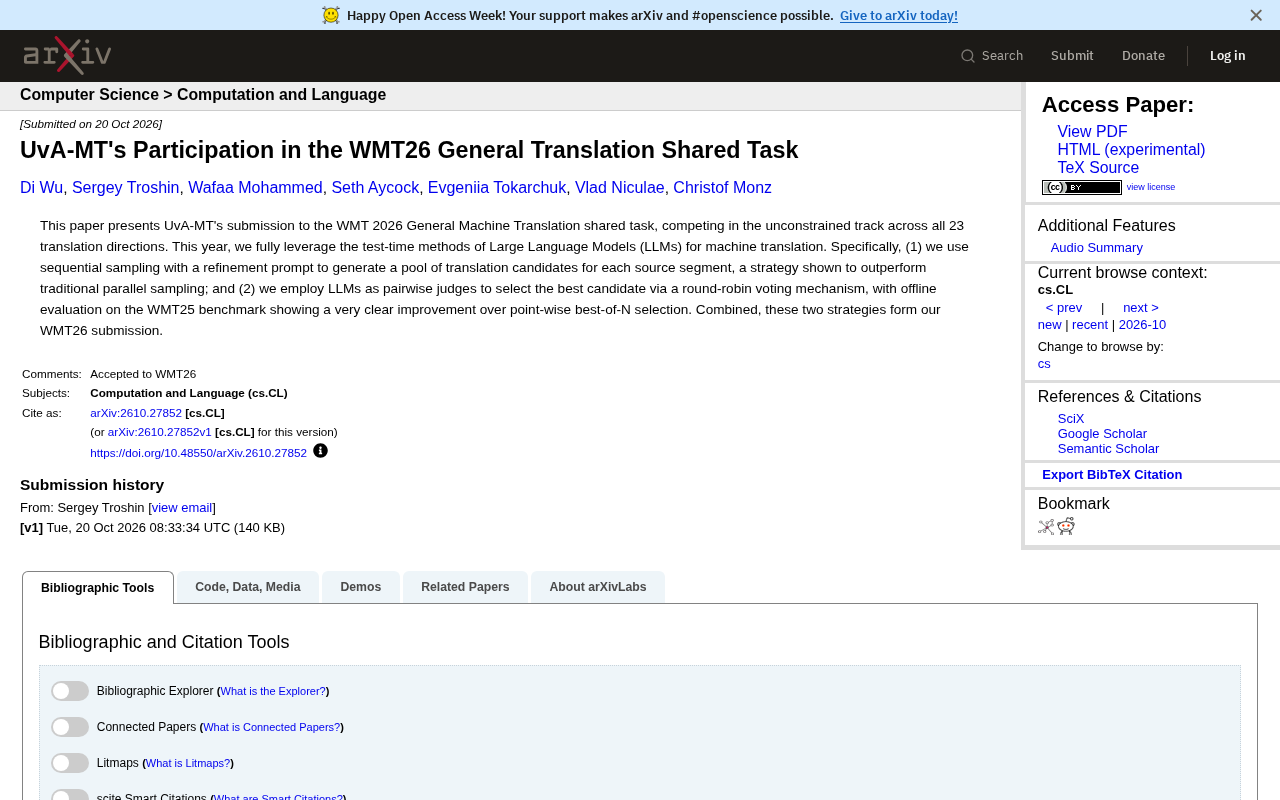
UvA-MT uses pure inference-time optimization for all 23 translation directions at WMT26, with sequential sampling plus refinement prompts for candidates and LLM pairwise judging with round-robin voting to pick the best.
The University of Amsterdam machine translation team submitted a fully LLM inference-time optimization approach to the WMT26 General Machine Translation shared task, covering all 23 translation directions in the unconstrained track. Without additional model training, the method has two core components: sequential sampling with a refinement prompt, which lets the model improve translations by referencing earlier candidates and outperforms parallel sampling; and LLM pairwise judging with round-robin voting to select the best translation from the candidate pool. Offline evaluation on the WMT25 benchmark shows pairwise voting clearly outperforms point-wise best-of-N. The work demonstrates that inference-time compute is becoming a quality lever as important as model scale, though inference costs rise significantly, requiring a trade-off between latency and quality in deployment.
The University of Amsterdam (UvA) machine translation team submitted an approach based on large language model (LLM) inference-time optimization for the WMT26 General Machine Translation shared task, covering all 23 translation directions in the unconstrained track. Unlike previous years that focused on model architecture or training data, this year they placed their bets entirely on test-time methods—unlocking the translation potential of LLMs through clever decoding and selection strategies without additional model training.
Method Breakdown: From Generating Candidates to Voting for the Best
UvA-MT's approach consists of two core components that form a complete "generate-then-select" pipeline.
Sequential Sampling with a Refinement Prompt
The first component is sequential sampling with a refinement prompt. Traditional approaches typically use parallel sampling, where multiple translation candidates are generated independently with no information exchange between them. UvA-MT instead has the model reference previous candidates during generation, using a refinement prompt to guide the model toward progressively improving translation quality. The paper notes that this sequential sampling strategy outperforms traditional parallel sampling.
From an engineering perspective, this design leverages the LLM's in-context learning capability: each sampling step not only generates a candidate but also provides a "draft" that subsequent sampling steps can build upon. For machine translation, where the output space is relatively constrained, step-by-step refinement is more likely to converge to high-quality translations than independent sampling.
In-context learning refers to an LLM's ability to adjust its output behavior without updating parameters, simply by drawing on examples or previously generated text provided in the prompt. In sequential sampling, each candidate generated by the model serves as context for subsequent generations, enabling later candidates to reference and improve upon earlier drafts. This mechanism relies on the LLM's strong contextual modeling capability, but it also carries a risk: if earlier candidates are of poor quality, errors may be inherited or even amplified by subsequent sampling. Therefore, the design of the refinement prompt is crucial—it must explicitly guide the model to identify and correct issues in prior translations rather than simply imitate them.
Pairwise Judging with Round-Robin Voting
The second component addresses the question of "which candidate to select from the pool." Rather than the common point-wise best-of-N approach, UvA-MT has the LLM act as a pairwise judge, selecting the best candidate through a round-robin voting mechanism.
Specifically, candidate translations are paired off, and the LLM judges which version is better in each pair; the champion is ultimately determined by counting wins. The research team conducted offline evaluations on the WMT25 benchmark, and the results showed that this method delivers a "very significant improvement" over point-wise best-of-N. This finding aligns with recent trends in LLM evaluation research: pairwise comparisons are more stable than absolute scoring because models are better at judging relative quality than assigning absolute scores.
Point-wise best-of-N is a commonly used candidate selection strategy in LLM inference: given a source sentence and N independently generated candidate translations, a model or reward model scores each candidate individually (e.g., for fluency and faithfulness), and the highest-scoring one is selected. Its advantages are simplicity of implementation and linear computational cost; its drawback is that absolute scoring is heavily influenced by prompt wording, score-scale calibration, and model bias, and score differences between candidates may be unstable. Pairwise comparison only requires the model to judge the relative quality of two candidates, avoiding the absolute score calibration problem, and is typically more robust—but it requires O(n²) comparisons, incurring higher computational cost.
Why It Matters: The Signal of Inference-Time Optimization
UvA-MT's submission sends a clear signal: in the race for translation quality, inference-time compute is becoming a lever as important as model scale. Competing across all 23 directions in a top-tier evaluation like WMT without fine-tuning or distillation—relying solely on sampling strategies and selection mechanisms—suggests that LLM translation capabilities may be underestimated: the bottleneck is often how to use them well, not that the models themselves are insufficiently strong.
Another intriguing detail is the combination of sequential sampling and pairwise voting. The former increases candidate diversity and introduces iterative improvement, while the latter replaces absolute scoring with relative judgment. Both point to the same principle: trade more inference compute for more reliable output. This approach can readily be transferred to other generation tasks, such as summarization, polishing, or even code generation.
Of course, the cost of this method is a significant increase in inference cost. Generating a candidate pool for each source sentence and performing O(n²)-scale pairwise comparisons requires weighing latency against quality in real-world deployment. The paper does not disclose specific computational costs in the abstract, which may be a practical concern worth monitoring going forward.
Inference-time compute refers to improving output quality by increasing computation during the decoding phase (e.g., generating more candidates, performing multi-step reasoning, self-evaluation and selection) after model training is complete, rather than relying on larger models or more training data. This concept is gaining increasing attention in LLM research, with representative works including chain-of-thought (CoT), self-consistency sampling, and tree search. In machine translation, inference-time optimization manifests as candidate generation and reranking strategies. Its advantage is that it requires no labeled data or fine-tuning and is plug-and-play; its cost is that latency and compute costs grow with the number of candidates and comparisons, requiring a trade-off between quality and efficiency.
Quick Overview
- Competition: WMT26 General Machine Translation shared task, unconstrained track, all 23 translation directions
- Core method: Sequential sampling + refinement prompt to generate a candidate pool; LLM pairwise judging + round-robin voting to select the best
- Key evidence: Offline evaluation on the WMT25 benchmark shows pairwise voting significantly outperforms point-wise best-of-N
- Trend assessment: Inference-time optimization is becoming an important direction for improving machine translation quality
One-line Summary
UvA-MT uses pure inference-time optimization across all 23 translation directions at WMT26, combining sequential sampling with refinement prompts to generate candidates and LLM pairwise judging with round-robin voting to select the best.
Related articles

Chain of Thought Isn't Just for AI: How Humans Can Use CoT to Improve Thinking Quality
Chain of Thought isn't just a prompt trick for large models. Starting from a Hacker News discussion, this article analyzes why CoT works for human thinking too, breaks down actionable ways to transfer it, and highlights the key differences between human CoT and machine CoT.
Cloudflare Teams Up with OpenAI: Closi…
Cloudflare Teams Up with OpenAI: Closing the Loop from Vulnerability Discovery to Defense with AI
Cloudflare uses OpenAI Daybreak to investigate security vulnerabilities and generate reviewable remediation plans, while developers use Codex to boost coding efficiency and quality.

Orca Multi-Agent Orchestration in Practice: A Guide to Parallel Collaboration with Claude and Codex
Orca is Stable AI's free open-source agent workbench supporting 34 agents like Claude Code and Codex in parallel. Learn its Git worktree isolation, multi-model orchestration, and mobile management.