v0.40.15-rc0 Released: New MiMo V2.6 Renderer for Qwen3.5

Open source project releases v0.40.15-rc0, adding MiMo V2.6 renderer for Qwen3.5 to fix output parsing
Open source project releases pre-release v0.40.15-rc0 (commit 355eaee, tagged by dhiltgen), adding a MiMo V2.6 renderer for Qwen3.5 via PR #19400. The renderer converts raw model token sequences into structured chat formats, handling chat templates, special tokens, and multi-turn context. It's GPG-signed and GitHub Verified, ensuring supply chain traceability. Developers using Qwen3.5 should test in a staging environment first; other model users are minimally affected.
A Low-Key but Critical Minor Iteration
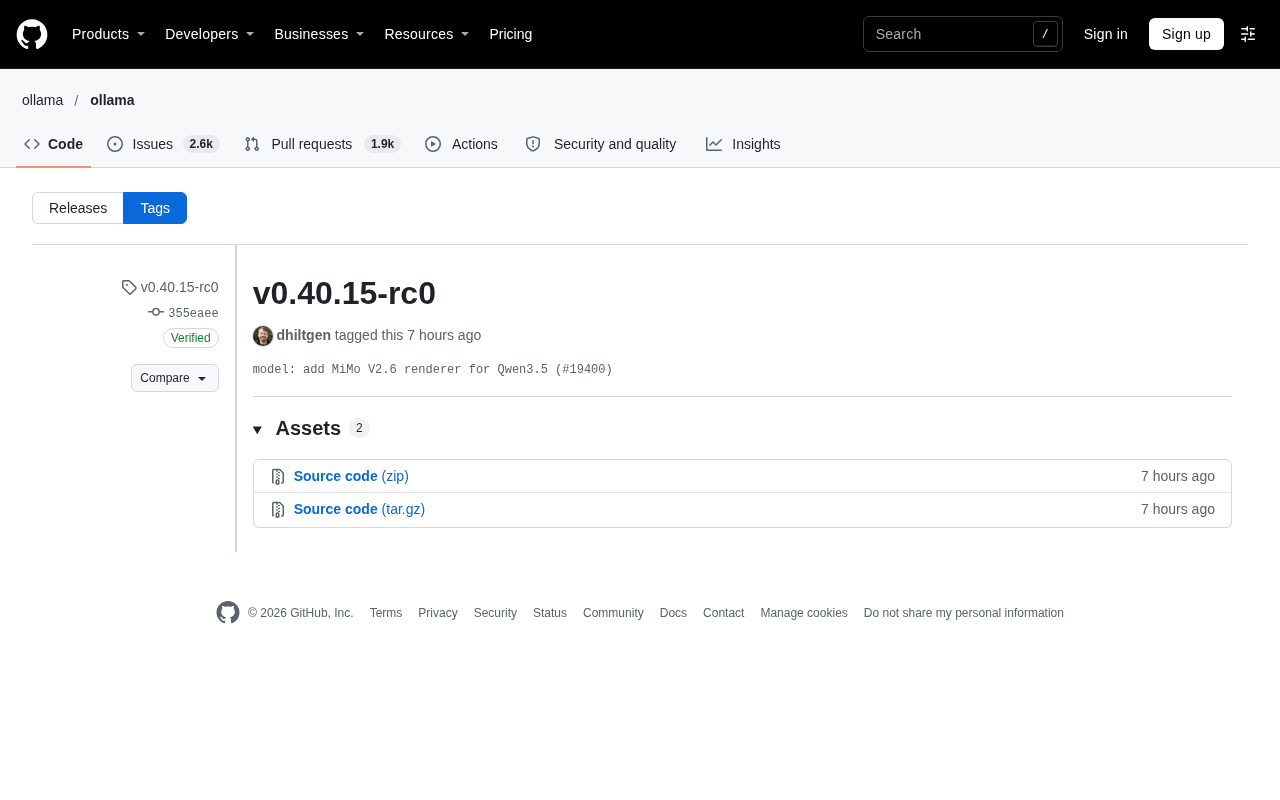
Open source project releases often don't attract as much attention as major version launches, yet they frequently carry key changes that affect real-world usage experience. Recently, the project tagged v0.40.15-rc0 on GitHub, with commit hash 355eaee, marked by developer dhiltgen. According to the commit message, the core of this update is adding a new MiMo V2.6 renderer for the Qwen3.5 model.
This is a pre-release version (rc stands for release candidate), meaning the functionality is essentially complete but still awaiting community validation before being promoted to a stable release. For users concerned with model adaptation and inference compatibility, this change is worth noting.
Core Change: MiMo V2.6 Renderer Landed
Commit Content Interpretation
The commit is titled "model: add MiMo V2.6 renderer for Qwen3.5 (#19400)", corresponding to PR #19400. Based on the naming convention, the renderer is an adapter component between the model layer and the output layer, responsible for converting raw model output into a structured, readable format. Different model families have different chat templates, special tokens, and output structures, and the renderer serves as the middleware that handles these differences.
Introducing the MiMo V2.6 renderer for Qwen3.5 indicates that the project is expanding support for newer versions of the Qwen series. As a relatively new model version, Qwen3.5's output format may differ from earlier versions, and directly reusing old rendering logic can easily lead to parsing errors or content truncation. The purpose of adding a dedicated renderer is precisely to ensure that model output is correctly reconstructed on the application side.
Why the Renderer Deserves Separate Attention
In local inference and model serving scenarios, the renderer is often an underappreciated component. No matter how capable the model itself is, if output parsing goes wrong, users may see incomplete conversations, misaligned role markers, or even completely unparseable garbage. The renderer takes on the "translation" responsibility, converting the model's internal token sequences into a structure that conforms to the chat protocol.
From this perspective, adapting the MiMo V2.6 renderer specifically for Qwen3.5 is a substantive compatibility fix rather than a superficial version number bump. For users already using Qwen3.5 or planning to migrate, this rc version provides an officially supported adaptation path.
The Relationship Between Renderers and Chat Templates
To understand the role of the renderer, one must first understand the chat template. Modern chat models are trained with specific role marker formats, such as special token sequences like <|im_start|>user...<|im_end|>. Before feeding user input into the model, the inference framework needs to assemble the prompt according to the template; after receiving model output, it needs to parse it in reverse using the same rules to reconstruct who said what. The renderer is the component that handles this bidirectional conversion.
It typically also handles multi-turn context concatenation, embedding of function calling results, and token boundary splitting during streaming output. Since different model families have non-uniform special token sets and output structures—and even different versions within the same family may adjust formats—the renderer must be model-specific. Once the rendering logic doesn't match the model's actual output, typical symptoms include residual role markers, premature content truncation, or structured field parsing failures.
Version Signing and Release Trustworthiness
GitHub Verified Signature
This commit shows as Verified on GitHub, signed with GPG key ID B5690EEEBB952194. This means the commit's origin is traceable and the content was not tampered with during transmission. For teams that need to audit dependency sources, signature verification is a fundamental means of assessing supply chain trustworthiness.
The tag was marked by dhiltgen on November 3 at 15:09, following the conventional open source project workflow: commit code first, then tag, and then enter the rc validation phase.
The Meaning of GPG Signatures and the Verified Badge
Git commits themselves can carry GPG (GNU Privacy Guard) signatures, which are based on asymmetric encryption: developers use their private key to generate a signature over the commit content, and anyone with their public key can verify that the commit was indeed created by the corresponding private key holder and that the content has not been modified. GitHub displays the Verified badge to indicate that the platform has successfully verified the signature using the public key uploaded to the developer's account.
The key ID B5690EEEBB952194 mentioned in the article is the short identifier for this public key, which can be used to look up the full fingerprint on a key server. For dependency auditing, signature verification answers two questions: whether the commit's origin is trustworthy and whether the transmission chain has been tampered with. However, it does not guarantee that the code itself is free of vulnerabilities—it is just one piece of the supply chain trustworthiness puzzle.
Recommendations for Using rc Versions
rc versions are suitable for users willing to try new features and provide feedback, but are not recommended for direct use in production environments with extremely high stability requirements. If your project depends on Qwen3.5's output parsing, you can first validate the actual performance of the MiMo V2.6 renderer in a test environment, confirming that chat templates, special token handling, and multi-turn context concatenation all work correctly before considering following up with the stable release.
Where rc Versions Sit in the Semantic Versioning Workflow
rc (release candidate) typically comes after feature freeze and before the stable release. At this point, new features have been merged, and what remains is primarily bug fixes and regression validation—generally no more breaking changes are introduced. Compared to alpha and beta, rc is more stable, but it still differs from the stable release: it has not yet undergone full community usage testing, and edge cases may still have undiscovered issues.
In the Semantic Versioning (SemVer) system, the -rc0 in v0.40.15-rc0 is a pre-release identifier, and by specification it has lower precedence than the same-numbered stable version v0.40.15. This means package managers typically won't select rc versions by default when resolving version constraints—explicit specification is required for installation. For users, this provides a natural layer of protection, and also reminds early adopters to actively pin version numbers to avoid being unexpectedly overridden by a subsequent stable release.
Practical Impact on Users
Scenarios to Watch
If you call Qwen3.5 through this project and encounter output format corruption, lost role markers, or parsing errors, this rc version may be the corresponding fix. Renderer updates typically do not change model weights or inference performance; the impact is concentrated in the output parsing stage, so the upgrade risk is relatively manageable.
Conversely, if your workflow is entirely based on other models, this update has limited impact on existing behavior. The version number continues from the v0.40.x series, indicating this is a maintenance iteration rather than an architectural adjustment.
Follow-Up Observation Points
What's worth watching next is how quickly the rc gets promoted to stable, and whether the community reports any renderer-related edge cases. The discussion area of PR #19400 typically accumulates compatibility feedback from actual usage, serving as a direct reference for judging the maturity of this change. Additionally, whether more models beyond Qwen3.5 receive similar renderer adaptations will also reflect the project's investment direction in the model compatibility layer.
Summary
v0.40.15-rc0 is a minor version update with a clear scope, centered on adding the MiMo V2.6 renderer for Qwen3.5 to address model output parsing adaptation issues. The commit is GPG-signed and verified, and the release process follows standard practices. For developers using Qwen3.5, this is a version worth validating in a test environment first; for other users, it can be seen as a signal of the project's ongoing efforts to improve model compatibility.
One-line Summary
Open source project releases v0.40.15-rc0, adding MiMo V2.6 renderer for Qwen3.5 to fix output parsing
Paragraph Summary
Open source project releases pre-release version v0.40.15-rc0 on GitHub (commit 355eaee, tagged by dhiltgen), with the core change being the addition of a MiMo V2.6 renderer for the Qwen3.5 model via PR #19400. The renderer sits between the model layer and output layer, responsible for converting raw model token sequences into structured chat formats, handling differences in chat templates, special tokens, and multi-turn context concatenation. Since Qwen3.5's output format may differ from earlier versions, reusing old rendering logic can easily cause parsing errors or content truncation, hence the need for dedicated adaptation. The commit is GPG-signed and GitHub Verified, making the supply chain traceable. The article recommends that developers using Qwen3.5 first validate renderer performance in a test environment and refrain from using it in production environments with high stability requirements; users of other models are minimally affected by this update.
Related articles

AI Coding Enters the Team Collaboration Era: Interpreting Three Major Moves from Meta, GitHub, and Mistral
Meta acquires Conductor, GitHub Copilot Fusion becomes available, Mistral opens Large 4 weights—three moves show AI coding shifting from code generation to organizing development workflows. This article explains task orchestration, model collaboration, and cost control for developers.

Building a RAG Assistant with Dify: A Practical Guide to Knowledge Bases, Workflows, and Agent Nodes
How should knowledge bases, workflows, and Agent nodes connect in a Dify RAG assistant? We break down the division of labor and wiring logic for a shippable app.
 Tech Frontiers
The AI Industry Doesn't Lack Marketing—It Lacks Good Products
AI faces market selloffs and public skepticism—is marketing really the problem? This analysis of market signals and product experience argues the core困境 is incomplete products and a gap between promises and experience; the only way to change perceptions is to ship better products.