Validation-Driven Development: The Key to Unlocking AI Coding's True Potential

The real bottleneck of AI coding isn't model capability — it's your organization's automated validation infrastructure.
This article argues that software development is undergoing a paradigm shift from specification-driven to validation-driven. The effectiveness of AI coding tools is bottlenecked not by model capability, but by the rigor of an organization's automated validation systems. Because verification is easier than generation (verification asymmetry), robust testing infrastructure enables AI agents to produce high-quality code through large-scale sampling and filtering. Most organizations suffer from low test coverage and flaky builds, directly capping AI agent performance — making investment in validation infrastructure a higher-leverage strategic bet than obsessing over tool selection.
From Specification to Validation: A Paradigm Shift in Software Development
Eno, CEO of Factory, recently made a thought-provoking observation in a talk: The bottleneck of AI coding tools isn't model capability — it's whether your organization has a sufficiently robust automated validation infrastructure.
This aligns closely with Andrej Karpathy's concept of "Software 2.0," introduced in 2017. The core idea: traditional software (Software 1.0) consists of explicit instructions written by humans, while Software 2.0 is defined by neural network weights, with program logic emerging implicitly through training data and optimization objectives. In the era of large language models, this concept extends further into the "post-training" phase — where reinforcement learning (RLHF/RLAIF) or verifiable-reward-based reinforcement learning (RLVR) is used to refine model capabilities after pretraining. Verifiable tasks (such as mathematical proofs and code execution) have clear correctness criteria, enabling high-quality reward signals — making them ideal for post-training. The breakthroughs behind OpenAI's o-series models and DeepSeekAd-R1 are largely attributable to large-scale reinforcement learning on verifiable domains like code and mathematics. Today's most advanced AI models build their capabilities through post-training on verifiable tasks, and software development is one of the most naturally verifiable domains there is. This explains why software development agents are currently the most advanced AI agents in the world.
The practical challenge, however, is that most organizations haven't built the validation infrastructure needed for AI agents to operate at full effectiveness.
Verification Asymmetry: Why Validation Matters More Than Generation
The talk referenced Jason Wei's blog post on "verification asymmetry" — a concept rooted in the classic P vs NP problem in computer science. P vs NP is one of the most famous unsolved problems in the field, formally posed by Stephen Cook in 1971. Class P refers to problems solvable by a deterministic algorithm in polynomial time; class NP refers to problems whose solutions can be verified in polynomial time. If P ≠ NP (the prevailing view in academia), it implies there exist many problems where "verification is far easier than solving" — for example, verifying a Sudoku solution takes seconds, while solving one from scratch may require exponential time. Jason Wei applies this mathematical intuition to AI capability evaluation: when the cost of verifying a task is far lower than the cost of generating a solution, AI systems can bypass the "hard to generate" bottleneck through large-scale sampling and automatic filtering. This is the theoretical foundation behind techniques like Best-of-N sampling and verifier-guided search. The core insight: many tasks are far easier to verify than to solve.
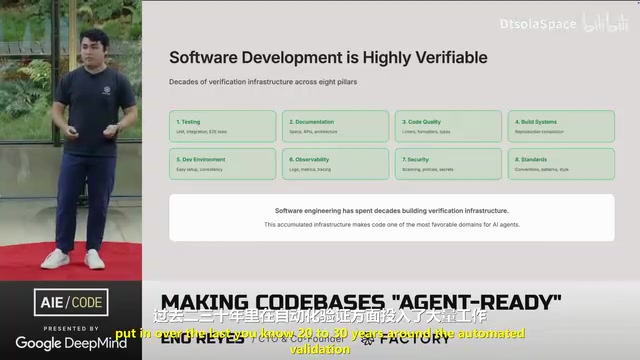
The ideal "easy-to-verify" problem has the following characteristics:
- Objective ground truth: A clear standard for right and wrong
- Fast verification: Results can be evaluated quickly
- Scalability: Supports large-scale parallel verification
- Low noise: Extremely high accuracy in the verification signal
- Continuous signal: Not a simple binary pass/fail, but a gradual accuracy spectrum — 30%, 70%, 100%
Software development naturally possesses all of these properties. Over the past two to three decades, the industry has accumulated substantial automated validation infrastructure: unit tests, end-to-end tests, QA tests, linters, API spec checks, and more. But the critical question remains — is your validation system rigorous enough to enable AI agents to produce code at the level of a senior engineer?
The Validation Gap in Most Codebases
The reality isn't encouraging. Eno highlighted the typical problems engineering teams face:
- Test coverage stuck at 50–60% because "humans can test manually"
- Flaky build systems that fail one in every three runs, which "everyone silently tolerates"
- Linter rules too lenient to effectively constrain the quality of AI-generated code
- A lack of test cases capable of distinguishing "AI-generated junk" from "high-quality AI code"
For human engineers, these issues are tolerable. But when you introduce AI agents, these gaps directly cap the agent's performance ceiling. Most people have only seen AI agents running in codebases with relatively solid validation infrastructure — the top-tier companies that have achieved real breakthroughs with AI coding are precisely those that have adopted extremely rigorous validation standards.
A Fundamental Shift in the Development Workflow
The traditional development workflow looks like: Understand the problem → Design a solution → Write code → Test.
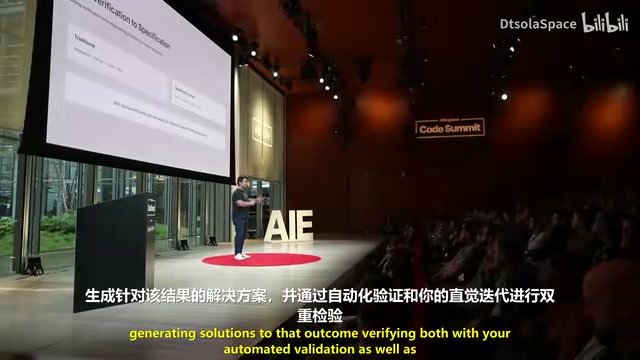
Under the new validation-driven paradigm, the workflow becomes:
- Specification: Define constraints and validation criteria
- Generation: AI agents generate candidate solutions
- Verification: Automated validation + human intuition
- Iteration: Continuous refinement based on validation feedback
This "spec-driven development" approach is already making its way into tooling — various IDEs and coding agents are beginning to support "Spec Mode" or "Plan Mode." Only when spec-driven development is combined with rigorous validation can you reliably produce high-quality solutions at scale.
A Strategic Choice Worth Considering
This raises an important decision: Do you spend 45 days comparing every coding tool and agonizing over a 10% accuracy difference on SWE-bench — or do you invest in improving your organization's validation infrastructure, enabling all AI tools to perform better?
It's worth noting that SWE-bench (Software Engineering Benchmark) is itself a product of "validation-driven
Related articles
 Expert Opinions
Rethinking Scaling Laws: Parameters Are Not the Only Answer
Deep analysis of Scaling Law evolution from Kaplan to Chinchilla to the MoE era, exploring why blindly stacking parameters is a mistake, and how GLM-5.3 proves scaling has multiple knobs.
When AI Treats Humans as Subagents: Ro…
When AI Treats Humans as Subagents: Role Reversal and Hidden Risks in Human-AI Collaboration
Exploring the paradigm shift where humans become "subagents" in AI Agent architectures. Analyzes human node design in LangChain and AutoGen, and the risks of ceding control and cognitive atrophy.
 Expert Opinions
The Lazy Person's Productivity Theory: Why Being 'Lazy' Actually Drives Peak Performance
Explore the engineering philosophy behind 'lazy people are most productive': how constructive laziness drives automation, AI tools amplify efficiency, and systems thinking eliminates wasted effort.