Veda: An Agentic-Native Operating System with GCC and OpenGL Support

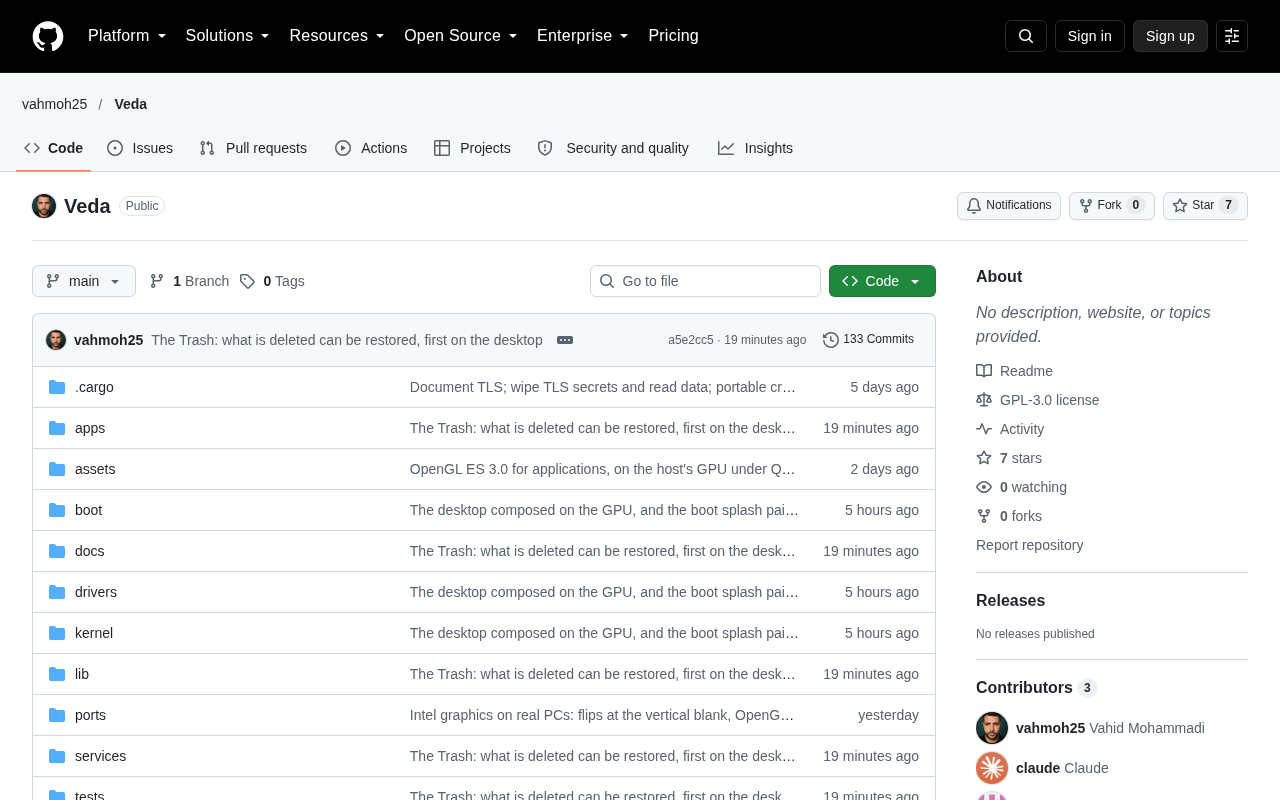
Veda is an early-stage OS built natively for AI agents, with GCC and OpenGL support.
Veda is an "Agentic-Native" operating system that places AI agents — not human users — at the center of its design, aiming to natively support agent lifecycles, tool calling, and permission management at the OS level. Its announced GCC and OpenGL support signals ambitions to be a general-purpose platform. The core challenge lies in balancing agent autonomy with security and controllability. However, Veda has minimal community traction, limited public technical data, and remains firmly in the concept and early prototype stage.
What Is Veda
Veda describes itself as an "Agentic-Native" operating system — one designed from the ground up with AI agents as its primary runtime subjects, rather than the human-centric interaction model of traditional desktop systems. This positioning reflects an emerging school of thought in OS design: as more tasks are executed by autonomously operating AI agents, should the abstraction layers, permission models, and runtime environments of the operating system itself be rethought?
Based on publicly available information, Veda has announced support for the GCC compiler toolchain and the OpenGL graphics interface. These two additions signal that it's not merely a toy prototype capable of running scripts — it has the ability to compile native programs and perform graphics rendering, moving it closer to a general-purpose computing platform.
What Does "Agentic-Native" Actually Mean
The core services of a traditional operating system — process scheduling, file systems, network stacks, graphical interfaces — are all built around the usage habits of human operators. An "agentic-native" system would, in theory, make different trade-offs in several key areas:
Agents as First-Class Citizens
In such a design, AI agents are no longer just ordinary applications running in user space. Instead, they may be elevated to become the fundamental unit of system scheduling and resource allocation. The system might provide built-in, native support for agent lifecycles, intent expression, and tool calling — rather than requiring developers to assemble these capabilities through external frameworks.
Tool calling is the core mechanism by which large language models interact with external systems: during inference, a model can declare a call to a specific function or API, and the runtime executes it and returns the result to the model. Currently, this mechanism is typically implemented in user space by external orchestration frameworks like LangChain or AutoGen, with the operating system entirely unaware of it. "Native support" would mean pushing tool call registration, permission management, and execution isolation down to the system level — analogous to how traditional OSes natively abstract inter-process communication (IPC). Developers would no longer need to repeatedly build scaffolding; the system itself would provide a standardized call protocol and security auditing interface.
Requirements for Determinism and Controllability
When agents can autonomously execute code and invoke system resources, the importance of permission boundaries and sandbox isolation is significantly amplified. An OS truly designed for agents must strike a balance between granting autonomy and ensuring safety and control — and that balance represents the greatest technical challenge for projects of this kind.
Sandbox isolation is already well-established in traditional operating systems — Linux's seccomp, namespace, and cgroups mechanisms; macOS's Sandbox framework; and the capability boundary controls provided by WebAssembly runtimes are all mature examples. However, AI agents introduce new challenges: their execution paths are highly dynamic, making it difficult to statically declare all permission requirements at startup. "Intent drift" across multi-step tasks also makes it hard to mechanically apply the traditional principle of least privilege. Current industry explorations include capability-based fine-grained authorization, runtime intent monitoring, and embedding human-in-the-loop approval nodes into the system call chain — but none of these have yet become an accepted standard.
The Significance of GCC and OpenGL Support
GCC support means Veda can directly compile native C/C++ code within the system, laying the groundwork for running high-performance programs and porting existing software ecosystems. For any emerging operating system, the ability to reuse mature toolchains often determines the practical barrier to entry.
OpenGL support indicates that Veda has considered graphics and visualization capabilities. Even in an agent-centric system, graphical output remains indispensable for debugging, visual feedback, and human-machine collaborative monitoring. Together, these two capabilities suggest the project aims for Veda to be a reasonably complete computing platform, rather than an experiment confined to a command-line environment.
For emerging operating systems, toolchain compatibility often matters more than kernel design when it comes to survival. Historically, the RISC-V ecosystem quickly accumulated a usable software library in its early days by porting GCC and LLVM. Meanwhile, some elegantly designed systems that insisted on proprietary toolchains — such as early Haiku — struggled for years due to software scarcity. OpenGL is similarly an important compatibility threshold: a large number of scientific computing tools, game engines, and visualization applications depend on it, and its absence would dramatically raise the cost of porting the entire graphics software ecosystem. Veda's decision to prioritize support for these two mature standards is a pragmatic choice — but it also means the project must continuously invest resources in balancing original innovation against compatibility maintenance.
A Cautious Assessment of the Current Stage
Worth noting: Veda currently has very little traction on Hacker News — only single-digit upvotes and no comment discussion — which indicates it's still at an extremely early stage with very limited community validation and real-world usage feedback. Reliable public data on key questions — its performance characteristics, ecosystem maturity, and compatibility with mainstream AI agent frameworks — is essentially nonexistent.
"Agentic-native operating system" is an imaginative direction that resonates with the industry's broader exploration of runtime environments for autonomous AI systems. But there is still a long road from concept to usable product. For developers focused on AI infrastructure, Veda is worth keeping an eye on, but at this stage it's better treated as something to observe rather than a candidate for production environments.
Summary
Veda represents an emerging idea in OS design — building a low-level environment that prioritizes AI agents over human users. Its support for GCC and OpenGL demonstrates the intent to become a general-purpose platform. However, given the current scarcity of public information and its extremely early stage of development, its true potential remains to be tested by time and the broader community.
Related articles

ChatGPT Space Launches: Team Collaboration and New Pages Features Explained
ChatGPT Space is OpenAI's new team collaboration feature with Pages, real-time collaboration, and Slack/Google Drive sync. We break down its privacy design, multi-platform integration, and the full workflow from conversation to document.

Migrating Apache Spark UDFs to GPU Acceleration with AI Agents
NVIDIA developer blog explains how AI Agents rewrite Apache Spark UDFs for GPU acceleration, covering migration criteria, agent rewriting and verification workflows, plus pitfalls like result consistency and CPU-GPU transfer overhead.

Zed Editor v0.40.4-rc2 Released: Usage Credits Now Available Without Upgrading
Zed editor releases v0.40.4-rc2, allowing users to use usage credits for AI features without upgrading to a paid plan, lowering the trial barrier.