Veda Nurse's Cranial Nerve Exam: Why ASMR Role-Play Is Going Viral

Veda role-plays a novice nurse conducting a cranial nerve exam, using humor and flaws to create a relaxing ASMR experience.
Bilibili creator Veda uploaded an ASMR role-play video themed around a cranial nerve exam, playing a nurse who claims to be "very new" to medicine and examines viewers under the supervision of a doll "Little Dr. V." The video covers smell, vision, facial touch, taste, hearing, and more, with each step infused with clumsy sincerity and dark humor—such as lightly touching the face with a steak knife and having viewers swallow food before asking about allergies. The article analyzes why the video went viral: the novice setup lowers viewers' defenses, classic ASMR triggers like whispering, light touch, and visual tracking create immersion, and the tension of "safely experiencing danger" plus equal interaction are its core appeals.
Title
Veda Nurse's Cranial Nerve Exam: Why ASMR Role-Play Is Going Viral
Meta Description
Bilibili creator Veda's cranial nerve exam ASMR video goes viral, blending humor and sensory triggers through nurse role-play. This article analyzes its unique appeal and the audience psychology behind ASMR role-play.
Article Content
On Bilibili, a creator named Veda uploaded a video titled "A Bizarre Cranial Nerve Exam with a Nurse." The content appears to be a standard neurological examination, yet it is permeated with eeriness and humor. The video has no flashy effects or complex plot, but thanks to its unique role-play and immersive sound design, it has caught attention among ASMR enthusiasts. What exactly is its magic?
An "Unprofessional" Yet Addictive Exam
At the opening, the nurse (played by Veda) confesses a key piece of information: she originally worked in beauty care, and ever since "Dr. V" left, she has been trying other types of medicine in case she needs to find a new doctor. Today she is conducting a cranial nerve exam, and she is "very new" to this.
This setup is inherently dramatic. An inexperienced nurse, supervised by "Little Dr. V" (a doll), performs a complex medical examination on you. As she works, she talks to herself—for instance, during the smell test, she brings out coffee and a wildflower candle and promises to give you the candle if you do well. This reward mechanism and slightly clumsy sincerity quickly close the distance with the audience.

The examination covers multiple aspects of the cranial nerves: smell, vision, visual fields, facial touch, taste, hearing, tongue movement, and more. But every step is given a unique "Veda-style" treatment. For example, in the vision test, she not only has you identify finger movements but also brings out an eye chart, only to look ridiculous because she can't reach high enough. In the facial touch test, she first uses a soft hat, then gently touches you with a "steak knife," stressing, "I won't hurt you—I'm running low on Band-Aids." This probing at the edge of safety and danger is exactly the source of tension common in ASMR role-play.
Role-Play Details: Balancing Humor and Tension
The essence of Veda's performance lies in the details. Throughout the exam, she constantly talks to "Little Dr. V" seeking approval, such as "I'm doing a good job, right, Little Dr. V?" This interaction not only enriches the character but also gives viewers the illusion of being noticed and cared for. At the same time, she occasionally throws in dark humor, like "Don't scream—no one will hear you anyway," or "I probably should have asked about allergies beforehand, but that would have ruined the test." These lines would be utterly inappropriate in a real medical setting, yet they perfectly match the psychological need in ASMR role-play to "safely experience danger."
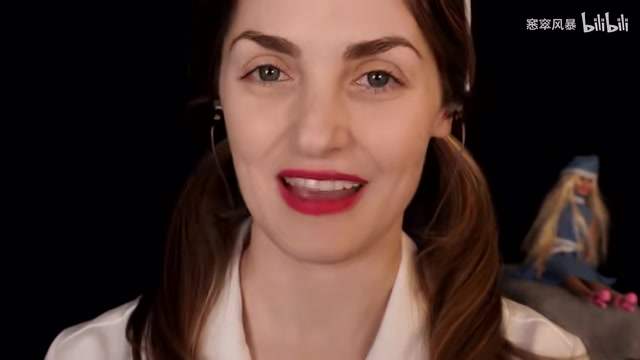
In the taste test, she puts food directly into your mouth and has you swallow before asking, "Do you know what that was? Chocolate, and almond. Good thing you're not allergic to almonds—that would have been bad." This act-first-ask-later approach is both exasperating and amusing, reinforcing the character's "unreliable" persona. Yet viewers at the screen feel relaxed precisely because of this unreliability—because everything is within controllable bounds.
Sensory Triggers: The Core Mechanism of ASMR
What makes this video appealing to ASMR audiences is the carefully designed sensory triggers. Whispers, light touches, object friction sounds, and the use of various props (such as the eye chart, tuning fork, and lights) are all classic ASMR elements. Veda uses whispering extensively in the video, especially during the hearing test, where she leans close to the ear and whispers, having you identify which ear the sound comes from. This close-range auditory stimulation can effectively trigger ASMR responses.

Visual triggers are equally important. She uses a penlight to check pupillary response, moving the light for you to follow—these visual tracking movements themselves help people focus and relax. In addition, the video's framing is mostly close-up, creating a private, personal sense of space that further enhances the immersive experience.
ASMR (Autonomous Sensory Meridian Response) refers to the tingling sensation on the scalp, neck, and back and the deep relaxation response triggered in some people by specific audio, visual, or tactile stimuli (such as whispering, light touch, and tapping sounds). This phenomenon was first named by internet user Jennifer Allen in 2007 and gradually became a content category on platforms like YouTube after 2010. Research suggests that the brains of ASMR responders differ in connectivity between the default mode network and sensorimotor areas, which may explain why the same audio clip delights some people while others feel nothing. ASMR triggers can be broadly divided into three categories: auditory (whispering, chewing, tapping), visual (slow movements, light and shadow changes), and tactile (simulated touch, hair brushing). Role-play often layers all three, amplifying the relaxing effect through situational narrative.
The cranial nerve examination is part of the neurological physical exam, used to assess the functional status of the 12 pairs of cranial nerves, including the olfactory nerve (smell), optic nerve (vision and visual fields), trigeminal nerve (facial touch), facial nerve (facial expression muscle movement), auditory nerve (hearing), and glossopharyngeal and vagus nerves (swallowing and taste). A standard exam requires the subject to cooperate in completing odor identification, eye chart recognition, visual field comparison, facial light touch localization, tuning fork audiometry, tongue protrusion, and other actions. Although Veda's video is for entertainment purposes, its sequence roughly replicates this examination, giving viewers familiar with medical settings a sense of déjà vu—and this structured set of operational steps itself provides a natural rhythm and narrative framework for ASMR videos.
Why Is "Unprofessional" Actually More Popular?
In the field of ASMR role-play, professionalism is not always the key. On the contrary, some "flaws" often add authenticity and approachability. Veda's character setup—a novice nurse working under the supervision of a doll doctor—cleverly lowers viewers' defenses. You don't feel scrutinized by an aloof expert; instead, you interact with an ordinary person who is equally nervous and trying hard to please you. This sense of equality makes it easier for viewers to let down their guard and enter a relaxed state.
Moreover, the humor in the video is a major highlight. It breaks the serious atmosphere of traditional medical role-play, making the whole process feel more like a game. When the nurse says, "You're doing well—you'll get a candle," viewers involuntarily get drawn into this reward system and experience a childlike delight.
The "safe boundary" in role-play is a key psychological concept for understanding ASMR's appeal. Social psychologists believe that when people experience tension, danger, or a sense of transgression in a controllable simulated situation, they derive a pleasure akin to "safe adventure." ASMR role-play (such as medical exams, haircuts, and interrogations) exploits this mechanism: viewers know they are in a safe environment, yet through the character's transgressive lines (like "Don't scream—no one will hear you anyway"), they get an experience where stimulation and relaxation coexist. This tension requires the character to maintain a delicate balance between "believable" and "unbelievable"—too professional weakens intimacy, while too absurd destroys immersion. Veda's "novice nurse" setup happens to land right at this balance point.
Conclusion: The Boundaries and Possibilities of ASMR Role-Play
Veda's cranial nerve exam video demonstrates a new possibility for ASMR role-play: combining professional knowledge with humorous narrative to create an experience that is both fun and relaxing. It does not pursue medical accuracy but focuses on emotional resonance and sensory stimulation. For viewers, this may be exactly what they need—in a stressful world, a slightly clumsy but sincere nurse uses an absurd exam to briefly take you away from reality.

Of course, this kind of content has also sparked some discussion: Where are the boundaries of role-play? Is it appropriate to entertain with medical scenarios? But regardless, Veda's video has proven its appeal. For ASMR creators, there may be inspiration to draw from: sometimes, imperfection is the best perfection.
One-line Summary
Veda role-plays a novice nurse conducting a cranial nerve exam, using humor and flaws to create a relaxing ASMR experience.
Paragraph Summary
Bilibili creator Veda uploaded an ASMR role-play video themed around a cranial nerve exam, playing a nurse who claims to be "very new" to medicine and examines viewers under the supervision of a doll "Little Dr. V." The video covers smell, vision, facial touch, taste, hearing, and more, with each step infused with clumsy sincerity and dark humor—such as lightly touching the face with a steak knife and having viewers swallow food before asking about allergies. The article analyzes why the video went viral: the novice setup lowers viewers' defenses, classic ASMR triggers like whispering, light touch, and visual tracking create immersion, and the tension of "safely experiencing danger" plus equal interaction are its core appeals.
Related articles

A 19-Year-Old's Rental Horror Story: Ceiling Collapse, Bug Infestation, and the Lessons It Taught Me
At 19, my first off-campus rental brought bug infestations, no heat, a collapsed ceiling, and a ruined laptop with no renter's insurance. Here are the hard-won lessons for first-time student renters.

LG Cinebeam AI Review: 120-Inch Giant Screen + 3000 Lumens, a New Choice for the Living Room Theater
LG Cinebeam AI projector review: 3000 ANSI lumens, 4K, 100 inches from about 8 cm and 120 inches from about 18 cm. Built-in webOS, AI Concierge voice recommendations, AI Sound Pro 11.1.2 virtual surround, and Game Optimizer—positioned for fixed living room installation, complementing the portable Cinebeam S.

Rolling Your Eyes Can "Raise" Your Line of Sight? Uncovering a Visual Geometry Trick
A darkroom experiment reveals the geometric secret of the human eye: the pupil is not at the eyeball's center, so rolling your eyes upward raises the pupil's position and lets blocked light enter from the peripheral field.