VehicleERP: The AI-Powered Management Platform Built for Used Car Dealers

VehicleERP gives used car dealerships an AI-powered all-in-one platform covering inventory, pricing, tax, and profitability.
VehicleERP is a vertical SaaS platform for used car dealers that consolidates inventory tracking, purchase records, sales workflows, GST invoicing, and profit calculations into a single system — replacing the spreadsheets and paper documents that typically fragment dealership operations. Its key differentiator is AI embedded in concrete business workflows: assisting with vehicle pricing, scanning and interpreting purchase documents, proactively flagging ageing stock, and supporting natural language queries against the dealer's own data (conversational BI). The product represents a pragmatic approach to AI in enterprise software — not chasing general intelligence, but solving high-frequency pain points on top of structured, private business data. Currently in its early launch phase on Product Hunt, real-world validation of pricing accuracy, document recognition, and onboarding costs remains limited.
In the used car industry — where success depends heavily on experience and the free flow of information — inventory buildup, runaway costs, and pricing mistakes are often the silent killers of small dealership profits. A used car management platform called VehicleERP has launched on Product Hunt, aiming to help dealers consolidate fragmented operations into a single system, powered by AI.
One Platform to Run the Entire Business
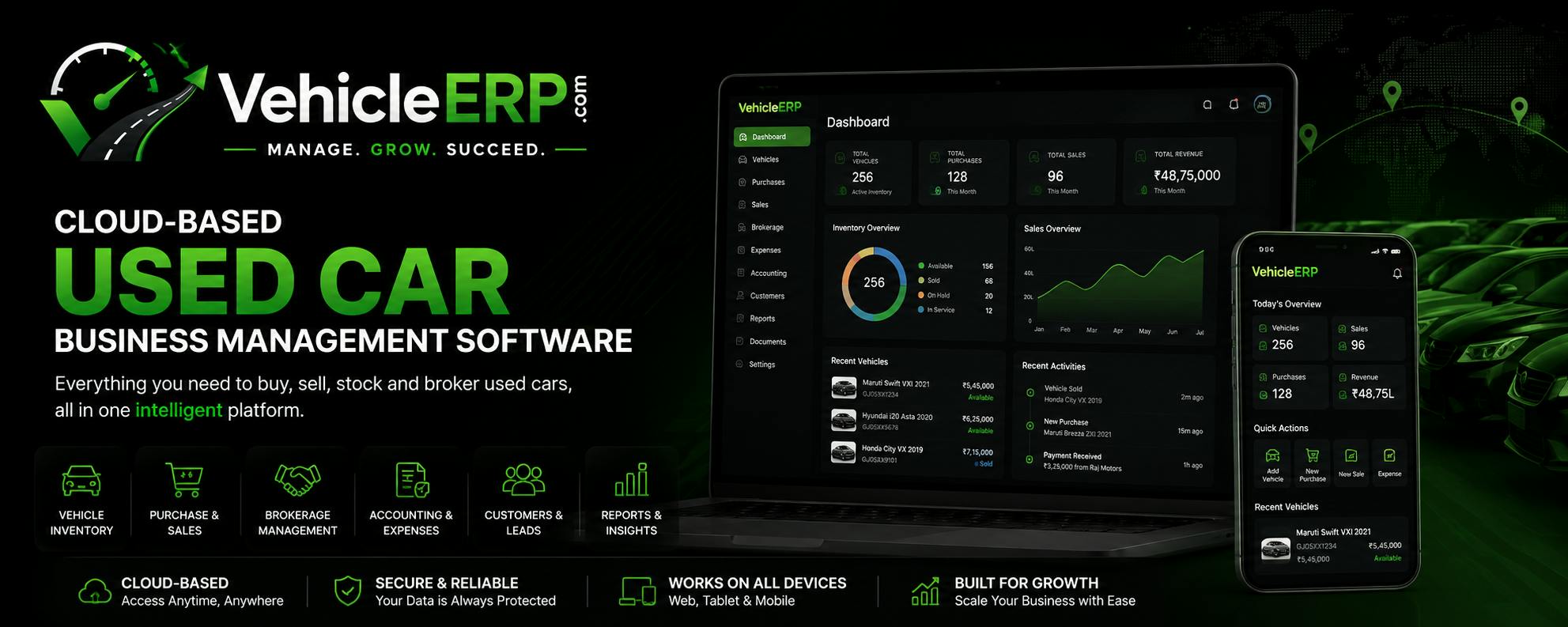
VehicleERP has a clear focus: serving dealers who buy, sell, and continuously manage vehicle inventory. It brings together the core functions of a used car business into one system — inventory tracking, purchase records, expense management, sales workflows, payments, GST tax invoicing, and organizational management across partners, staff, and branches — all rolling up into a unified profit calculation.
For small and mid-sized dealerships, these operations have traditionally been scattered across Excel spreadsheets, chat messages, and paper documents. Those information silos make it nearly impossible for owners to know, in real time, the true cost of each vehicle, the performance of each branch, or the overall profit-and-loss picture. VehicleERP is designed to solve exactly that: giving dispersed operational data a single place to live and connect.
AI That's Embedded in Real Workflows, Not Just a Gimmick
What makes this product stand out is that its AI capabilities are tied to specific business actions, rather than being a vague "smart assistant." According to the official description, AI features cover several practical scenarios:
Vehicle Pricing and Document Processing
AI assists with vehicle pricing — a uniquely critical function in the used car industry, where every vehicle differs in condition, mileage, and market dynamics. Price too high and it won't sell; price too low and you leave money on the table. The system also uses AI to scan and interpret documents, converting purchase contracts, invoices, and other paper or image-based records into structured data — reducing both manual data entry and the risk of errors.
Inventory and Risk Insights
AI can identify ageing stock that has been sitting too long, and flag errors in the data. Inventory turnover is the lifeblood of a used car operation — every day a vehicle sits on the lot represents ongoing capital tied up and depreciation accumulating. When the system proactively flags stagnant vehicles, it gives operators an early-warning radar.
Ageing is one of the most critical risk metrics in the used car industry. From the day a vehicle enters inventory, every additional day it sits carries compounding costs: tied-up capital, market price fluctuations, natural wear, insurance, and storage expenses. Industry convention typically uses 30/60/90-day thresholds as warning benchmarks — vehicles unsold past 60 days often require active price reductions or wholesale clearance, otherwise per-unit losses accelerate over time. Smaller dealerships, lacking systematic tracking tools, can easily lose sight of a "stuck" vehicle in the day-to-day grind, only to discover the capital is deeply locked in when it's too late. AI-driven ageing detection essentially transforms the latency of manual stocktaking into real-time alerts, helping operators make timely decisions while losses are still containable.
Forecasting and Conversational Data Queries
Beyond that, AI provides performance forecasting and supports natural language queries against the dealership's own business data. Operators can ask the system direct questions instead of manually digging through reports and pulling data themselves. This "conversational BI" approach is precisely the direction that enterprise software broadly is exploring right now.
Conversational Business Intelligence (Conversational BI) refers to users querying a data system in natural language, with the system automatically retrieving, aggregating, and returning results — bypassing the traditional BI workflow of building dashboards, writing SQL, or relying on a data analyst. The core value is lowering the barrier to data consumption: operators need zero technical skills to get instant answers to questions like "which branch had the highest gross margin last month?" or "what is the total cost on this vehicle so far?" In the used car context, because every vehicle's purchase price, refurbishment costs, days on lot, and final sale price are all recorded in the system, conversational queries return more accurate and trustworthy answers than a general-purpose LLM — because the answers come from real private business data, not generalized model inference.
The Case for Vertical Industry SaaS
VehicleERP represents a broader trend: general-purpose ERP or accounting software struggles to fit the workflows of specific industries, while vertical SaaS products — by deeply understanding a particular industry's business language (such as GST invoicing, vehicle ageing, and multi-branch management in the used car space) — can deliver out-of-the-box value.
Embedding AI into such a vertical system tends to produce more directly useful results than a general-purpose model, because it runs on real, structured business data. Pricing suggestions, ageing alerts, and performance forecasts are all grounded in actual records rather than generated from thin air. This is a pragmatic path for AI deployment in enterprise software today: not chasing general intelligence, but solving the recurring, high-frequency pain points of a specific industry.
GST (Goods and Services Tax) is the value-added tax system used in countries such as Australia, India, and New Zealand. In used car transactions, GST calculation and reporting rules are notably complex: when a dealer buys a vehicle from a private seller, there is typically no input tax credit available, whereas purchases from another registered business involve full input/output tax matching. Some markets also distinguish between "full GST vehicles" and those under the Margin Scheme, where tax applies only to the profit margin rather than the full sale price. Handling these nuances in a general-purpose accounting tool typically requires extensive manual configuration. Vertical dealership management software that bakes these industry-specific tax rules in as default workflows — enabling compliant invoicing right out of the box — holds a significant competitive advantage over generic tools.
An Early-Stage Product — Worth Watching
Based on Product Hunt data, VehicleERP has currently received 13 upvotes and 3 comments, ranking 12th — a clear sign it's in the early launch phase with limited market feedback so far. It's categorized under Cars, Artificial Intelligence, and Business, and was built by a team including Kruti Parekh.
For used car dealers considering whether to adopt a tool like this, the key questions come down to a few things: Can the AI pricing hold up under real transaction conditions? Is document scanning recognition reliable enough? And what are the costs of data migration and getting the team up to speed? The promise of an all-in-one platform is compelling, but real value can only be validated in the details of day-to-day operations. For small and mid-sized dealerships still drowning in spreadsheets and paper slips, this is at least a direction worth trying.
Related articles

@ai-sdk/vue 3.0.306 Patch Release Syncs with [email protected] Update
@ai-sdk/vue 3.0.306 released, synced with [email protected]. A routine patch release for the Vercel AI SDK ecosystem with no public API changes; the Vue adapter layer stays version-aligned with the core package.

Gemini 4 Argon API Launches: The Era of Million-Token Output Begins
Google launches Gemini 4 Argon with sparse MoE architecture, up to 1M output tokens, and a 68.90% Vals Index score, available across API, AI Studio, and the Gemini app.

DukaanAI: Turning Product Photos into Inventory Lists with Open-Source AI
DukaanAI is an AI inventory tool for small retailers that turns product photos into inventory entries using the open-source Gemma 3 model, with local inference, editable fields, and CSV export.