Vendo Open-Source Project: Let Users Build Their Own Features Inside Your Product Using Natural Language

Vendo lets SaaS users build custom features inside products using natural language, no coding required.
Vendo is an open-source customization layer that embeds directly into SaaS products, enabling end users to create custom features and micro-apps simply by describing what they need in natural language. Built on the product's own APIs and secured by configurable guardrails, it shifts customization from a product team burden to a controlled self-service capability, representing a new paradigm for personalized B2B software in the AI era.
An Open-Source Project That Rethinks the SaaS Paradigm
Software has long been "rigid": product managers decide what features to build, engineers schedule the development, and users can only passively adapt to the product's existing form. Every customer has unique needs, but the vast majority of those needs get shelved indefinitely because they're not high enough priority. This is a classic dilemma that virtually every SaaS product encounters.
Since the early 2000s, when companies like Salesforce pioneered the SaaS (Software as a Service) model, its core business logic has always been built on "one-to-many" standardized delivery — serving thousands of customers with a single codebase and sharing infrastructure costs through multi-tenant architecture. This model excels during the scaling phase, but as the customer base grows, the accumulation of long-tail demands becomes a universal pain point. According to industry research, over 70% of feature requests in a typical B2B SaaS product's backlog will never be implemented. This structural contradiction has given rise to various mitigation strategies — configuration options, low-code extensions, plugin marketplaces — but none have fundamentally solved the problem.
The open-source project Vendo, which recently landed on Product Hunt, aims to break this deadlock. Its tagline is refreshingly direct — "Let your users build their own features inside your product." After launch, it quickly garnered 131 upvotes and 16 comments, ranking #4 for the day and appearing in the Open Source, SaaS, and Developer Tools categories.
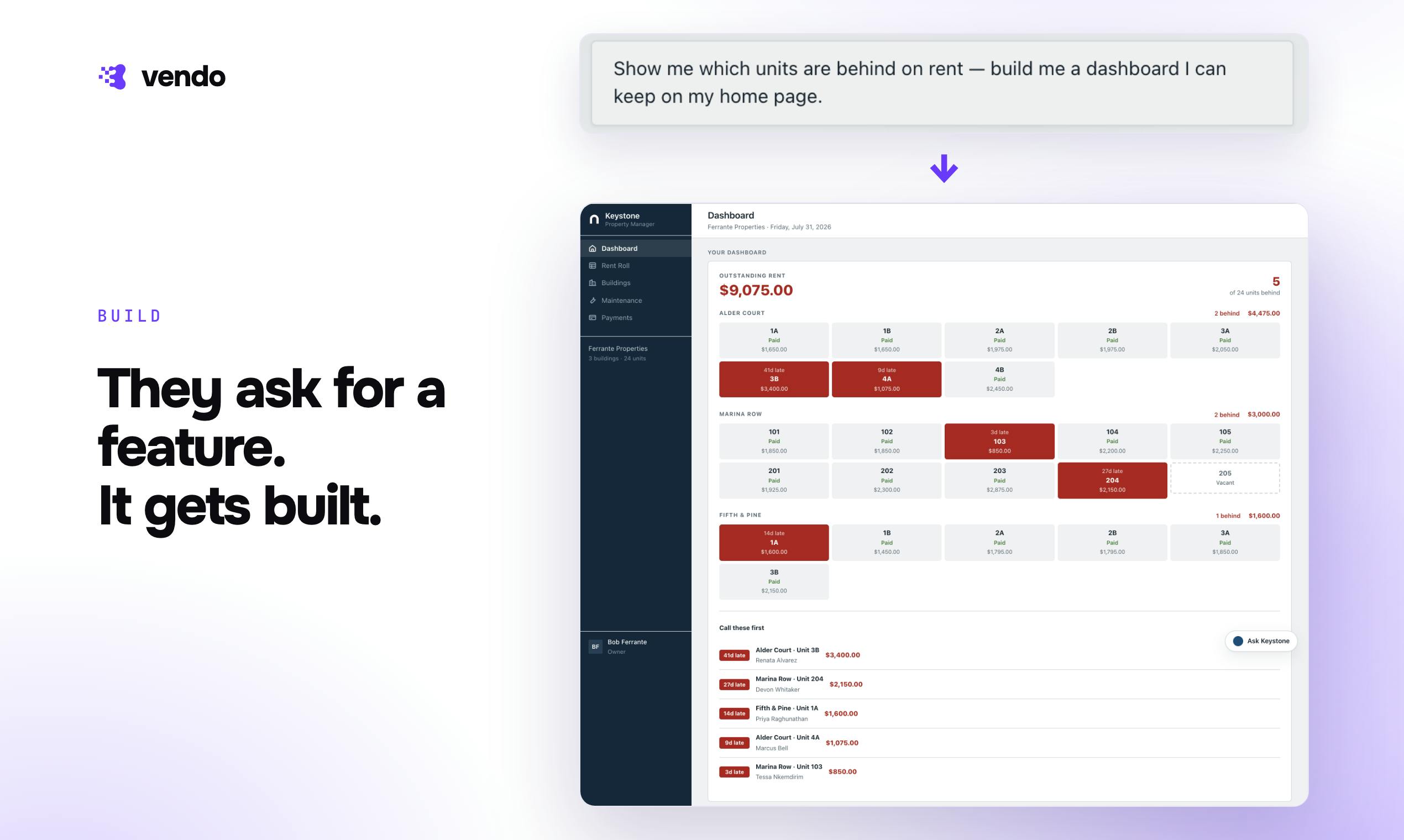
What Vendo Is: An Open-Source Customization Layer Embedded Inside Your Product
Vendo positions itself as an open-source customization layer embedded within your product. Its core philosophy can be summed up in one sentence: Make the product shape itself around each customer, rather than forcing customers to adapt to the product.
Generate Custom Features Just by Describing Them in Natural Language
According to the official description, end users don't need to write any code — they simply describe in natural language what feature or "micro-app" they want, and Vendo builds it right inside the product. This essentially takes the hot "natural language to application" capability and pushes it down from developer tools into the hands of end users.
This capability is rooted in the code generation and reasoning abilities of large language models (LLMs). Since ChatGPT's release in late 2022, models like GPT-4, Claude, and Gemini have achieved remarkably high accuracy on code generation tasks. GitHub Copilot's data shows that AI-assisted coding acceptance rates have exceeded 30%. What Vendo does is take this a step further: it wraps code generation capabilities into a natural language interface for non-technical users, who don't need to understand the underlying programming language or API call details — they just need to describe their business intent. Behind the scenes, this typically involves techniques such as prompt engineering, function calling, and context injection based on the product's API schema.
In the past, when users wanted a custom report, a specific workflow automation, or a small tool tailored to their business, they had to submit a feature request and wait through a lengthy backlog. Vendo's approach is to hand that capability directly to the users themselves.
Built on the Product's Own API, Secured by Guardrails
A noteworthy detail is that features generated by Vendo are built on top of the product's own API and run within guardrails pre-configured by the product team.
In the context of AI-generated content and features, "guardrails" refer to a set of safety mechanisms that constrain the boundaries of AI output behavior. In Vendo's specific scenario, guardrails may span multiple layers: API-level permission controls (OAuth scope restrictions, rate limiting), data-level access controls (row-level security policies, field-level masking), and code execution-level sandboxing. A mature guardrail system typically also includes output validation, audit logging, and rollback mechanisms. This concept is gaining increasing attention in the AI safety field, with open-source projects like Nvidia's NeMo Guardrails and Guardrails AI working to standardize such safety frameworks.
This means:
- User-built features still operate on officially exposed data and interfaces, staying within the product's capability boundaries;
- The product team can set permissions, data access scopes, and security rules to prevent users from going "out of bounds";
- Customization is no longer a burden on the product team — it becomes a controlled, scalable self-service capability.
Why Vendo Deserves Attention
From One-Size-Fits-All SaaS to Personalized Product Experiences
The traditional SaaS business logic is to serve as many customers as possible with a single standardized product, spreading costs through scale. But the price of standardization is the inability to meet long-tail needs. Vendo's approach is to layer a "dynamic customization layer" on top of the standard product, allowing each customer to see a different version of the product — which could, in theory, significantly boost product stickiness and satisfaction.
AI Turns User-Built Features from a Slogan into Reality
"Let users customize" is not a new concept. From early low-code platforms and visual editors to various plugin marketplaces, the industry has been trying for years. But these solutions either had too high a barrier (still requiring knowledge of logic and configuration) or lacked sufficient flexibility.
The exploration of user customization capabilities has a long history. As early as the 2000s, Salesforce's Force.com platform allowed enterprise admins to create custom objects and workflows through point-and-click configuration. In the 2010s, tools like Airtable, Zapier, and Notion further lowered the barrier, but still required users to understand abstract concepts like data models and trigger conditions. More recently, internal tool-building platforms like Retool and Appsmith have significantly simplified the development process, but their target users are still primarily people with some technical background. Vendo's differentiation lies in completely bypassing the intermediate steps of visual editing and drag-and-drop configuration, using natural language as the sole interaction interface — bringing the barrier to customization down to an unprecedented low.
The emergence of large language models made it engineering-feasible for the first time to "describe requirements in natural language and have machines automatically generate features." Vendo is riding precisely on this technological inflection point.
Open-Source Strategy Brings Trust and Extensibility
Vendo's decision to go open source is particularly crucial for developer tool products. Open source means enterprises can audit the code themselves, deploy it on their own infrastructure, and deeply customize it for their business needs. For a "customization layer" that touches user data and API permissions, the transparency that open source provides is a vital asset for earning developer trust.
In the developer tools and infrastructure space, open source has become a proven business strategy, known as the "open-core" model. Projects like PostHog, Supabase, and Cal.com have all used open-core versions to gain developer trust and community contributions, then monetized through hosted services or enterprise features. For products like Vendo that involve API permissions and user data, open source is especially important: enterprise customers need to audit the code to confirm there are no data leakage risks, security teams need to verify the quality of sandbox isolation implementations, and compliance departments need to confirm that data processing meets regulations like GDPR. Closed-source solutions face inherent trust barriers in these scenarios.
Potential Challenges Facing Vendo
Despite the highly appealing concept, products like Vendo still face several practical challenges:
- Security and Permission Governance: When end users generate features inside a product, how do you ensure the generated code or logic doesn't introduce security vulnerabilities, data leaks, or performance issues? The granularity of the guardrail mechanisms will directly determine the product's viability.
- Consistency of Generation Quality: The conversion from natural language to functional features depends on the underlying model's capabilities, and accuracy and maintainability for complex requirements remain industry-wide challenges. Although LLM code generation capabilities have improved significantly, they still face multiple challenges in production environments. A 2023 Stanford University study found that AI-generated code has a significantly higher probability of containing security vulnerabilities compared to human-written code, and developers using AI assistance tend to be overconfident about the security of generated code. Additionally, the robustness of AI-generated features when handling edge cases, the explainability and debuggability of generated logic, and code consistency after multiple iterative modifications are all engineering problems that haven't been fully solved. For Vendo, this means the guardrail mechanisms need to not only constrain "what can be done" but also perform automated quality testing and security scanning on generated artifacts.
- Integration Cost for Product Teams: For Vendo to truly deliver value, the host product needs well-designed, thoroughly documented APIs. Products with poor API quality may struggle to benefit from it.
Conclusion: A New Paradigm for SaaS Customization
Vendo represents a new paradigm for SaaS products in the AI era: software is no longer a finished product with a fixed form, but a platform that can continuously "grow" based on each user's needs. It shifts the initiative for customization from the product team back to the users themselves, while maintaining control through APIs and guardrail mechanisms.
Regardless of how far Vendo ultimately goes, this philosophy of "letting the product shape itself around each customer" is likely a direction that many B2B products will need to seriously consider going forward. For SaaS teams overwhelmed by an endless stream of customization requests, it at least provides an open-source example worth studying.
Key Takeaways
Related articles

Chain of Thought Isn't Just for AI: How Humans Can Use CoT to Improve Thinking Quality
Chain of Thought isn't just a prompt trick for large models. Starting from a Hacker News discussion, this article analyzes why CoT works for human thinking too, breaks down actionable ways to transfer it, and highlights the key differences between human CoT and machine CoT.
Cloudflare Teams Up with OpenAI: Closi…
Cloudflare Teams Up with OpenAI: Closing the Loop from Vulnerability Discovery to Defense with AI
Cloudflare uses OpenAI Daybreak to investigate security vulnerabilities and generate reviewable remediation plans, while developers use Codex to boost coding efficiency and quality.

Orca Multi-Agent Orchestration in Practice: A Guide to Parallel Collaboration with Claude and Codex
Orca is Stable AI's free open-source agent workbench supporting 34 agents like Claude Code and Codex in parallel. Learn its Git worktree isolation, multi-model orchestration, and mobile management.