Vera Rubin NVL72 Benchmark Leaked: MLPerf Performance Reaches Twice That of Blackwell Ultra

NVIDIA says Vera Rubin NVL72 achieves up to 2x Blackwell Ultra in MLPerf training, but it's a peak claim.
NVIDIA's developer blog published Vera Rubin NVL72's MLPerf Training v6.1 results, claiming up to 2x the performance of Blackwell Ultra. The article notes this data arrives as AI agent workflows grow more complex and training time becomes the model iteration bottleneck, with NVIDIA directly linking training time compression to agent iteration frequency. But "up to" means the 2x is a peak for specific benchmark tasks; the original text does not disclose breakdown results, power consumption, or cost comparison conditions, and it should be viewed as a vendor claim rather than a procurement conclusion. Vera Rubin NVL72 continues the rack-level system form factor, reflecting that training performance increasingly depends on the overall synergy of chips, interconnect, and system software. The implication for infrastructure selection is that platform replacement cycles are accelerating, requiring attention to matching procurement cycles with model iteration cycles.
Title
Vera Rubin NVL72 Benchmark Leaked: MLPerf Performance Reaches Twice That of Blackwell Ultra
Meta Description
NVIDIA has published Vera Rubin NVL72's results in MLPerf Training v6.1, claiming up to 2x the performance of Blackwell Ultra. This article interprets what this data means in the context of agent training iteration, the evolution direction of the NVL72 form factor, and how benchmark data should be rationally viewed in infrastructure selection.
Article Content
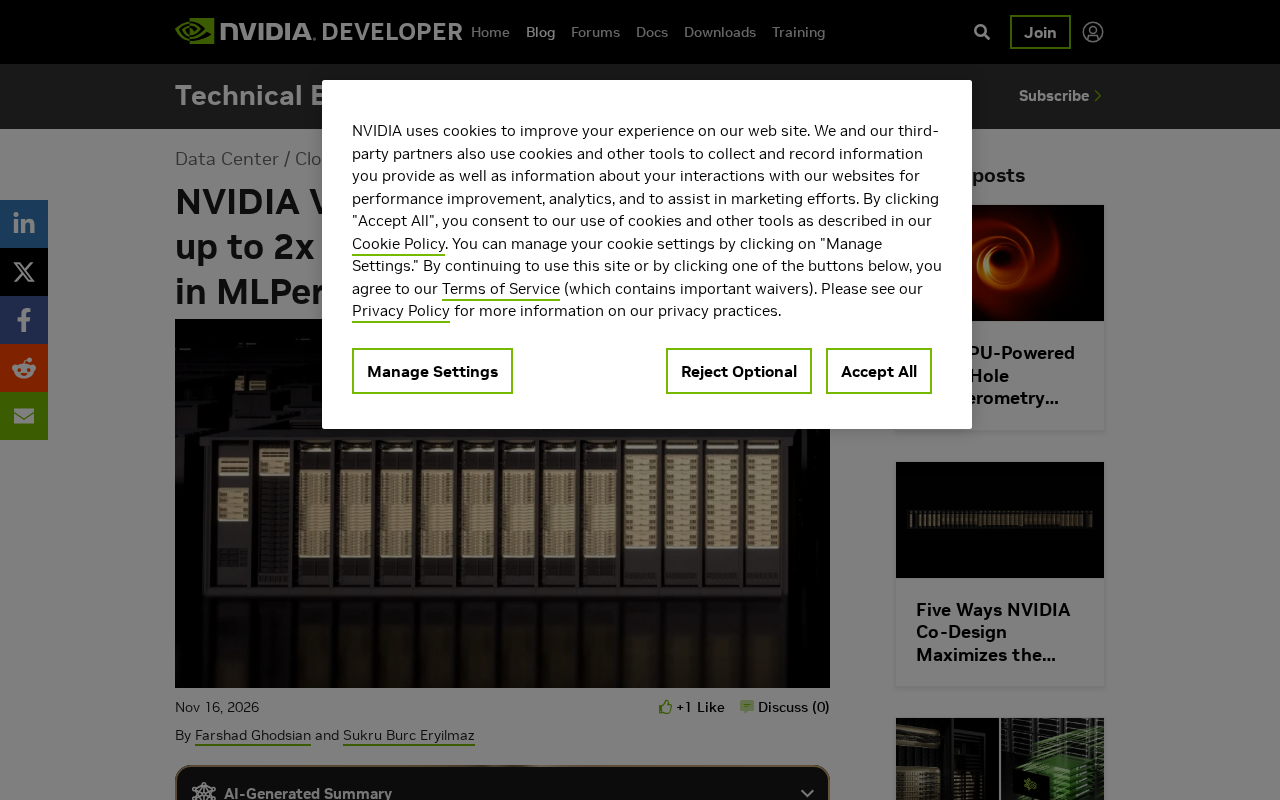
NVIDIA's developer blog has just published the benchmark results for Vera Rubin NVL72 in MLPerf Training v6.1, claiming performance up to 2x that of the Blackwell Ultra platform. This figure arrives against the backdrop of AI agents handling increasingly complex workflows and training time becoming the bottleneck for model iteration, pointing to a clear signal: the generational leap in training platforms is becoming the infrastructure race of the agent era.
Why Training Time Has Become the Core Metric of the Agent Era
The logic NVIDIA lays out at the start of the blog is straightforward: as AI agents take on increasingly complex workflows, shortening training time is critical both for rapidly iterating the models themselves and for the model-driven agents. MLPerf, as the industry-recognized training benchmark, its results to some extent represent the upper limit of iteration speed a platform can achieve under real workloads.
The subtext of this statement is that the past evaluation approach—centered on the single-run duration of large model pre-training—is giving way to "iteration frequency"—debugging and optimization of agent applications depend on continuous model updates, and the shorter the training cycle, the more versions the product side can try. Doubling performance in this context is not just about impressive benchmark scores, but directly translates into usable iteration rounds.
MLPerf Training is an industry-standard benchmark suite maintained by the non-profit organization MLCommons, designed to provide reproducible, cross-verifiable performance comparisons for machine learning training systems. The benchmark covers multiple task categories including image classification, object detection, language models, and recommendation systems, and imposes strict rules on permitted optimization methods (such as data preprocessing and precision formats); submitted results must undergo peer review. As a result, MLPerf scores are often used as the "hard currency" for cross-platform comparisons, but their scores reflect throughput or convergence time for specific tasks under controlled conditions, with a gap from real business workloads. Understanding this is essential to rationally interpret the multiples vendors announce.
From Blackwell Ultra to Vera Rubin: The 2x Performance Leap
According to information published on NVIDIA's developer blog, Vera Rubin NVL72 achieved up to 2x performance improvement over Blackwell Ultra in the MLPerf Training v6.1 test. It should be noted that NVIDIA uses the "up to" phrasing, meaning this is the peak performance under specific benchmark tasks, and the improvement magnitude will vary across different models and workloads.
The original text does not disclose the breakdown results for each benchmark item one by one, nor does it provide comparison conditions such as power consumption, cost, or cluster scale. Therefore, this "2x" is better understood as an upper limit rather than an average performance across all scenarios. For teams planning capacity, waiting for the complete MLPerf public results table would be more prudent than directly extrapolating linearly at 2x.
In the context of MLPerf, "up to" typically refers to the relative improvement corresponding to the best-performing item among the multiple benchmark tasks submitted. Since different tasks have varying sensitivities to compute, memory bandwidth, and interconnect, the speedup ratios across items often form a distribution rather than a single value. Vendors selecting the peak value for communication is a common practice. In addition, MLPerf results tables distinguish categories such as "availability" (e.g., whether reproducible on the cloud) and "closed" (whether additional data is allowed), and these details affect the comparability of the numbers. Therefore, when seeing "2x," one should ask: which benchmark task is this, at what cluster scale and precision mode was it achieved, and does it belong to the same submission category.
The NVL72 Form Factor and the Evolution Direction of Training Platforms
Vera Rubin NVL72 continues the NVL72 rack-level system naming, indicating that NVIDIA still uses the full-rack scale as the delivery unit for training systems on its new-generation platform. The significance of this form factor is that improvements in training performance increasingly depend on the overall synergy of chips, interconnect, memory, and system software, while the marginal reference value of single-card metrics is declining.
Combined with NVIDIA's narrative that directly links MLPerf results to agent workflow iteration, it is clear that its product positioning is shifting from "faster GPUs" to "shorter training loops." For users, evaluating a new platform requires attention not only to peak throughput but also to whether such benchmark advantages can be realized under their own model architectures.
NVL72 refers to a rack-level reference architecture in NVIDIA's GB200/Vera Rubin generation: connecting 72 GPUs and 36 Grace CPUs through an NVLink domain into a single high-bandwidth compute unit. Its design goal is to push the interconnect topology down from "inter-node networking" to "intra-rack switching," thereby greatly reducing the communication latency of tensor parallelism and expert parallelism in large model training. For training systems, this means performance evaluation can no longer look only at single-card FLOPS, but must consider the effective bandwidth of the entire NVLink domain, memory pooling capabilities, and the maturity of orchestration software. This is also the context for NVIDIA using full racks as delivery units and emphasizing system-level synergy.
How to Read Benchmark Data
The results of MLPerf Training v6.1 need to be interpreted within the context of the benchmark system. MLPerf is maintained by the MLCommons organization, and results submitted by vendors must comply with rules and undergo review, which makes it a relatively credible reference for cross-platform comparisons. However, there is always a gap between benchmark tasks and real business workloads, especially when workflows involve multi-turn agent calls and complex data pipelines, where end-to-end time is also affected by factors such as storage and scheduling.
NVIDIA's choice to disclose the data first on its developer blog rather than in the complete results table also reminds readers: before the official full leaderboard is released, the 2x figure should be regarded as a vendor-side performance claim rather than a final conclusion that can be directly used for procurement decisions.
Implications for Training Infrastructure Selection
For teams building or expanding training clusters, the practical value of this news lies in the reminder: the pace of training platform replacement is accelerating, and matching procurement cycles with model iteration cycles is becoming more important. If training time can indeed be compressed by an order of magnitude with each platform generation, then the cost saved by delaying procurement may be offset by the lengthened iteration cycle.
On the other hand, NVIDIA's use of agent workflows as the main thread of its performance narrative also means that subsequent benchmarks may lean more toward multi-stage, long-chain task forms. Paying attention to changes in the task composition of future MLPerf versions will better reflect the industry's true optimization direction than remembering a single score.
One-line Summary
NVIDIA claims Vera Rubin NVL72 achieves up to twice Blackwell Ultra in MLPerf training, but this is a peak claim.
Paragraph Summary
NVIDIA's developer blog published the benchmark results for Vera Rubin NVL72 in MLPerf Training v6.1, claiming performance up to 2x that of the Blackwell Ultra platform. The article notes that this data arrives against the backdrop of increasingly complex AI agent workflows and training time becoming the bottleneck for model iteration, with NVIDIA directly linking training time compression to agent iteration frequency. However, the "up to" phrasing means the 2x is a peak for specific benchmark tasks; the original text does not disclose breakdown results, power consumption, or cost comparison conditions, and it should be regarded as a vendor claim rather than a procurement conclusion. Vera Rubin NVL72 continues the rack-level system form factor, reflecting that training performance increasingly depends on the overall synergy of chips, interconnect, and system software. The implication for infrastructure selection is that platform replacement cycles are accelerating, and matching procurement cycles with model iteration cycles needs attention.
Related articles

Prompt Engineering for Beginners: From Writing Prompts to Engineering Thinking
Starting from the essence and four functions of prompts, this article systematically explains the six-step process, four success criteria, learning value, and practical limitations of prompt engineering to help you build a complete understanding.

Anthropic Launches Nasdaq IPO: AI Giant's Listing and Risk Disclosures
Anthropic officially launches its Nasdaq IPO under ticker ANT, with market valuation expected to potentially exceed SpaceX's record. The prospectus devotes nearly 100 pages to AI risks, while first-half revenue grew over 14x but net losses widened sharply, reigniting the AI bubble debate.

Rust cURL Clone Uses 4,832 unsafe Blocks—Is the Memory Safety Myth Broken?
A Rust cURL clone uses 4,832 unsafe keywords, challenging Rust's memory safety narrative. We analyze what unsafe really means, compare Fil-C, and examine rewrite motives.