Vercel AI Gateway 40% Limited-Time Discount: Testing Grok 4.7 Integration

Vercel is using a time-limited 40% discount on Grok 4.7 via AI Gateway to win developer ecosystem loyalty.
Vercel has announced a 40% discount on Grok 4.7 model calls through its AI Gateway service, valid through September 27. AI Gateway acts as a unified multi-model proxy layer, eliminating the need to integrate separate vendor SDKs, and works alongside Vercel tools like v0. This promotion reflects broader market dynamics: as inference costs keep falling, platforms increasingly rely on price incentives to build developer stickiness. The article advises developers to evaluate the offer rationally — run small-scale tests during the discount window to validate Grok 4.7's real-world fit before committing to production.
Vercel Partners with Grok 4.7 for a Limited-Time Promotion
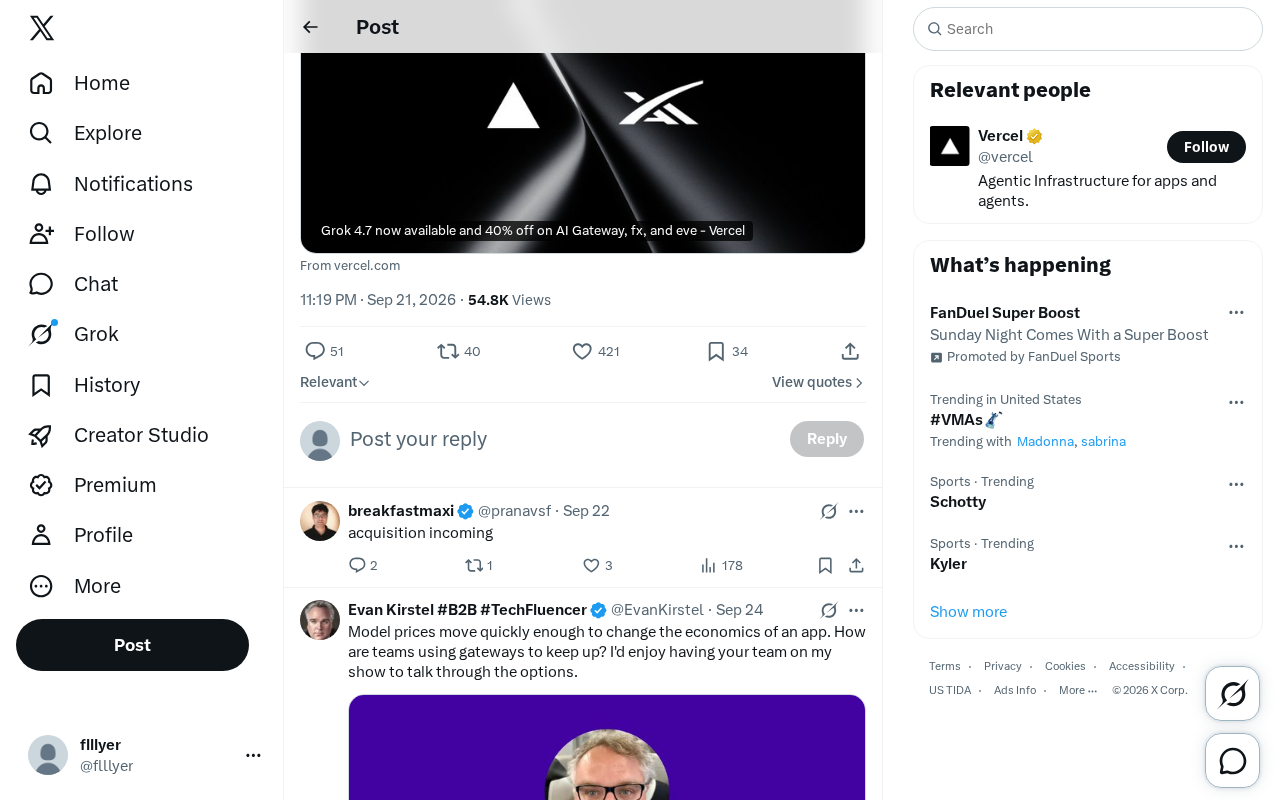
Vercel recently launched a limited-time offer for developers through its AI Gateway service: a 40% discount on API calls to the Grok 4.7 model, valid through September 27. The goal is straightforward — lower the cost of model inference for developers building AI applications, while promoting Vercel's AI Gateway as a unified model access layer.
For teams evaluating different large language models, price incentives like this are often the nudge needed to try something new. With Grok 4.7 — xAI's latest model release — routed through Vercel's gateway, developers can skip the infrastructure overhead of managing API keys, rate limits, and billing for each individual provider.
What Is AI Gateway and Why Does It Matter
Vercel AI Gateway is essentially a model routing and proxy layer. It lets developers call models from multiple providers through a single unified interface, without having to integrate separate SDKs or manage credentials for each vendor. This "one gateway, many models" architecture is increasingly practical as multi-model usage becomes the norm.
Based on the original announcement, the promotion specifically highlights three tools or use cases: @v0, @eve, and fx. Of these, v0 is Vercel's AI-powered UI generation tool that converts natural language descriptions directly into frontend code and UI components. Routing Grok 4.7 through toolchains like this allows developers to experience model-driven development workflows at a lower cost.
AI Gateway is technically similar to a reverse proxy, but purpose-built for LLM call patterns. Beyond routing, mature AI Gateway solutions typically offer request caching, automatic retries, rate limiting, token usage tracking, and multi-model fallback — automatically switching to a backup model when the primary is unavailable. As multi-model strategies become more common, development teams often route different task types to different models: lightweight models for cost-sensitive simple tasks, flagship models for high-complexity work. The gateway layer centralizes this dispatch logic, so developers don't need to hardcode each vendor's differing API specs into their business logic. Vercel AI Gateway competes with AWS Bedrock, Azure API Management, and open-source alternatives like LiteLLM — a market that's still in early-stage standardization.
The Industry Logic Behind the Promotion
Model pricing wars are no accident. As the number of LLM providers grows and inference costs continue to fall, every platform is using price as leverage to win developer mindshare. For Vercel — primarily a frontend deployment and development platform — AI Gateway is a key hook for keeping developers within its ecosystem. Once teams get used to calling models through the gateway, switching costs naturally increase.
A 40% discount is meaningful, but the hard cutoff date of September 27 is a classic limited-time promotion tactic designed to create urgency and accelerate trial decisions. For teams already deploying on Vercel, testing Grok 4.7's fit with their existing workflow during the discount window is a low-risk move.
The rapid decline in LLM inference costs is driven by several converging forces: expanding capacity for inference-optimized chips (like NVIDIA H100/H200), the widespread adoption of quantization and distillation techniques, and massive cloud provider investment in inference infrastructure. Using GPT-4 as a benchmark, per-million-token pricing has fallen more than 90% over two years. This "inference price deflation" has shifted platform competition from "can you access the model" to "whose ecosystem is more complete." Pure price wars aren't sustainable, but using price incentives at a critical window to lock in developer habits is a growth strategy nearly every platform is pursuing right now. Vercel also benefits from collecting developer model-call behavior data through the gateway, helping inform its future product roadmap.
How Developers Should Approach This Kind of Offer
When faced with limited-time promotions like this, the rational approach is to start from your actual needs rather than being driven purely by the discount. Key dimensions worth evaluating include: whether Grok 4.7 meets your performance requirements for specific tasks, whether routing through the gateway introduces meaningful latency, and whether standard pricing after the promotion ends remains competitive.
Since the original source is primarily a promotional announcement, specific performance benchmarks for Grok 4.7 — such as context window length and actual gateway latency figures — have not been disclosed. Developers who are interested should run small-scale validation tests during the discount window before deciding whether to bring it into production. Overall, this is a fairly standard developer ecosystem promotion, and its real value depends entirely on the model's actual capabilities and your team's specific use case.
Related articles

How Big Can Stars Really Get? The Physical Limits of the Largest Stars
Red supergiants are the largest stars by volume, with radii up to 2,000 times the Sun, engulfing the inner solar system. But there is no precise upper limit on stellar size—models predict up to 15,000 solar radii. The most massive blue stars are far smaller than red supergiants—biggest and heaviest are two different things.

Apple HomeView Smart Display Full Feature Breakdown: Wall-Mount or Desktop, $299
Apple launches HomeView, a $299 smart display with wall-mount and desktop options, 12MP camera for facial recognition, smart home control, music playback, and recipe step-by-step cooking. Full breakdown of watch faces, apps, privacy, and cooking integration.

Where Did the Promised New Studio Go? Craft Computing Answers After Five Years
Craft Computing's host responds to viewer questions: the new studio promised five years ago was shelved as construction costs soared from $30,000 to $75,000, and was replaced by a 168-square-foot garage conversion.