Vercel AI SDK 2.0.84 Patch Release: What the Dependency Bumps Mean

Vercel AI SDK ships patch 2.0.84 with only dependency bumps — not a required upgrade.
This article breaks down the @ai-sdk/[email protected] patch release. Published automatically by github-actions with GPG-verified commits, its only core change is bumping @ai-sdk/provider-utils to 4.0.58 and @ai-sdk/openai-compatible to 2.0.82, with no new features or breaking changes. It explains the roles of these two dependencies in the AI SDK architecture — the former being a cross-provider utility library, the latter an adapter for unified access to OpenAI-compatible services. The author notes that automated releases reflect a highly pipeline-driven maintenance model, though dense patch numbers blunt version perception. The verdict: this version is not a required upgrade, and projects pinned to older, stable versions can safely skip it.
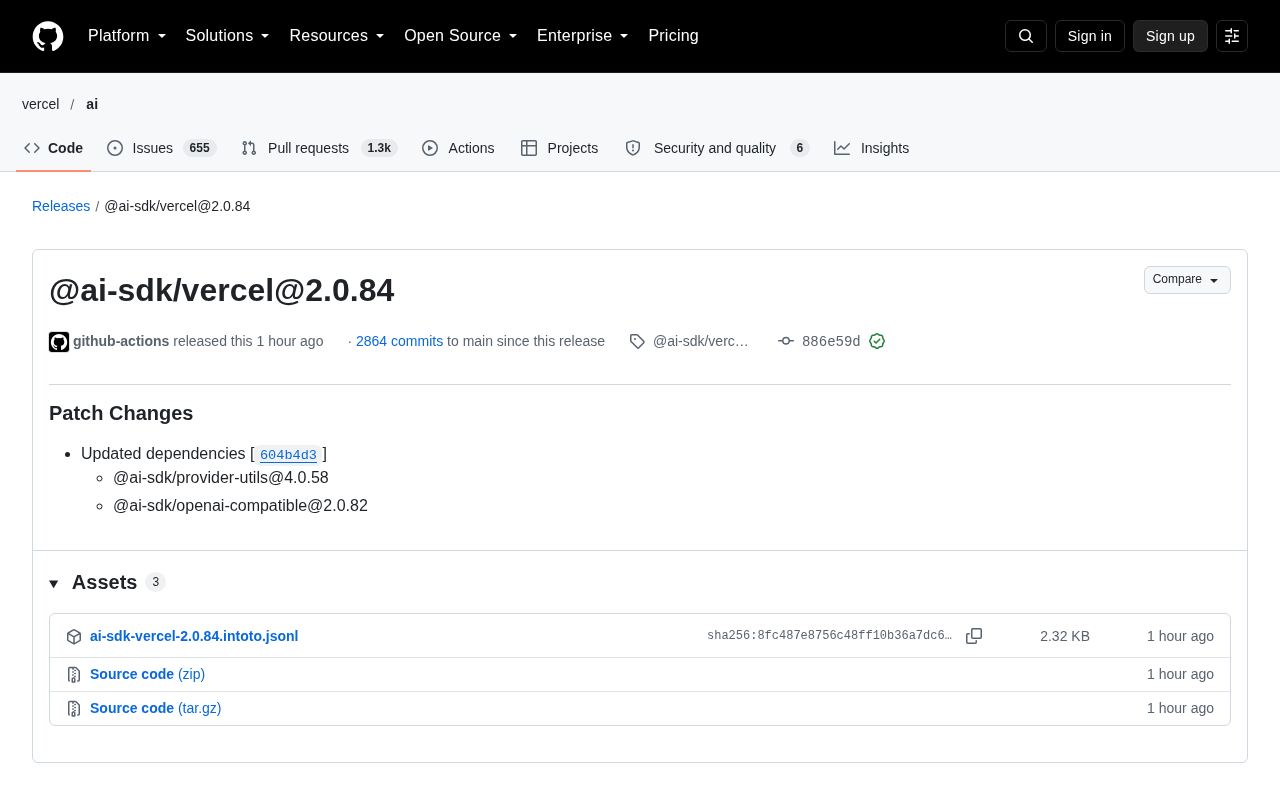
Vercel's AI SDK ecosystem has rolled out another minor iteration. @ai-sdk/[email protected] was published automatically via GitHub Actions, with commit 886e59d verified through GPG signing and over two thousand commits accumulated since the previous version. For developers building AI applications with this SDK, the update is labeled Patch Changes, but the dependency chain shifts behind it are worth a closer look.
What Actually Changed in This Update
According to the release notes, the core change in @ai-sdk/[email protected] is just one thing: updating dependencies. Specifically, two packages are involved — @ai-sdk/provider-utils bumped to 4.0.58 and @ai-sdk/openai-compatible bumped to 2.0.82.
This kind of patch that "only touches dependencies without changing business logic" is extremely common in the npm ecosystem. It usually means an upstream package fixed some low-level issues, and the downstream package is syncing along. The release was completed automatically by the github-actions bot at 16:11 on 13 Oct, fully unattended from commit to publish.
Interestingly, this automated release cadence shows that Vercel's maintenance of the AI SDK has entered a highly pipeline-driven stage. The accumulation of 2,864 commits to the main branch also reflects how active this project is — it's not the kind of package that gets published and then forgotten.
The Roles of provider-utils and openai-compatible
To understand the significance of this update, you need to first grasp where these two dependency packages fit.
@ai-sdk/provider-utils is the underlying utility library of the AI SDK, handling common logic across various AI service providers — things like request formatting, response parsing, and error handling. Its bump to version 4.0.58 means this infrastructure layer has been polished once again. For callers, API changes usually aren't noticeable, but the stability of underlying behavior and handling of edge cases may improve.
@ai-sdk/openai-compatible, on the other hand, is an adaptation layer that lets developers call services "compatible with the OpenAI API format" through a unified interface. The very existence of this package is interesting: it acknowledges a fact — OpenAI's API design has effectively become the industry standard, with a large number of third-party inference services mimicking its interface. This adapter's bump to 2.0.82 is likewise a maintenance update.
For developers, the practical action here is just running npm update or reinstalling dependencies. If your project pins an older version and isn't experiencing problems, skipping the upgrade won't cost you anything; but if you're troubleshooting some strange behavior, following the latest patch is a reasonable choice.
What Is the AI SDK's Provider Abstraction
Vercel's AI SDK uses a "core + adapter" architecture: the core layer defines a unified interface spec, and various model services plug in through provider adapters. @ai-sdk/provider-utils is the shared foundation of this architecture — it isn't bound to any specific service provider, but provides the low-level capabilities shared by all providers.
The key value of this design lies in decoupling. When the APIs of OpenAI, Anthropic, Google and others each evolve, only the corresponding adapter package needs to change, while the core utility library and upper-layer application code remain stable. Therefore, a minor version bump in provider-utils often represents a batch of cross-provider common logic (such as chunked parsing of streaming responses, retry strategies, schema validation) being uniformly fixed, benefiting the entire ecosystem rather than a single service.
Why the OpenAI-Compatible Interface Became a De Facto Standard
The existence of @ai-sdk/openai-compatible reflects a structural phenomenon in the large-model inference services market: the /v1/chat/completions request and response format has been replicated by many vendors as their default interface, including locally deployed inference frameworks (such as vLLM and Ollama) and various cloud services.
For developers, this means the same calling code can be migrated between different service providers, simply by swapping the baseURL and API Key. The maintenance cost of such adapters mainly centers on field compatibility — different implementations vary in their support for extension fields like tool_calls, stream_options, and response_format. So this kind of patch update in version 2.0.82 is usually about filling in these parsing discrepancies for edge fields, bringing the word "compatible" closer to its literal meaning.
Engineering Practices Around Automated Releases
The most intriguing detail about this release is that it's entirely driven by github-actions. The commit message carries a GPG signature verification marker, indicating the release process has basic security safeguards — at least confirming the package genuinely comes from Vercel's official repository and hasn't been tampered with by a man-in-the-middle.
This "commit equals release" model is becoming increasingly mainstream in open source projects. The benefits are obvious: less manual work, lower error rates, faster iteration. But the trade-off is that version numbers can become very dense, and numbers like 2.0.84 no longer give users an intuitive sense of "what's special about this version."
Judging from the scale of 2,864 commits to the main branch, Vercel's AI SDK team is clearly pushing forward rapidly on feature development and bug fixes. The frequent jumps in patch version numbers reflect a toolchain that is still evolving at high speed.
The Relationship Between Semantic Versioning and Automated Releases
The 2.0.84 mentioned in the article belongs to the patch position in Semantic Versioning (SemVer). SemVer specifies that the MAJOR.MINOR.PATCH segments correspond respectively to breaking changes, backward-compatible new features, and backward-compatible bug fixes. When the release process is fully automated, version number assignment is typically derived automatically from commit messages (such as the fix, feat, and BREAKING CHANGE prefixes in the Conventional Commits spec).
This also explains why patch numbers climb quickly: every dependency sync and every internal fix triggers a patch increment, even without any perceivable change for external users. For dependency management, this means range declarations like ^2.0.0 will keep pulling in new patches, and developers need to understand that "frequent updates" aren't the same as "frequent risk."
Who Should Upgrade to This Version
Frankly, @ai-sdk/[email protected] is not a "must-upgrade" version. It introduces no new features, fixes no major vulnerabilities, and contains no breaking changes.
You might consider following along if: you're using @ai-sdk/openai-compatible to call third-party model services and the upstream dependency fix affects your scenario; you prefer keeping dependencies up to date for continuous security and stability improvements; or your CI/CD pipeline already includes automated dependency updates.
If you've pinned a version that's running stably, skipping this version is completely fine. Patch versions in the npm ecosystem are meant for "those willing to follow along," not a requirement for everyone to sync.
For developers tracking the direction of Vercel's AI SDK, what's more worth waiting for is an update with a minor or major version bump — that's when new APIs, new capabilities, or architectural adjustments are coming.
Related articles

How Big Can Stars Really Get? The Physical Limits of the Largest Stars
Red supergiants are the largest stars by volume, with radii up to 2,000 times the Sun, engulfing the inner solar system. But there is no precise upper limit on stellar size—models predict up to 15,000 solar radii. The most massive blue stars are far smaller than red supergiants—biggest and heaviest are two different things.

Apple HomeView Smart Display Full Feature Breakdown: Wall-Mount or Desktop, $299
Apple launches HomeView, a $299 smart display with wall-mount and desktop options, 12MP camera for facial recognition, smart home control, music playback, and recipe step-by-step cooking. Full breakdown of watch faces, apps, privacy, and cooking integration.

Where Did the Promised New Studio Go? Craft Computing Answers After Five Years
Craft Computing's host responds to viewer questions: the new studio promised five years ago was shelved as construction costs soared from $30,000 to $75,000, and was replaced by a 168-square-foot garage conversion.