Vercel AI SDK Minor Update: @ai-sdk/valibot Releases 2.0.59

@ai-sdk/valibot releases patch 2.0.59, only synchronizing the underlying provider-utils dependency.
@ai-sdk/valibot in Vercel's AI SDK ecosystem released patch version 2.0.59. It introduces no new APIs or feature changes; the only change is upgrading the underlying dependency @ai-sdk/provider-utils to 4.0.58. @ai-sdk/valibot lets developers define structured output formats for AI models with the lightweight validation library Valibot, which is better for edge and frontend scenarios than Zod. provider-utils is the shared low-level utility set for provider adapters, and its changes may indirectly affect validation consistency. For most users, this upgrade is essentially seamless; just check that any manually pinned provider-utils version matches 4.0.58. The release was automated by GitHub Actions and passed signature verification.
In Vercel's AI SDK ecosystem, data validation has always been an easily overlooked yet crucial aspect. Recently, @ai-sdk/valibot released patch version 2.0.59. Although the version number change is minor, it is still worth attention for developers who rely on this package for structured output validation.
What Changed in This Update?
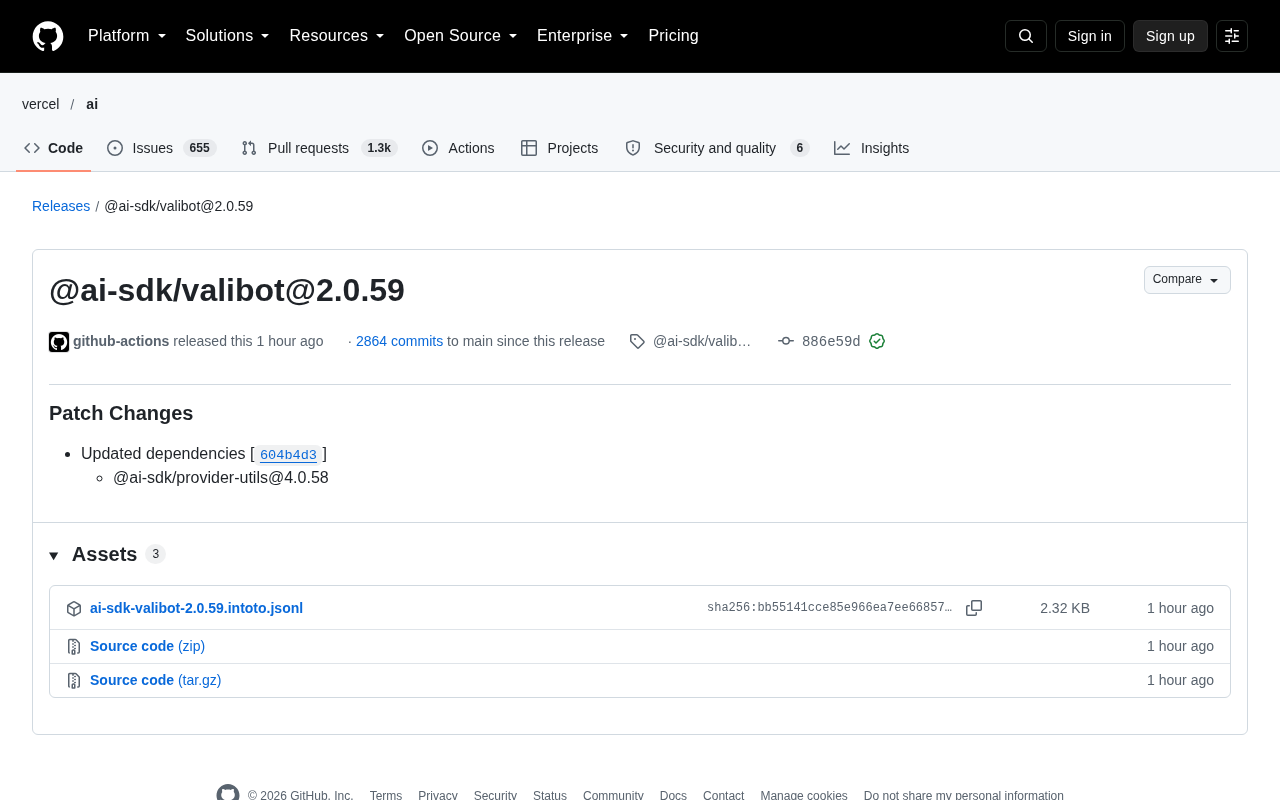
According to the release notes on GitHub, @ai-sdk/valibot@2.0.59 is a Patch Change. Patch versions typically indicate backward-compatible bug fixes or dependency upgrades, rather than breaking changes.
The core content of this update is:
- Dependency update: Upgraded
@ai-sdk/provider-utilsto version4.0.58(commit hash604b4d3).
In other words, @ai-sdk/valibot itself does not introduce new APIs or feature changes; its changes come from the synchronized upgrade of the underlying utility library.
Why Is This Update Worth Attention?
For readers unfamiliar with the AI SDK, @ai-sdk/valibot enables developers to use Valibot, a lightweight schema validation library, to define the format of structured outputs from AI models. Compared to Zod, Valibot has a smaller bundle size, giving it an advantage in edge computing and frontend scenarios.
Meanwhile, @ai-sdk/provider-utils is a shared utility collection used by all provider adapter layers in the AI SDK, handling request construction, response parsing, error wrapping, and other low-level logic. Its version changes can indirectly affect:
- Consistency of validation behavior: If the schema parsing logic at the provider layer is adjusted, it may affect the behavior of the Valibot adapter.
- Compatibility boundaries: If your project pins an older version of
provider-utils, you need to confirm there are no hidden conflicts after upgrading. - Dependency tree cleanliness: Automated dependency updates reduce manual maintenance costs.
Valibot is a modular schema validation library written in TypeScript. It has a similar positioning to Zod but adopts a different design philosophy: its API consists of a large number of tree-shakable small functions, so unused validators are not bundled into the final output. Under equivalent functionality, Valibot's compressed size is typically only a fraction of Zod's, which is particularly important for AI applications that need to be deployed to constrained runtimes like Cloudflare Workers and Vercel Edge Functions. In the context of the AI SDK, developers use Valibot to declare a schema describing the JSON structure the model should return. The SDK converts it into a JSON Schema the model can understand, and after the model returns a result, it uses the same schema again for runtime validation, thereby avoiding subtle errors like "the model claims to have returned valid JSON but the field types don't match."
Structured Output refers to constraining a large language model to generate results according to a predefined schema rather than free text. There are usually two implementation approaches: one is to have the model directly decode according to a JSON Schema constraint (such as OpenAI's structured outputs or Google Gemini's responseSchema), and the other is to have the model output JSON and then have the client validate and retry. Regardless of the path, the schema must first be translated into a format description on the model side, and then a local validation must be performed after the response comes back—this is exactly the middle-layer responsibility that @ai-sdk/provider-utils handles. The schema conversion, JSON parsing fault tolerance (e.g., stripping Markdown code fences), and error wrapping logic it provides are shared across all provider adapters, so its version changes may simultaneously affect structured output behavior across OpenAI, Anthropic, Google, and other providers.
Practical Impact on Developers
If you are already using @ai-sdk/valibot in your project, this upgrade can basically be completed seamlessly. Just run the regular package manager update command:
npm update @ai-sdk/valibot
# or
pnpm up @ai-sdk/valibot
One scenario to watch out for: if you have also manually pinned the version of @ai-sdk/provider-utils, it is recommended to check whether the two match. The expected provider-utils version for @ai-sdk/valibot@2.0.59 is 4.0.58.
The Big Trend Behind a Minor Version
This kind of high-frequency patch release reflects a reality: the AI application development stack is iterating rapidly. Vercel's AI SDK is managed as a monorepo and automatically released via GitHub Actions. As one part of it, @ai-sdk/valibot updates in sync with the rhythm of provider-utils.
For teams, rather than chasing every patch version, it is better to establish a dependency update strategy: regularly batch upgrade, run integration tests related to structured output in CI, and pay attention to major versions with breaking changes. After all, the risk brought by patch versions is usually very low, but failing to update for a long time will accumulate compatibility debt.
This release was automatically completed by the github-actions bot at 13 Oct 16:11, with signature verification passed (GPG key ID: B5690EEEBB952194), making it a trustworthy official release.
One-line Summary
@ai-sdk/valibot releases patch 2.0.59, only synchronizing the underlying provider-utils dependency.
Paragraph Summary
In Vercel's AI SDK ecosystem, @ai-sdk/valibot released patch version 2.0.59. This version does not introduce new APIs or feature changes; the only change is upgrading the underlying dependency @ai-sdk/provider-utils to 4.0.58. @ai-sdk/valibot enables developers to define structured output formats for AI models using the lightweight validation library Valibot, which is better suited than Zod for edge computing and frontend scenarios. Meanwhile, provider-utils is the shared low-level utility collection used by all provider adapter layers, responsible for request construction and response parsing, and its changes may indirectly affect the consistency of validation behavior. For ordinary users, this upgrade can basically be completed seamlessly; just note that if you have manually pinned the provider-utils version, you should confirm it matches 4.0.58. The release was automatically completed by GitHub Actions and passed signature verification.
Related articles

JobRunner MCP Server: AI Agents Can Now Fix Failed Java Jobs
JobRunner launches an open-source MCP server enabling AI agents to view cluster status, diagnose failures, and recover Java jobs—incident response from any cloud coding environment or existing agent.

MLAI Digital Launches 9 Security Agents: MCP Server Safeguards the Full Lifecycle of Agentic AI
MLAI Digital launches Security MCP Server with nine built-in specialized security agents covering vulnerability discovery, attack simulation, prompt injection detection, API and infrastructure assessment, and accelerated remediation—embedding security validation across the full Agentic AI lifecycle from development to production.

Running Isaac Lab on H100 GPUs: Exploring Better Approaches
Exploring optimization methods for running Isaac Lab on NVIDIA H100 GPUs, including MIG configuration, mixed precision, TensorRT acceleration, and community experience to improve robotics simulation and reinforcement learning efficiency.