Vercel AI SDK OpenAI Package Update: Declaring Language Model Capabilities by Model ID
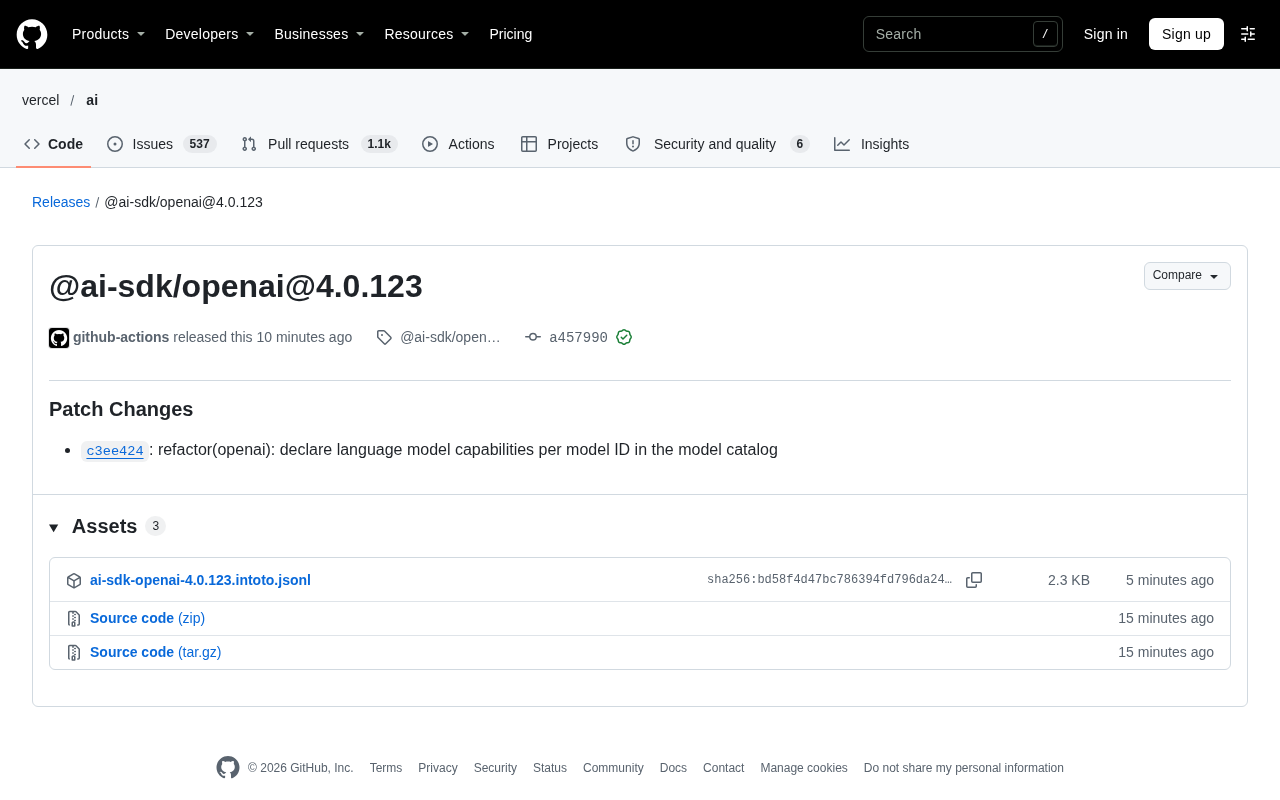
@ai-sdk/openai releases 4.0.123, an internal refactor declaring language model capabilities per model ID.
@ai-sdk/openai has released patch version 4.0.123, whose core change is an internal refactor: language model capability declarations move from scattered conditional logic to a data-driven structure bound to specific model IDs in the model catalog. The article explains the model catalog's role in the AI SDK's cross-provider unified calling layer, noting that "one model ID, one capability declaration" makes adding models simpler and capability differences enumerable and testable, reducing multi-model adaptation costs. Since the public API is unchanged, ordinary developers need no code changes, but advanced usages depending on internal capability checks should undergo regression testing. The release was automated via github-actions with a verified-signature commit, showing version publishing is part of continuous integration.
The AI SDK's OpenAI adapter package (@ai-sdk/openai) has released patch version 4.0.123. The core change is an internal refactor: declaring language model capabilities per model ID in the model catalog. For developers calling the high-level API directly, this is typically a seamless upgrade—but it touches the underlying mechanism of how the SDK distributes capabilities across multiple models, making it worth paying attention to.
Update Overview
This release is version 4.0.123, a patch-level release. The GitHub release notes show that the change was introduced by a single commit with the message "refactor(openai): declare language model capabilities per model ID in the model catalog"—that is, refactoring the OpenAI module to bind language model capability declarations to specific model IDs in the model catalog.
The release was completed by the github-actions automation workflow, and the commit carries a GitHub verified signature. Automated releases like this are common in the AI SDK's iteration cadence, indicating that the repository has integrated version publishing into its continuous integration pipeline.
What This Refactor Changed
To understand this change, we first need to clarify the role of the "model catalog" in the AI SDK. The AI SDK is a cross-provider unified calling layer, and OpenAI is just one of its providers. To keep the calling experience consistent across different models for upper-layer code, the SDK needs to maintain an internal list of model capabilities—such as whether a model supports a particular input type or has certain calling features—and use it to decide how to assemble requests.
From Centralized Checks to Per-ID Declarations
Before the refactor, capability checks were often scattered across code logic, and adding or adjusting a model required modifying multiple conditional branches. After the refactor, capability information is attached directly to each model ID in the model catalog, forming a structure of "one model ID, one capability declaration."
This data-driven approach has two direct benefits: adding a new model only requires adding an entry to the catalog, rather than shotgun-editing the checking logic; and capability differences become enumerable and comparable, reducing the risk of missing edge cases.
Semantic Versioning (SemVer) and patch releases: Semantic versioning specifies version numbers in the form major.minor.patch, corresponding to incompatible changes, backward-compatible feature additions, and backward-compatible bug fixes, respectively. Internal refactors that do not change externally visible behavior should, by convention, fall into the patch position. Therefore, the number 4.0.123 itself sends a clear signal: no public API additions or removals, and no behavioral semantic changes.
The boundary to note is this: SemVer only constrains the "public contract." If project code depends on the SDK's internal implementation details (for example, directly reading internal capability-check functions or non-exported types), such usage is not covered by compatibility guarantees and may exhibit behavioral deviations after the refactor. This is also why the article recommends regression testing code that depends on internal capability checks. In the npm ecosystem, range dependencies like ^4.0.0 automatically receive such patch upgrades, so understanding the convention that "patch number = no breaking changes" helps assess upgrade risk.
Practical Impact on Users
For the vast majority of application developers, this change is transparent—public API signatures are unchanged, and upgrading to 4.0.123 requires no changes to business code. The real beneficiaries are two groups: SDK contributors who maintain the multi-model adapter layer, and advanced users who need fine-grained control over specific models.
AI SDK's provider abstraction layer: The AI SDK uses a layered architecture of "core + provider adapter packages." The core package (ai) defines a unified calling interface and message/streaming protocol, while each model service is implemented by a separate provider package (such as @ai-sdk/openai, @ai-sdk/anthropic, @ai-sdk/google). Upper-layer code only needs to switch the provider instance to migrate between models, without rewriting the calling logic—this is the practical meaning of a "cross-provider unified calling layer."
The key difficulty of this abstraction is that parameters, input modalities, and supported capabilities differ not only across providers but also across models within the same provider. Therefore, provider packages must not only handle request serialization and response parsing but also take on the responsibility of "capability description"—telling the core layer what a specific model can do, so that the unified interface preserves a consistent experience without forcibly flattening underlying differences. Pushing capability declarations down into the model catalog strengthens this responsibility boundary of provider packages.
Why Model Capability Declarations Matter
OpenAI's model family differs significantly in input modalities, context specifications, and calling features, and different models accept the same parameter to varying degrees. Consolidating these differences into the model catalog amounts to establishing a single source of truth inside the SDK.
From an engineering perspective, this aligns with the "configuration as data" philosophy: moving volatile parts from code into structured lists, leaving code responsible only for interpretation and execution. For an SDK that frequently follows new model releases, this structure can significantly reduce maintenance costs and make the capability matrix easier to cover with tests.
Upgrade Recommendations
Since this is a patch version involving only internal refactoring, regular projects can upgrade directly, with a focus on regression testing that the models you rely on still work as expected. If your code depends on the SDK's internal capability-check behavior, it is recommended to cross-check against the declarations for the corresponding model IDs in the model catalog.
It is worth noting that this release record contains only this one change, with no migration notes or behavior-change announcements attached—which in itself confirms that it is a non-breaking internal adjustment.
FAQ
Will this update affect existing code?
The public interface is unchanged, so generally no code changes are needed. If you use non-public usages that depend on internal capability checks, you should run regression tests after upgrading.
What is the model catalog?
It is an internal model list maintained by the AI SDK, recording each model ID and its capability information, used for request assembly and capability checks.
Why release a refactor as a patch version?
The refactor does not change external behavior, so releasing it under a patch number follows semantic versioning conventions.
One-line Summary
@ai-sdk/openai releases 4.0.123, an internal refactor declaring language model capabilities per model ID.
Paragraph Summary
@ai-sdk/openai has released patch version 4.0.123, with the core change being an internal refactor: language model capability declarations are moved from scattered conditional-check logic to a data-driven structure bound to specific model IDs in the model catalog. The article explains the role of the model catalog in the AI SDK's cross-provider unified calling layer, noting that the "one model ID, one capability declaration" approach means adding a new model only requires adding a catalog entry, makes capability differences enumerable and testable, and lowers the maintenance cost of multi-model adaptation. Since the public API is unchanged, ordinary developers need not modify business code when upgrading, but advanced usages that depend on internal capability-check behavior should undergo regression testing. The release was automated via github-actions with a verified-signature commit, reflecting that the repository has integrated version publishing into continuous integration.
Related articles
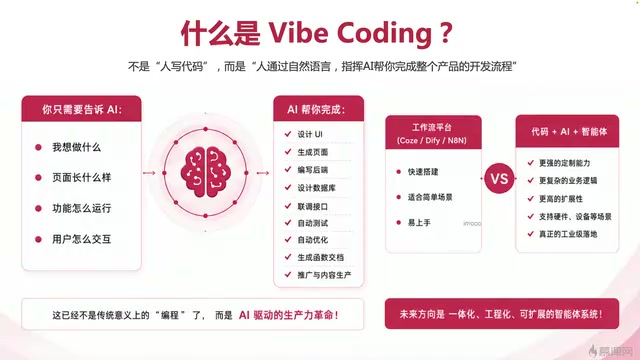
Vibe Coding End-to-End in Practice: A One-Person Company Development Guide for the AI Era
An analysis of the 80-episode Vibe Coding tutorial: from humans directing AI to write code to a full product loop, covering AI-collaborative development, UniApp multi-platform, and AI-automated operations, while clarifying that workflow orchestration is not AI development.
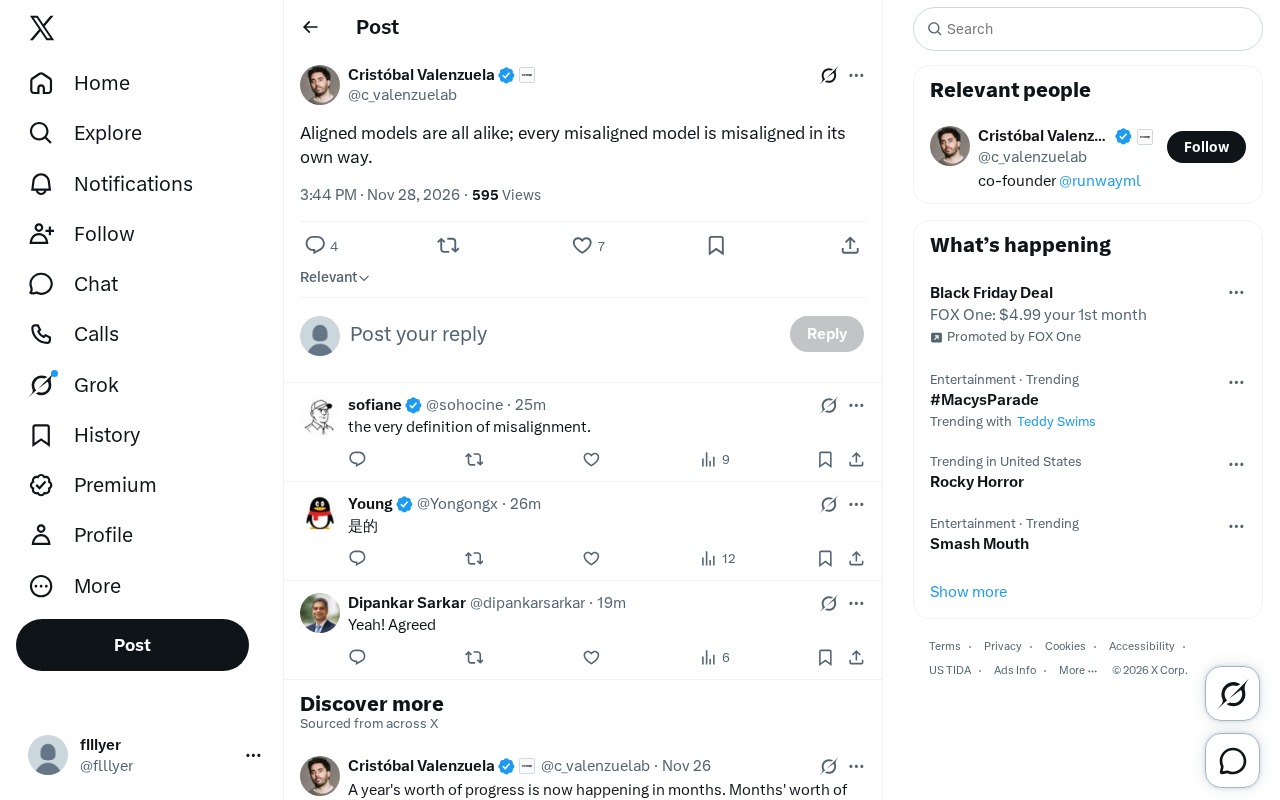
Aligned Models Are All Alike; Every Misaligned Model Is Misaligned in Its Own Way
A Tolstoy-inspired community observation reveals AI alignment's core challenge: aligned models converge, while misaligned models fail in wildly diverse ways.
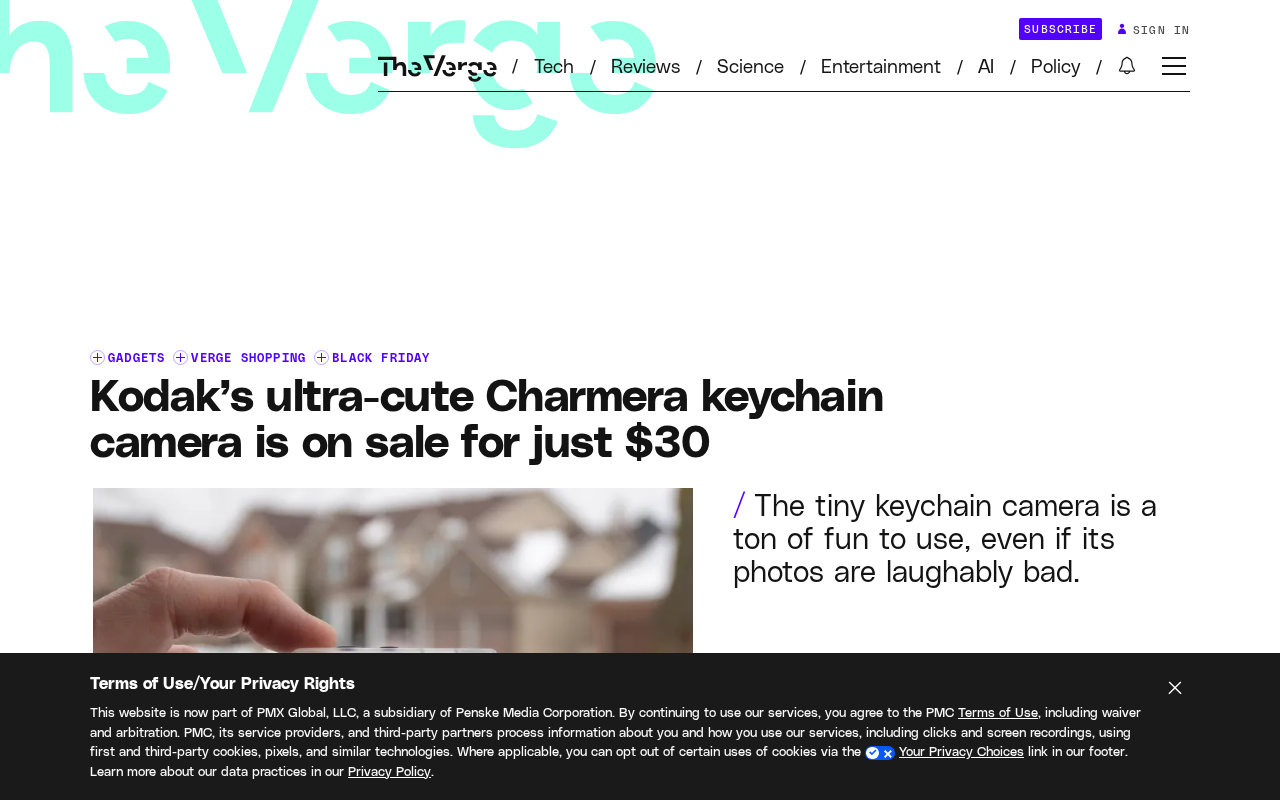
Kodak Charmera Mini Camera Drops to $30: Retro Charm Beats Image Quality
Kodak Charmera keychain camera on sale for $30. Review calls image quality mediocre but charm undeniable. Learn about this mini retro camera's positioning and buying advice.