Vercel AI SDK Patch Update: Analyzing the OpenAI-Compatible Layer Upgrade

Vercel AI SDK's Vercel adapter package releases patch 2.0.87, upgrading compatible-layer and utility-library dependencies.
This article explains the patch-level release of @ai-sdk/vercel@2.0.87. It was completed automatically by GitHub Actions, and the core change is simply bumping @ai-sdk/openai-compatible to 2.0.85 and @ai-sdk/provider-utils to 4.0.61, with no new features introduced. These two downstream packages handle OpenAI-compatible endpoint adaptation and lower-level functions such as streaming parsing and tool-call validation, and their patch fixes propagate upward through the dependency chain. Developers should evaluate dependency direction, check lockfile conflicts, and regression-test streaming, tool calls, and multi-turn conversations. Overall, patch-level updates can be left to dependency tools, and only major-version changes in core shared layers require reading migration guides.
The Vercel provider adapter package for Vercel's official AI SDK has released version 2.0.87, a typical patch-level update. According to the release notes, the core change is not the introduction of new features but a synchronized update of downstream dependencies — @ai-sdk/openai-compatible was bumped to 2.0.85 and @ai-sdk/provider-utils to 4.0.61. For developers using the Vercel AI SDK to build AI applications, understanding the significance of such patch updates is more practical than chasing new features.
The Real Purpose of a Patch Update
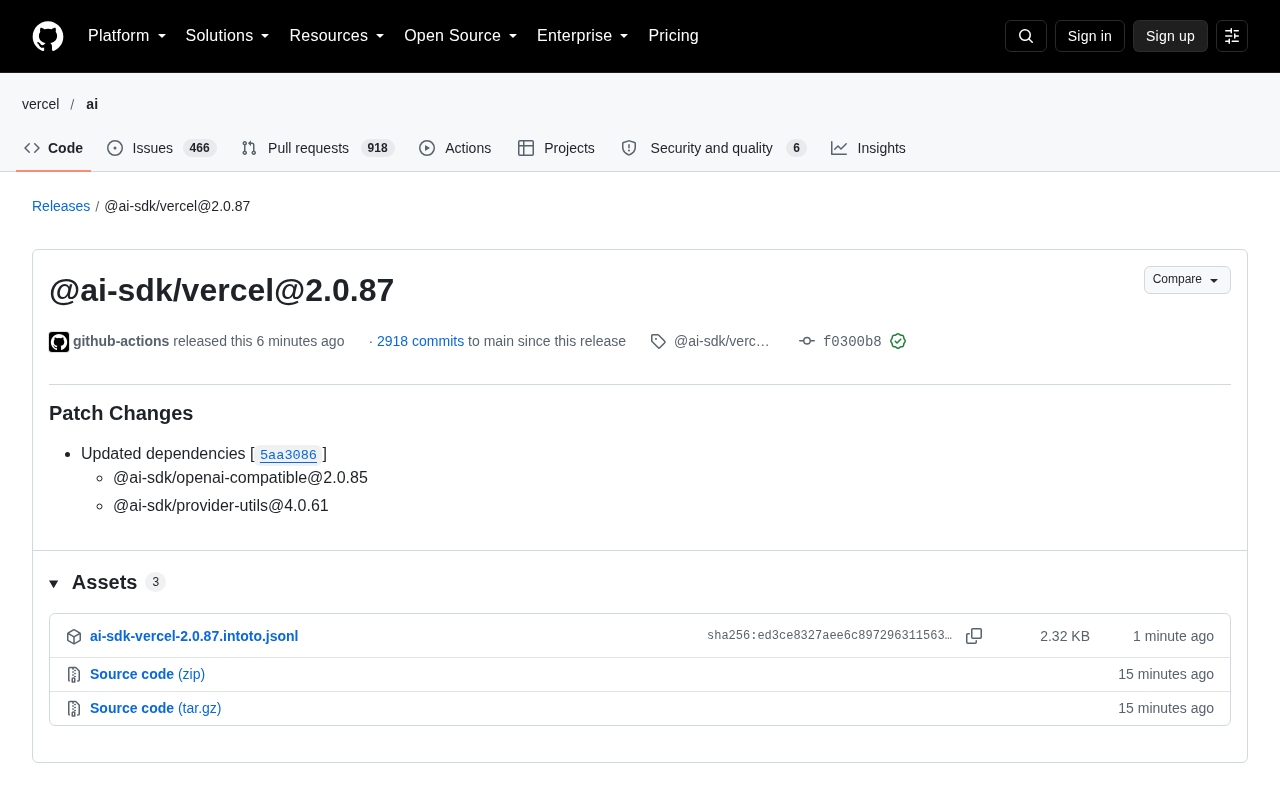
This release of @ai-sdk/vercel@2.0.87 was completed automatically by GitHub Actions, with commit hash f0300b8 and a GitHub verified signature. The release notes list only one Patch Change: updating dependencies.
The two ends of the dependency chain are worth noting:
- @ai-sdk/openai-compatible@2.0.85: This is the service layer in the AI SDK used to connect to any service that provides an OpenAI-compatible interface. A large number of third-party model services (local inference frameworks, privately deployed gateways, cloud provider compatible endpoints) connect through this layer.
- @ai-sdk/provider-utils@4.0.61: This is the shared utility library for the Provider layer, responsible for lower-level logic such as message transformation, streaming handling, and error mapping.
When the Vercel provider package is upgraded and simultaneously pulls up these two dependencies, it indicates that the upstream project has made fixes to compatibility protocols or utility functions. Developers using this adapter package can indirectly benefit from these lower-level fixes after updating, without having to handle dependency conflicts separately.
Why the OpenAI-Compatible Layer Is Key to the AI SDK
The design philosophy of the Vercel AI SDK is unified interface, multi-provider adaptation. Developers write one set of generateText or streamText calling logic and can switch between OpenAI, Anthropic, Google, and various compatible endpoints.
@ai-sdk/openai-compatible is precisely the general-purpose adapter in this architecture. It is not tied to any specific vendor but instead converts requests and responses according to OpenAI's format. This means:
- Teams running their own inference services such as vLLM, Ollama, or LocalAI can directly use this package to integrate with the AI SDK ecosystem;
- "OpenAI-compatible mode" endpoints provided by cloud vendors are also supported through this layer;
- When OpenAI adjusts API details (such as new fields or changes in streaming format), this layer needs to be updated accordingly.
Therefore, version changes in openai-compatible often reflect actual changes at the compatibility level more than changes in an individual vendor package. The 2.0.85 patch version is very likely a fix for some edge case or protocol detail.
SemVer (Semantic Versioning) splits a version number into three parts, MAJOR.MINOR.PATCH, and is a basic tool for judging the risk of an update. A MAJOR jump represents incompatible breaking changes, and consumers must adapt manually; a MINOR increment indicates newly added backward-compatible functionality; PATCH contains only backward-compatible bug fixes. The repeatedly appearing 2.0.87 and 4.0.61 remain at the PATCH position, meaning the public API contract has not changed and upgrading is a low-risk operation.
This convention is especially important in a multi-package collaborative ecosystem like the AI SDK. Because @ai-sdk/vercel depends on provider-utils and openai-compatible, if any lower-level package undergoes a MAJOR change, all provider adapter packages that depend on it will be forced to follow, creating a chain of upgrades. Therefore, when you see version numbers moving only in the PATCH position, you can basically conclude that this update will not affect calling code and can simply be handled by updating the lockfile.
The Role of provider-utils: Invisible Infrastructure
@ai-sdk/provider-utils is the lowest-level shared utility set in the AI SDK. It handles capabilities that developers do not call directly but constantly rely on:
- Chunk parsing and reassembly of streaming responses;
- Parameter validation and serialization for tool calls;
- Construction and throwing of unified error objects;
- Encoding conversion for multimodal content (text, images).
Patch upgrades to this kind of utility library usually do not change the public API, but they do affect stability and edge-case behavior. The version number 4.0.61 indicates that it is in continuous iteration under the 4.x major version, and an increment in the patch number means backward-compatible fixes.
For production AI applications, these seemingly "insignificant" dependency upgrades can often fix hidden issues such as interrupted streaming transmission or failed parsing of tool calls.
Streaming is the core mechanism that distinguishes AI applications from the traditional request-response model. Large models generate content token by token, and the server continuously pushes data fragments in the form of SSE (Server-Sent Events) or chunked HTTP responses. The client needs to parse these fragments in order and concatenate them into complete text.
This process looks simple but actually hides many edge cases: a data chunk may truncate a JSON object or UTF-8 character midway; different providers' end markers (such as [DONE]) and chunking rhythms are not consistent; network jitter can also cause out-of-order fragments or reconnections. @ai-sdk/provider-utils is responsible for this set of chunk parsing, buffering, and reassembly, and it uniformly handles the merging of tool call increments. This is why its patch updates, although they do not change the API, often fix difficult-to-reproduce issues such as interrupted streaming output or garbled content.
How Developers Should Handle This Kind of Update
When facing a patch release like @ai-sdk/vercel@2.0.87, it is recommended to evaluate it in the following order of priority:
First, look at the direction of dependency changes. This update pulled two downstream packages up to the latest patch, with no breaking-change markers (no major or minor jumps). This kind of update can usually be adopted directly.
Then check your lockfile. If your project has direct dependencies on or version locks for @ai-sdk/openai-compatible or @ai-sdk/provider-utils, you need to confirm that the upgrade will not conflict with the existing locked versions.
Finally, regression-test critical paths. Focus on validating three scenarios: streaming output, tool calls, and multi-turn conversations, because lower-level changes in provider-utils are most likely to show up in these three places.
For projects that use the AI SDK only in prototyping or experimentation, simply upgrading is enough; for services already in production, it is recommended to run a round in staging before pushing to production.
A lockfile (such as pnpm-lock.yaml, package-lock.json, or yarn.lock) records every dependency actually installed by the project and its exact version. When a directly depended-upon vendor package requires a higher version of provider-utils, the package manager will try to raise the corresponding entry in the lockfile, which may trigger synchronized changes in indirect dependencies and even introduce other patches that were previously locked.
Therefore, before upgrading, you should first compare the lockfile diff to confirm whether the scope of promoted transitive dependencies is controllable. If the project has explicitly pinned a version through overrides, resolutions, or npm shrinkwrap, it may conflict with the new dependency declaration and require manual adjustment. This is exactly why the article suggests "first check your lockfile" — it can expose version conflicts in advance and avoid discovering problems only in CI or production.
Understanding the AI SDK's Maintenance Model from Its Release Cadence
One detail of this release is worth noting: it happened after 2918 commits and was completed by an automated process. This shows that the Vercel AI SDK adopts a high-frequency, small-step release strategy — a patch update to a single vendor package drives the entire dependency chain forward in sync.
The takeaway for users is: you do not need to track the details of every patch individually, but you should pay attention to major version changes in core shared layers such as provider-utils and openai-compatible. Only when they cross a major version do you need to carefully read the migration guide. Updates at the patch-number level can simply be synchronized by dependency management tools on their own cadence.
Overall, @ai-sdk/vercel@2.0.87 itself does not contain earth-shattering changes, but it reflects a mature dependency governance mechanism: fixes at the lower utility layer propagate upward, vendor adapter packages quickly follow, and developers gain stability improvements at minimal cognitive cost.
One-line Summary
Vercel AI SDK's Vercel adapter package released patch 2.0.87, synchronously upgrading its underlying compatibility layer and utility library dependencies.
Paragraph Summary
This article explains the patch-level release of @ai-sdk/vercel@2.0.87. It was completed automatically by GitHub Actions, and the core change is simply bumping @ai-sdk/openai-compatible to 2.0.85 and @ai-sdk/provider-utils to 4.0.61, with no new features introduced. The article points out that these two downstream packages are respectively responsible for OpenAI-compatible endpoint adaptation and lower-level duties such as streaming parsing and tool call validation, and their patch fixes propagate upward through the dependency chain, allowing consumers to benefit indirectly. For developers, it is recommended to evaluate the direction of dependency changes in order, check whether the lockfile conflicts, and then regression-test three critical paths: streaming output, tool calls, and multi-turn conversations. Finally, from the perspective of release cadence, the article summarizes the Vercel AI SDK's high-frequency, small-step release strategy: patch-level updates can be left to dependency tools for automatic synchronization, and only when the core shared layers cross a major version do you need to carefully read the migration guide.
Related articles

Python 3.15 New Feature: Is the sentinel Type Better Than None?
Python 3.15 adds the sentinel type, using named unique sentinel objects to replace None and bare object(), resolving confusion among missing values, explicit emptiness, and invalid input while avoiding type hint failures.

Deep Learning's Three Architectures and the Universal Approximation Theorem: A Complete Guide to MLPs, CNNs, and Transformers
Explaining the inductive bias differences among MLP, CNN, and Transformer, the existence meaning of the Universal Approximation Theorem (UAT), and the role of Taylor expansion in approximation analysis, while clearing up common misconceptions.

GitLab Emergency Patch Release: Analysis of Critical Security Fixes
GitLab releases critical patch 19.5.1, sparking 355 points of discussion on Hacker News. This article analyzes the background, upgrade steps for self-hosted instances, and verification points to help DevOps teams respond quickly to security updates.