Vercel AI SDK Releases @ai-sdk/mcp Patch: Fixes stdio Transport Environment Variable Issue

Vercel AI SDK patches @ai-sdk/mcp to fix explicit environment variables being dropped in stdio transport.
`@ai-sdk/mcp@1.0.86` is a pure bug-fix patch for Vercel AI SDK's MCP integration module. The core issue: when launching a local MCP Server subprocess via stdio transport, explicitly set environment variables could be lost or overwritten, preventing the target process from reading expected API keys or paths and causing connection or auth failures. The fix ensures explicit env values are correctly preserved and passed to the subprocess. There are no breaking API changes, making this a low-cost upgrade recommended for all projects using stdio transport with local MCP integrations.
Vercel's AI SDK ecosystem recently released a patch version of @ai-sdk/mcp@1.0.86. While this is a small-scale Patch Release, it addresses an environment variable handling bug in MCP (Model Context Protocol) integrations — one that directly affects developers using local inter-process communication.
What's in This Update
According to the GitHub Release page, @ai-sdk/mcp@1.0.86 was automatically published by Vercel's official repository (vercel/ai) via GitHub Actions, with a verified GitHub signature. The release contains one key Patch Change:
fix(mcp): preserve explicit stdio transport environment values
This fix means that when launching an MCP server process using stdio transport (standard input/output transport), the SDK now correctly preserves environment variable values that developers have explicitly set, rather than losing or overwriting them during transmission.
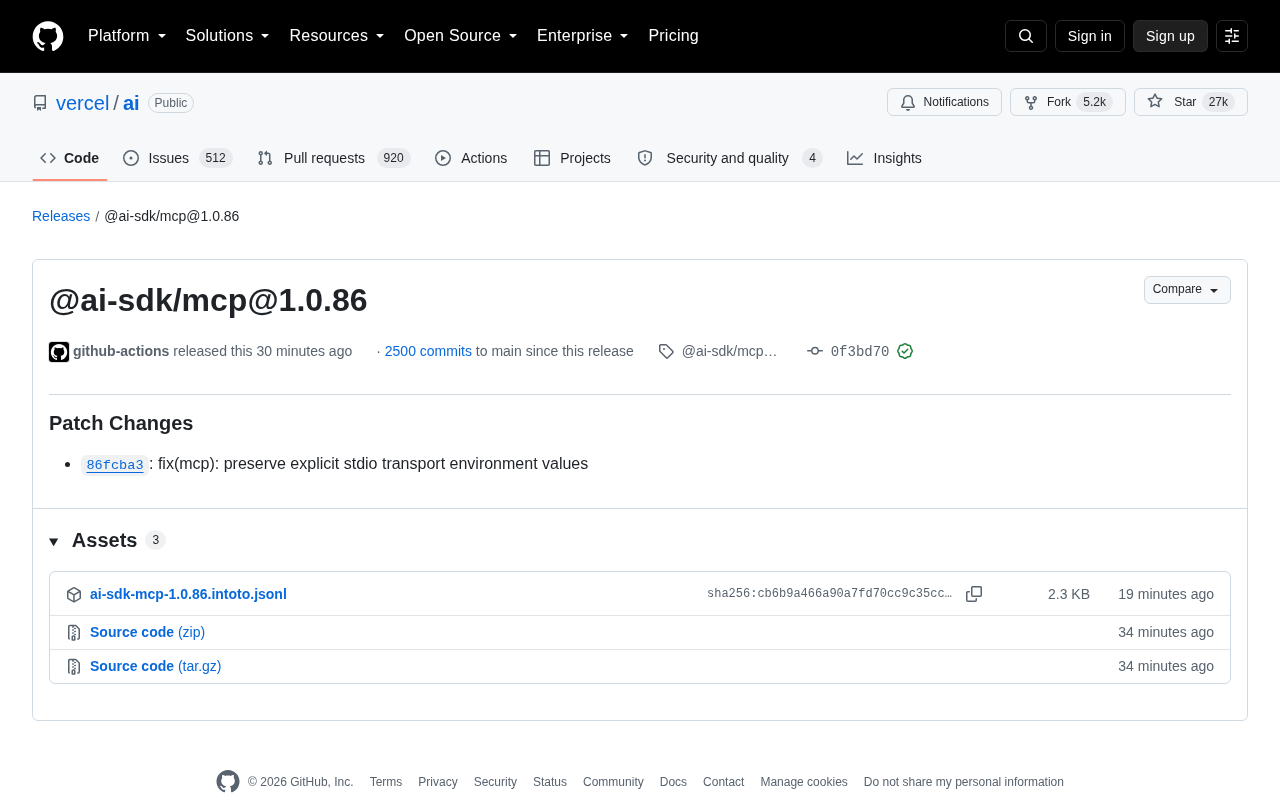
For applications that rely on locally spawned subprocesses to run an MCP Server, this bug could previously cause the process to fail to read expected configurations — such as API keys or path variables — leading to connection or authentication failures. After this fix, explicitly configured environment values are reliably passed through to the target process.
What Are MCP and stdio Transport?
MCP (Model Context Protocol) is a standardized protocol for enabling large language models to communicate with external tools and data sources. Its core value lies in abstracting "the context a model needs" into pluggable Servers, allowing different clients and tools to interact through a unified interface.
Among MCP's various transport modes, stdio transport is one of the most common local integration patterns. It works by spawning a subprocess and exchanging JSON-RPC messages over standard input/output streams. This approach requires no network ports, making it well-suited for local tools, CLI programs, and scenarios that demand low-latency communication.
Since stdio mode fundamentally involves launching a new process, correct environment variable propagation becomes critically important. Many MCP Servers rely on environment variables to read credentials, configure runtime paths, or switch behavioral modes. If these values are inadvertently mishandled at the transport layer, it results in hard-to-diagnose runtime errors — which is exactly the problem this patch addresses.
JSON-RPC (JSON Remote Procedure Call) is the underlying message format used by the stdio transport layer — a lightweight remote procedure call protocol based on JSON encoding. MCP uses it to pass tool invocation requests, resource queries, and responses between clients and servers. Each message contains a method name, parameters, and a request ID, with both sides reading and writing these JSON objects line by line over stdin/stdout. This design means that any program capable of reading and writing stdin/stdout can act as an MCP Server, dramatically lowering the barrier to tool integration — a Python script, a Go binary, or a Node.js module can all serve as MCP tool nodes without needing to implement an HTTP service or maintain a network connection.
What This Means for Developers
@ai-sdk/mcp is the module within the Vercel AI SDK responsible for MCP integration, enabling developers to easily connect to the MCP tool ecosystem within AI SDK-based applications. This release is a pure bug fix with no breaking API changes, making it an extremely low-cost upgrade.
The following users are encouraged to upgrade as soon as possible:
- Projects that use stdio transport to launch local MCP Servers
- Integrations that rely on explicit environment variables to pass credentials or configuration
- Developers who have previously encountered the "local MCP process can't read environment variables" issue
From an engineering perspective, this type of "preserve explicit config values" fix reflects the SDK team's attention to edge-case behavior. The logic for merging and overriding environment variables is often a hidden pitfall, and establishing clear "explicit values take priority" semantics helps reduce unexpected behavior during integration.
Environment variable merge logic is a classic edge-case issue in subprocess spawning scenarios. Node.js APIs like
child_process.spawninherit the parent process's full environment by default when noenvoption is passed. However, once a customenvobject is provided, it completely replaces — rather than merges with — the existing environment, causing variables to be lost if not handled carefully. The standard SDK-level approach is to mergeprocess.envwith the user-provided environment object ({ ...process.env, ...userEnv }), but the merge order determines precedence. The fix addresses a priority inversion where explicitly set values were being overwritten by same-named variables from the parent process, ensuring that values explicitly specified by the user always take effect.
Version Context and Ecosystem Activity
Vercel's vercel/ai repository is one of the most closely watched open-source projects in the AI application development space, with over 27k stars and 5.2k forks, and approximately 2,498 commits on the main branch. This high-cadence iteration reflects the team's commitment to rapidly responding to community feedback and protocol evolution.
As MCP has become a widely adopted model context protocol, the stability of its supporting toolchain directly affects the reliability of a large number of downstream applications. A patch this seemingly small is actually an essential part of ensuring production integration quality. For teams that depend on this SDK long-term, staying on top of these minor version updates is a necessary habit for keeping systems stable.
Summary
@ai-sdk/mcp@1.0.86 is a stability-focused patch release that primarily fixes the issue of explicit environment variables being lost during stdio transport. While the change is small in scope, it's a worthwhile upgrade for developers using local MCP integrations. Affected projects are advised to update their dependencies promptly to avoid hidden failures caused by environment variable propagation issues.
Related articles

Chain of Thought Isn't Just for AI: How Humans Can Use CoT to Improve Thinking Quality
Chain of Thought isn't just a prompt trick for large models. Starting from a Hacker News discussion, this article analyzes why CoT works for human thinking too, breaks down actionable ways to transfer it, and highlights the key differences between human CoT and machine CoT.
Cloudflare Teams Up with OpenAI: Closi…
Cloudflare Teams Up with OpenAI: Closing the Loop from Vulnerability Discovery to Defense with AI
Cloudflare uses OpenAI Daybreak to investigate security vulnerabilities and generate reviewable remediation plans, while developers use Codex to boost coding efficiency and quality.

Orca Multi-Agent Orchestration in Practice: A Guide to Parallel Collaboration with Claude and Codex
Orca is Stable AI's free open-source agent workbench supporting 34 agents like Claude Code and Codex in parallel. Learn its Git worktree isolation, multi-model orchestration, and mobile management.