Vercel AI SDK Releases @ai-sdk/typesafe-ai 3.0.13 Patch Update

typesafe-ai 3.0.13 renames `evaluate` to `decide` and adds TYPESAFE_AI_BASE_URL support.
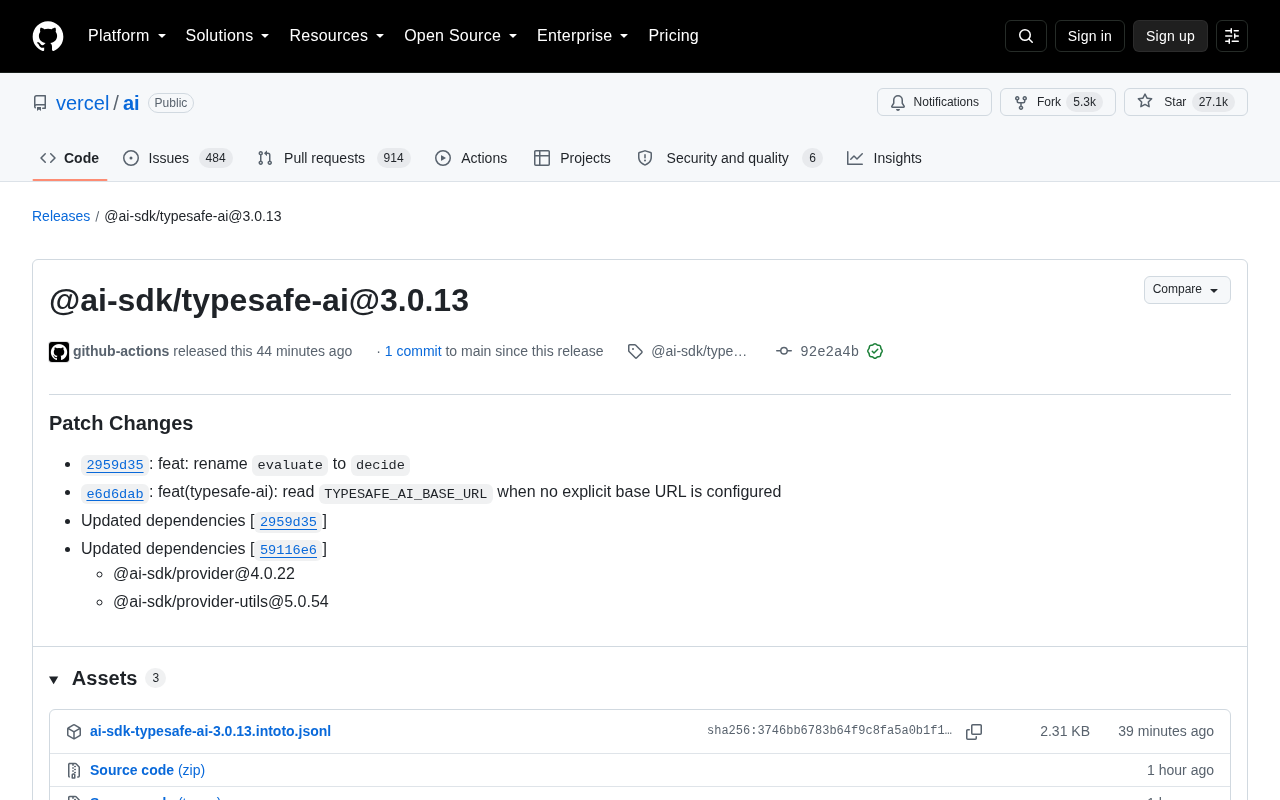
`@ai-sdk/typesafe-ai@3.0.13` is a patch update with two developer-facing changes: the core `evaluate` method is renamed to `decide` for clearer API semantics, and support for the `TYPESAFE_AI_BASE_URL` environment variable is added to enable code-free endpoint switching across environments. Underlying dependencies `@ai-sdk/provider` and `@ai-sdk/provider-utils` are also bumped. Teams using this module should do a global find-and-replace of `evaluate` with `decide` before upgrading, and validate in a test environment first.
Vercel's AI SDK project (which has earned over 27.1k stars on GitHub) recently released version 3.0.13 of @ai-sdk/typesafe-ai. This is a patch-level update — while the version bump is minor, it includes an API naming change worth noting for developers, along with an improvement to environment variable configuration.
Key Changes in This Release
According to the official Release Notes, @ai-sdk/typesafe-ai@3.0.13 contains two main changes:
API Rename: evaluate Becomes decide
The most notable change is the renaming of the evaluate method to decide (commit 2959d35). Naming adjustments like this are common during the early evolution of an SDK, typically reflecting the team's deeper thinking around API semantics. decide more intuitively expresses the intent of "making a decision" compared to evaluate, and better aligns with the mental model developers have when working with type-safe AI scenarios.
Developers already using this method in their projects should pay close attention when upgrading and update their call sites accordingly. Although this is a patch version, a method rename can have a broader practical impact than a typical bugfix patch.
New Environment Variable Support: TYPESAFE_AI_BASE_URL
The second change (commit e6d6dab) adds support for reading the TYPESAFE_AI_BASE_URL environment variable in typesafe-ai. When no base URL is explicitly configured, the SDK will now automatically read from this environment variable.
This improvement reduces configuration overhead, making it easier to switch API endpoints across different deployment environments (e.g., local development, testing, production), and simplifies integration with self-hosted or proxied model services — no code changes required.
The BASE_URL environment variable pattern has clear practical use cases in the AI SDK ecosystem: many teams proxy requests to local inference services like Ollama or LM Studio during local development, point to mock services in CI/test environments, and only connect to real cloud APIs (such as OpenAI or Anthropic) in production. Previously, if an SDK didn't natively read this environment variable, developers typically had to write conditional process.env.XXX logic in their code, or manually inject values via dotenv — adding boilerplate. The introduction of TYPESAFE_AI_BASE_URL means this switching can be handled entirely at the infrastructure layer (e.g., Docker Compose, Vercel project environment variable settings), keeping the codebase itself environment-agnostic — consistent with the configuration principles of the 12-Factor App methodology.
Dependency Updates
Alongside this release, related dependencies have also been bumped:
@ai-sdk/provider@4.0.22@ai-sdk/provider-utils@5.0.54
These underlying dependency updates are typically done to maintain consistency across the AI SDK ecosystem and ensure compatibility between the provider abstraction layer and utility functions. Your package manager will handle these dependency relationships automatically when you upgrade typesafe-ai.
About typesafe-ai
@ai-sdk/typesafe-ai is a component of the Vercel AI SDK ecosystem. The Vercel AI SDK as a whole is positioned as a toolkit for rapidly building AI applications in TypeScript/JavaScript environments, with a strong emphasis on type safety and developer experience. As the name suggests, typesafe-ai focuses on providing type-safe wrappers around AI capabilities, giving developers TypeScript type-checking guarantees when calling models and handling structured outputs.
The naming evolution from evaluate to decide, along with enhanced environment variable support, both indicate that this module is still in an active iteration phase, refining its API design. For teams focused on AI application engineering, the maturity and usability of tooling like this directly impacts development efficiency.
The type-safe design at the core of the Vercel AI SDK relies heavily on TypeScript's generics and pattern matching capabilities. Specifically, typesafe-ai lets you define Zod schemas or TypeScript interfaces for model outputs, catching data structure mismatches at compile time rather than at runtime. This is especially critical when working with LLM structured outputs — JSON fields returned by large language models can easily drift as prompts change, and type-safe wrappers act as a static guardrail at the application layer. The decide method fits squarely into this context: developers pass in context data, and the method returns a type-known, validated decision result object based on model inference — rather than a raw string — seamlessly embedding AI capabilities into strongly-typed business logic.
Upgrade Recommendations
- If your project uses the
evaluatemethod, replace it withdecidebefore or during the upgrade; - If you need flexible API endpoint configuration, take advantage of the new
TYPESAFE_AI_BASE_URLenvironment variable; - As a patch release, the overall upgrade risk is low, but it's recommended to validate the API changes in a test environment first.
The commits in this release have been verified with GitHub's GPG signature, ensuring the trustworthiness of the release source.
Related articles

Chain of Thought Isn't Just for AI: How Humans Can Use CoT to Improve Thinking Quality
Chain of Thought isn't just a prompt trick for large models. Starting from a Hacker News discussion, this article analyzes why CoT works for human thinking too, breaks down actionable ways to transfer it, and highlights the key differences between human CoT and machine CoT.
Cloudflare Teams Up with OpenAI: Closi…
Cloudflare Teams Up with OpenAI: Closing the Loop from Vulnerability Discovery to Defense with AI
Cloudflare uses OpenAI Daybreak to investigate security vulnerabilities and generate reviewable remediation plans, while developers use Codex to boost coding efficiency and quality.

Orca Multi-Agent Orchestration in Practice: A Guide to Parallel Collaboration with Claude and Codex
Orca is Stable AI's free open-source agent workbench supporting 34 agents like Claude Code and Codex in parallel. Learn its Git worktree isolation, multi-model orchestration, and mobile management.