Vercel AI SDK Releases @ai-sdk/valibot@3.0.52 Patch Update

Vercel AI SDK's valibot adapter gets a patch update, migrating its build tool from tsup to Rolldown-based tsdown.
@ai-sdk/valibot@3.0.52 is a purely engineering-focused patch update, migrating the package build tool from tsup to tsdown. tsup is built on esbuild; tsdown is built on Rolldown (a Rust rewrite of Rollup), offering faster builds, better ESM/CJS dual-format support, and deeper Vite ecosystem integration. For a large monorepo like the Vercel AI SDK, this kind of infrastructure upgrade meaningfully improves release efficiency. No API changes or breaking changes are included — existing users can upgrade safely. The dependency @ai-sdk/provider-utils@5.0.52 is also synced in this release.
Vercel's widely-followed AI SDK project (27k GitHub stars and over 5.2k forks) has just released @ai-sdk/valibot@3.0.52 as a patch version. While this is a minor iteration, it signals a noteworthy evolution in the project's build toolchain.
What Changed in This Update
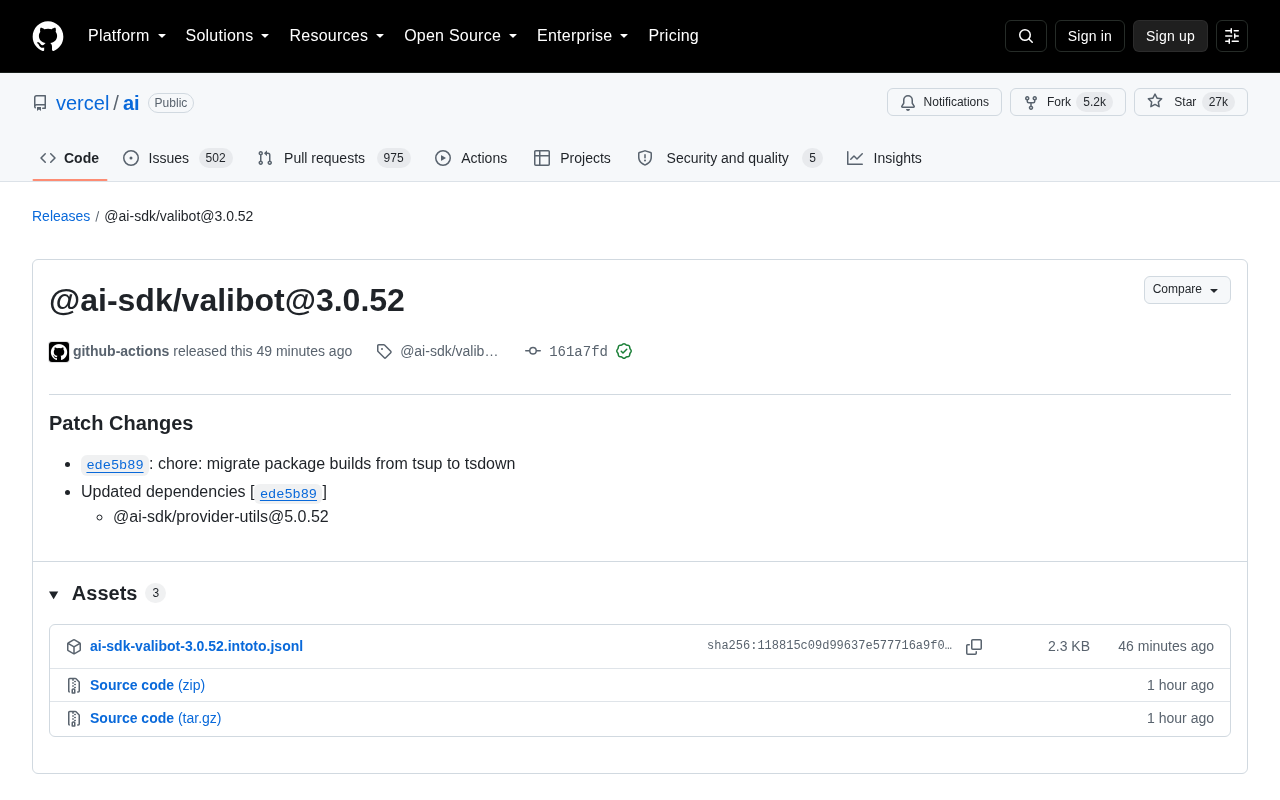
According to the GitHub release notes, @ai-sdk/valibot@3.0.52 is a Patch Change with one engineering-focused update:
chore: migrate package builds from tsup to tsdown
In other words, the package's build process has been migrated from tsup to tsdown. This release also syncs the dependency @ai-sdk/provider-utils@5.0.52. The entire commit was published automatically via GitHub Actions and verified with a GitHub GPG signature (key ID: B5690EEEBB952194), ensuring the trustworthiness of the release source.
For everyday users, this is a nearly invisible update — it involves no API changes or new features, focusing purely on how the package is bundled and output.
Why Migrate from tsup to tsdown
tsup has been one of the most popular TypeScript bundlers in recent years — built on esbuild, it's simple to configure, works out of the box, and has been widely adopted by open-source libraries. tsdown is a newer build tool built on top of Rolldown (a Rust rewrite of Rollup), designed for faster build speeds and better support for modern output formats.
This kind of migration is becoming increasingly common in mature JavaScript/TypeScript libraries. Choosing tsdown typically signals that the team wants:
- Faster build performance, especially in monorepo environments
- Better support for dual ESM/CJS output formats
- Tighter integration with the Rolldown/Vite ecosystem
For a large-scale monorepo like the Vercel AI SDK — with many packages — build speed and output consistency directly affect release efficiency and maintenance overhead. This migration can be seen as part of its ongoing infrastructure optimization.
Rolldown is a Rust rewrite of Rollup, led by the Vite team, with the goal of dramatically improving build performance while maintaining Rollup API compatibility. Thanks to Rust's low-level performance advantages, Rolldown can be several times — or even tens of times — faster than JavaScript-based bundlers when processing large codebases. tsdown is a library-focused bundler built on Rolldown as its core engine, led by Vite ecosystem core contributor Anthony Fu. It's positioned similarly to tsup but targets the next-generation toolchain. Notably, Vite 6's long-term roadmap explicitly plans to adopt Rolldown as its underlying bundler engine — so migrating to tsdown early also means aligning with Vite's future direction and reducing future migration costs.
What Is @ai-sdk/valibot
@ai-sdk/valibot is an adapter package in the Vercel AI SDK ecosystem that integrates Valibot — a lightweight TypeScript schema validation library — into the AI SDK's structured output and tool-calling capabilities.
When building AI applications, developers often need large language models to return data in specific structures (such as JSON), which requires schema validation. The AI SDK natively supports Zod, while the valibot adapter package provides an alternative for developers who prefer Valibot. Valibot is known for its extremely small footprint (tree-shakable, import-on-demand), making it particularly advantageous in frontend and edge computing scenarios where bundle size matters.
Valibot and Zod serve very similar purposes — both are used to declare data structures and perform runtime validation in TypeScript projects — but their design philosophies differ significantly. Zod is imported as a single unit, with a compressed bundle size of roughly 12–14KB. Valibot, on the other hand, uses a fully modular, functional API where each validator is an independent function. With tree-shaking, the actual bundle size can be reduced to just a few hundred bytes. This is especially important for edge runtime environments like Cloudflare Workers and Vercel Edge Functions, where cold start times are sensitive. The AI SDK abstracts away the differences between underlying schema libraries through adapter packages, allowing developers to freely choose between Zod and Valibot without affecting how they integrate with LLM structured output capabilities.
Practical Impact for Developers
If your project is using @ai-sdk/valibot, you can safely upgrade to 3.0.52. Since this update only involves a build tool migration, it should not introduce any breaking changes, and runtime behavior remains consistent.
After upgrading, it's recommended to:
- Verify that ESM/CJS imports of the package work correctly in your build environment
- Keep an eye on the synced update to
@ai-sdk/provider-utilsto ensure dependency versions are aligned - Run your full test suite in CI to confirm no unexpected issues
From a broader perspective, seemingly insignificant patch updates like this one actually reflect the healthy, active state of an open-source project: even after features have stabilized, the team continues to polish the underlying engineering quality. For teams building production-grade applications on top of the AI SDK, this kind of attention to infrastructure is a guarantee of long-term reliability.
Related articles

Chain of Thought Isn't Just for AI: How Humans Can Use CoT to Improve Thinking Quality
Chain of Thought isn't just a prompt trick for large models. Starting from a Hacker News discussion, this article analyzes why CoT works for human thinking too, breaks down actionable ways to transfer it, and highlights the key differences between human CoT and machine CoT.
Cloudflare Teams Up with OpenAI: Closi…
Cloudflare Teams Up with OpenAI: Closing the Loop from Vulnerability Discovery to Defense with AI
Cloudflare uses OpenAI Daybreak to investigate security vulnerabilities and generate reviewable remediation plans, while developers use Codex to boost coding efficiency and quality.

Orca Multi-Agent Orchestration in Practice: A Guide to Parallel Collaboration with Claude and Codex
Orca is Stable AI's free open-source agent workbench supporting 34 agents like Claude Code and Codex in parallel. Learn its Git worktree isolation, multi-model orchestration, and mobile management.