Vercel AI SDK Releases @ai-sdk/voyage 1.0.33 Patch Update

Vercel AI SDK's Voyage AI integration releases a 1.0.33 patch, upgrading its core shared dependency.
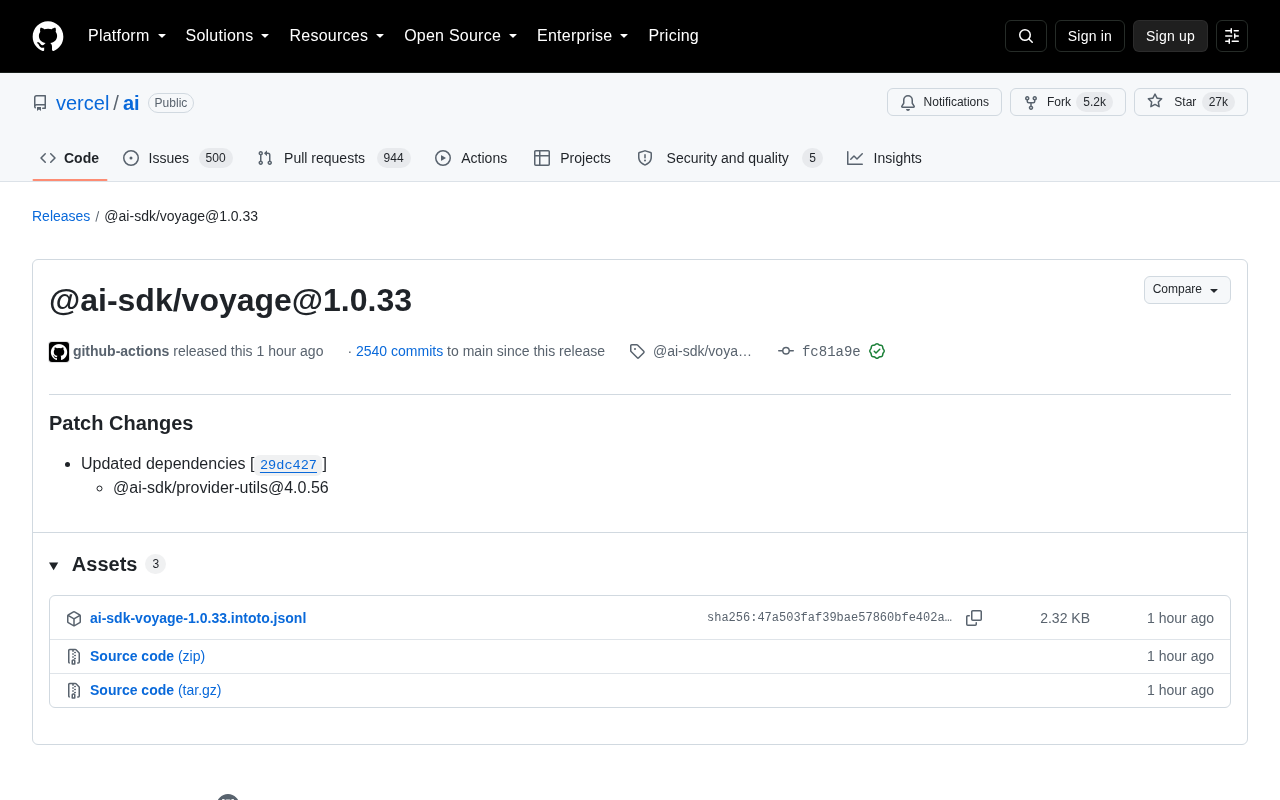
`@ai-sdk/voyage@1.0.33` is a low-risk maintenance release in the Vercel AI SDK ecosystem, with the sole change being an upgrade of the shared utility package `@ai-sdk/provider-utils` to 4.0.56. `@ai-sdk/voyage` is the official provider integration for Voyage AI's embedding and reranking models, primarily used in RAG and semantic search scenarios. This update follows SemVer patch semantics with no breaking changes, automatically triggered by GitHub Actions and verified with a GPG signature.
Vercel's AI SDK ecosystem has recently released @ai-sdk/voyage@1.0.33. This is a patch-level release focused on a dependency update — a minor change, but still worth noting for developers using Voyage AI embedding models.
Update Overview
According to the GitHub Releases page, @ai-sdk/voyage@1.0.33 is a Patch Change, with the core modification being an internal dependency upgrade:
- Updated dependencies: Upgraded
@ai-sdk/provider-utilsto4.0.56
This version was automatically published via GitHub Actions and signed with a verified GitHub signature (GPG key ID: B5690EEEBB952194), ensuring the integrity of the release pipeline. Automated CI-triggered releases like this are a common practice in modern open-source projects for keeping dependencies in sync and maintaining security.
What Is @ai-sdk/voyage
@ai-sdk/voyage is the official Voyage AI integration module provided by the Vercel AI SDK. Voyage AI specializes in high-quality text embedding and reranking models, commonly used in RAG (Retrieval-Augmented Generation), semantic search, document similarity, and related scenarios.
Through this provider package, developers can call Voyage's embedding models via the Vercel AI SDK's unified interface, without needing to write custom adapter logic for each vendor. This "unified provider abstraction" is a core design principle of the Vercel AI SDK — decoupling application-layer code from the underlying models.
RAG (Retrieval-Augmented Generation) is one of the most widely adopted architectural patterns in LLM applications today. The system converts a user's query into a vector (embedding), retrieves semantically similar document chunks from a knowledge base, and feeds those retrieved results as context to the LLM to generate a response. Voyage AI's embedding models play a critical role in this pipeline by converting text into high-quality vectors. Their reranking models can then perform fine-grained scoring on candidate documents after an initial broad retrieval, significantly improving the relevance of the final answer. Compared to general-purpose embedding models, Voyage offers specialized model variants optimized for vertical domains such as code, legal, and finance — which is a key reason it has gained traction in RAG engineering practice.
The Significance of a Patch Update
For developers, patch releases like this typically don't involve breaking changes. The version increment from 1.0.32 to 1.0.33 follows the Semantic Versioning (SemVer) specification at the patch level, meaning it contains only backward-compatible fixes and dependency synchronization.
The upgrade to @ai-sdk/provider-utils is worth paying attention to. This utility package is a shared foundational library used across all AI SDK providers, and updates to it tend to ripple through every provider package that depends on it. In this sense, the voyage release is essentially one link in a coordinated version update across the entire SDK ecosystem.
Should You Upgrade Immediately?
Since this is a pure dependency update, if you're not experiencing any issues with the voyage module, you can update on your regular schedule. However, if @ai-sdk/provider-utils@4.0.56 addresses a bug or security concern you care about, it's worth upgrading sooner. As an active project with over 27,000 stars and 5,200 forks, keeping your dependencies reasonably up to date helps ensure better compatibility support.
The Semantic Versioning (SemVer) specification defines version numbers as a three-part
MAJOR.MINOR.PATCHstructure: MAJOR changes indicate backward-incompatible API breaks; MINOR changes add backward-compatible new features; PATCH changes contain only backward-compatible bug fixes or internal dependency synchronization.@ai-sdk/provider-utils, as a shared foundational utility library within the SDK, is depended upon by all provider packages (including OpenAI, Anthropic, Voyage, and others) for common logic such as request construction, error parsing, and streaming responses. When this library publishes a new version, provider packages typically follow with a patch-level version update to keep the entire ecosystem's dependency graph consistent and avoid hidden compatibility issues caused by version fragmentation.
Summary
@ai-sdk/voyage@1.0.33 is a low-risk maintenance release whose primary purpose is to synchronize an underlying dependency. For teams building RAG or semantic search applications, this serves as a reminder to keep an eye on version evolution across the entire Vercel AI SDK ecosystem — updates to a single provider package often reflect the continuous iteration cadence of the framework as a whole.
Related articles

JobRunner MCP Server: AI Agents Can Now Fix Failed Java Jobs
JobRunner launches an open-source MCP server enabling AI agents to view cluster status, diagnose failures, and recover Java jobs—incident response from any cloud coding environment or existing agent.

MLAI Digital Launches 9 Security Agents: MCP Server Safeguards the Full Lifecycle of Agentic AI
MLAI Digital launches Security MCP Server with nine built-in specialized security agents covering vulnerability discovery, attack simulation, prompt injection detection, API and infrastructure assessment, and accelerated remediation—embedding security validation across the full Agentic AI lifecycle from development to production.

Running Isaac Lab on H100 GPUs: Exploring Better Approaches
Exploring optimization methods for running Isaac Lab on NVIDIA H100 GPUs, including MIG configuration, mixed precision, TensorRT acceleration, and community experience to improve robotics simulation and reinforcement learning efficiency.