Vercel AI SDK Releases @ai-sdk/vue 2.0.263 Patch Update

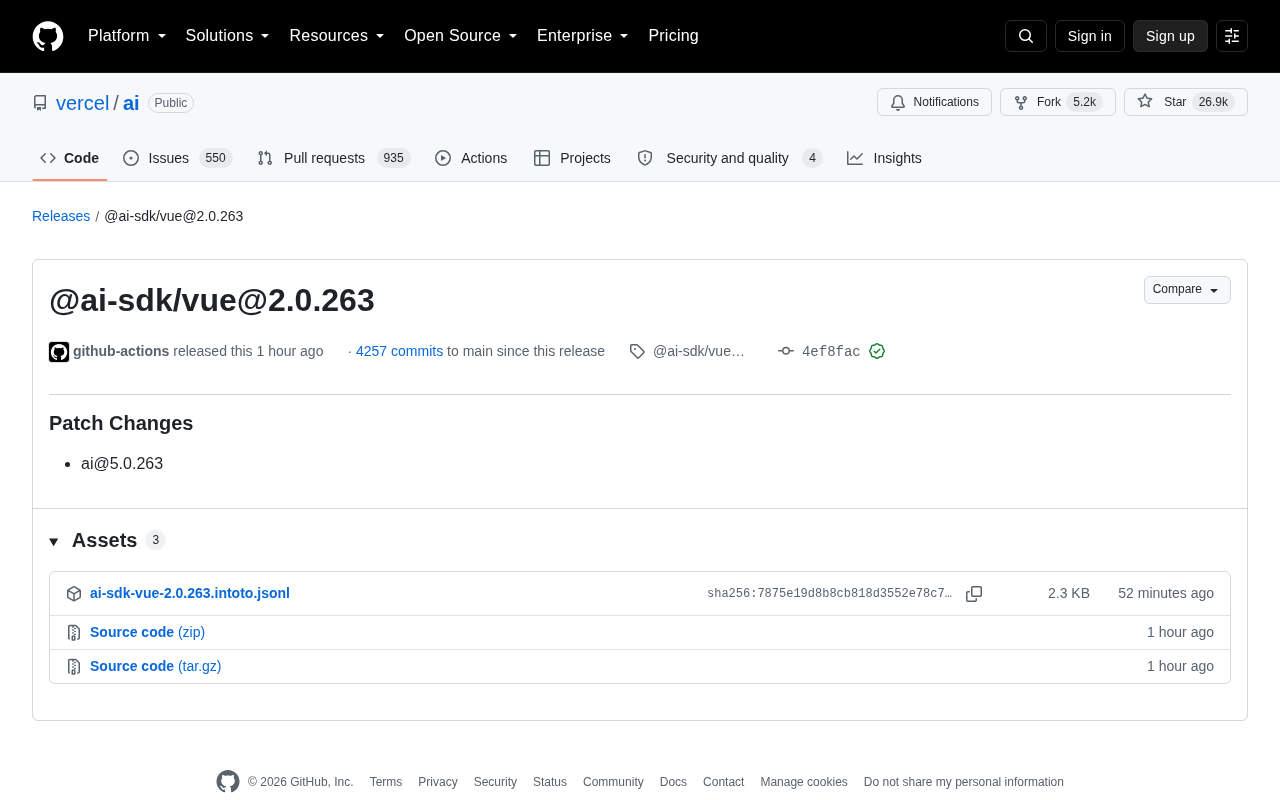
@ai-sdk/vue 2.0.263 patch released, syncing with core package ai@5.0.263 with no breaking changes.
Vercel AI SDK's Vue adapter `@ai-sdk/vue` has released version 2.0.263, a routine dependency alignment update that follows the core package `ai@5.0.263` with no new standalone features or breaking changes. The SDK has surpassed 27,000 GitHub stars and maintains a near-continuous integration release cadence via monorepo architecture and Changesets tooling (4,257+ commits on main). For Vue teams building AI applications, this upgrade is generally safe, but ensure the `ai` core package is updated to the matching version and that lockfiles and regression tests are in place to guard against subtle issues from frequent dependency changes.
Vercel's AI SDK ecosystem continues its rapid iteration cadence, with @ai-sdk/vue recently releasing version 2.0.263. This is a patch-level update, primarily syncing with the core package ai@5.0.263. For developers building AI applications with Vue, updates like this don't introduce breaking changes — but they're still worth paying attention to from an engineering rhythm and ecosystem perspective.
Release Overview
This release was published via Vercel's official GitHub Actions automation pipeline, with commits verified by GitHub's GPG signature (key ID: B5690EEEBB952194), ensuring the integrity and authenticity of the published artifacts. Based on the release notes, @ai-sdk/vue@2.0.263 falls under Patch Changes, with its core change being a dependency alignment — upgrading to ai@5.0.263.
This means the update itself doesn't introduce standalone new features at the Vue adapter layer. Instead, it propagates underlying improvements, bug fixes, or stability optimizations from the main package into the Vue integration package. This "version alignment" release strategy is very common in monorepo projects. Vercel AI SDK uses unified version management to ensure consistency across all framework adapter packages (React, Vue, Svelte, etc.).
A monorepo (monolithic repository) is an engineering practice of managing multiple related packages or projects within a single Git repository. Vercel AI SDK adopts a monorepo architecture, co-maintaining the ai core package alongside framework adapters like @ai-sdk/react, @ai-sdk/vue, and @ai-sdk/svelte. The key advantage of this structure is that cross-package changes can be committed atomically in a single Pull Request, version numbers can increment uniformly, and the classic problem of "an adapter package missing a core package update" is eliminated entirely. At the tooling level, Vercel AI SDK uses Changesets to manage version releases. After merging a PR with a changeset description, the automated pipeline batch-publishes all affected packages and applies tags uniformly. This is why you'll notice @ai-sdk/vue's version number stays tightly in sync with the ai main package — they're both products of the same release pipeline.
Why High-Frequency Patch Updates Are Worth Watching
Vercel AI SDK has accumulated over 27,000 stars and 5,200 forks on GitHub, making it one of the most active AI application development toolkits today. The version numbers alone tell a story: the ai main package has iterated to 5.0.263, and @ai-sdk/vue has reached 2.0.263. The high patch count reflects the team's near-continuous integration release model — this particular release represents the 4,257th commit on the main branch.
For developers, this high-frequency, small-step iteration has two sides. The upside is that bug fixes reach users quickly, feature evolution is smooth, and the migration cost of large one-time version bumps is reduced. The caveat is that frequent dependency version changes require teams to establish reliable lockfile management and regression testing practices, to avoid hard-to-detect behavioral changes introduced by automatic upgrades.
Practical Impact for Vue Developers
@ai-sdk/vue is Vercel AI SDK's official adapter for the Vue ecosystem, providing capabilities for calling large language models, handling streaming responses, and managing conversation state within Vue components. For projects currently using this package, upgrading to 2.0.263 is generally safe — patch versions follow Semantic Versioning, which theoretically means no breaking API changes.
The recommended upgrade path is to update to the latest patch version via your package manager, while ensuring the ai core package is simultaneously upgraded to the matching 5.0.263, to avoid type incompatibilities or runtime issues caused by version mismatches. After upgrading, run your existing test suite to verify that key code paths — such as streaming output and message handling — behave as expected before deploying with confidence.
Semantic Versioning (SemVer) defines version numbers as a three-part MAJOR.MINOR.PATCH structure: MAJOR indicates breaking API changes, MINOR indicates backward-compatible new features, and PATCH indicates backward-compatible bug fixes. The 263 in @ai-sdk/vue@2.0.263 is the PATCH segment, meaning upgrades should theoretically be safe without breaking existing code. Worth noting is the role of lockfiles (package-lock.json or pnpm-lock.yaml) in this system: they precisely record the exact version of every installed dependency, ensuring that team members and CI environments install identical dependency trees. When dealing with rapidly iterating dependency libraries, committing and maintaining your lockfile is the first line of defense against "works on my machine" issues.
Summary
Taken in isolation, the @ai-sdk/vue@2.0.263 patch itself carries limited information: it's a routine sync update following ai@5.0.263, with no standalone new features. But viewed within the broader iteration context of Vercel AI SDK, it reflects the project's stable and intensive maintenance cadence — which is itself an important indicator for evaluating whether an open-source foundational library is worth long-term adoption. For teams on the Vue stack, staying current with updates like this is simply part of the day-to-day work of keeping an AI application healthy.
Related articles

Chain of Thought Isn't Just for AI: How Humans Can Use CoT to Improve Thinking Quality
Chain of Thought isn't just a prompt trick for large models. Starting from a Hacker News discussion, this article analyzes why CoT works for human thinking too, breaks down actionable ways to transfer it, and highlights the key differences between human CoT and machine CoT.
Cloudflare Teams Up with OpenAI: Closi…
Cloudflare Teams Up with OpenAI: Closing the Loop from Vulnerability Discovery to Defense with AI
Cloudflare uses OpenAI Daybreak to investigate security vulnerabilities and generate reviewable remediation plans, while developers use Codex to boost coding efficiency and quality.

Orca Multi-Agent Orchestration in Practice: A Guide to Parallel Collaboration with Claude and Codex
Orca is Stable AI's free open-source agent workbench supporting 34 agents like Claude Code and Codex in parallel. Learn its Git worktree isolation, multi-model orchestration, and mobile management.