Vercel AI SDK Releases @ai-sdk/vue@3.0.289 Patch Update

Vercel AI SDK releases @ai-sdk/vue@3.0.289 patch to sync core library dependencies.
The Vercel AI SDK Vue adapter `@ai-sdk/vue` has released version `3.0.289`, a patch update that primarily syncs two underlying dependencies: `ai@6.0.289` and `@ai-sdk/provider-utils@4.0.53`. Per Semantic Versioning, patch updates contain no breaking changes, making the upgrade low-risk with no code modifications required. Developers are advised to upgrade the `ai` core library in tandem to avoid version mismatches. This update reflects Vercel AI SDK's ongoing commitment to dependency consistency across its SDK family, a project that has grown to ~26.9k GitHub stars.
Vercel's open-source AI SDK project recently released @ai-sdk/vue@3.0.289. This is a patch-level update focused primarily on syncing dependency versions. While the changes are modest, Vue developers building AI applications with the Vercel AI SDK should still take note.
Update Overview
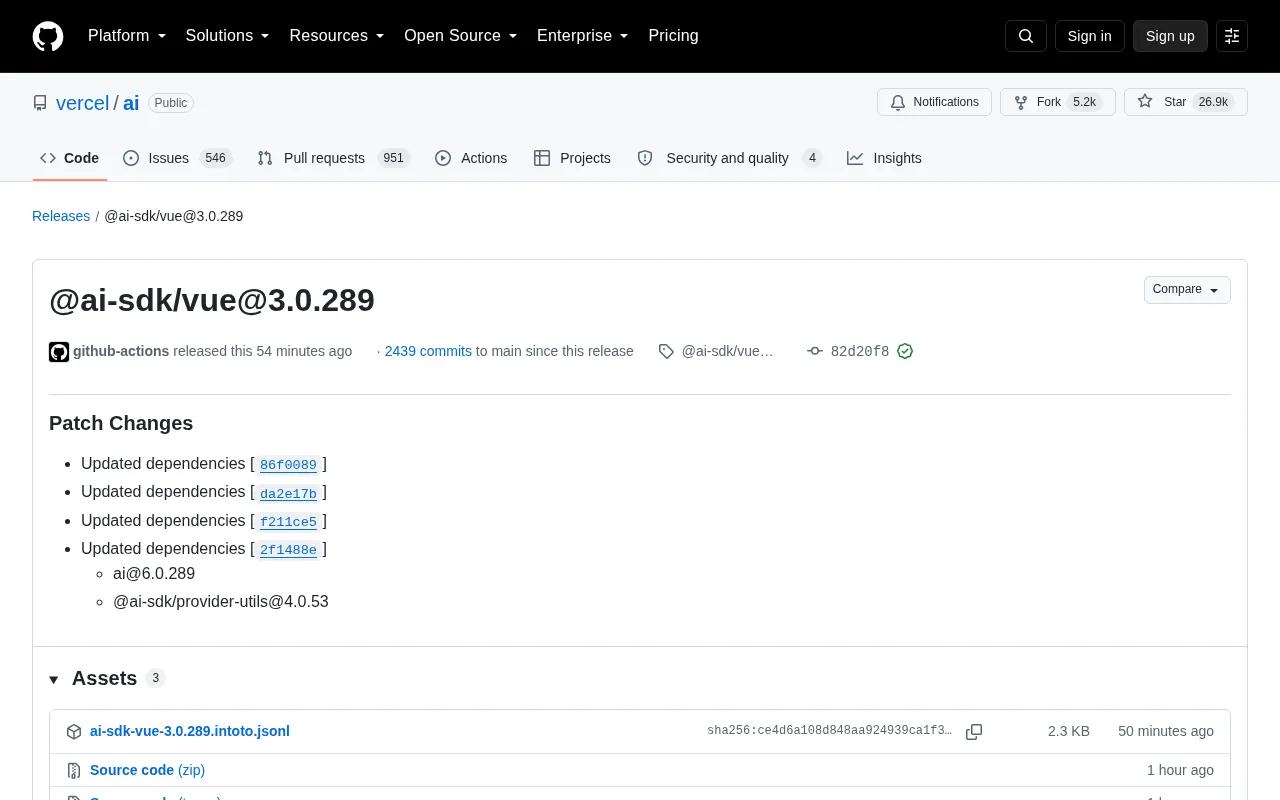
The @ai-sdk/vue@3.0.289 release falls under Patch Changes, with the core changes centered on dependency version synchronization rather than new features or breaking changes. According to the GitHub Release page, this update involves the following dependency upgrades:
ai@6.0.289@ai-sdk/provider-utils@4.0.53
The release notes list several updated dependency commits (with commit hashes 86f0089, da2e17b, f211ce5, and 2f1488e). This ensures the Vue adapter package stays in sync with the underlying ai core library and the provider-utils utility library.
What a Patch Update Means
From a Semantic Versioning perspective, a patch update typically represents backward-compatible fixes and minor adjustments with no significant API changes. These updates are often triggered by iterations in underlying dependencies — when the core ai library upgrades, the various framework adapters (Vue, React, Svelte, etc.) release corresponding sync versions to maintain consistency across the entire SDK family.
For developers, this type of update is generally safe to apply without worrying about compatibility issues in existing code. That said, it's still good practice to review the ai@6.0.289 core library changelog before upgrading in production, to confirm whether the underlying changes include any fixes that may affect your business logic.
Semantic Versioning (SemVer) uses a three-part numbering scheme:
MAJOR.MINOR.PATCH. A major version change indicates incompatible, breaking API changes; a minor version change adds backward-compatible new features; and a patch version change represents only backward-compatible bug fixes or internal adjustments. In this release,@ai-sdk/vueupgrades to3.0.289with the3remaining unchanged, meaning there are no API-level compatibility risks — developers can upgrade without modifying any existing call code. This convention is widely supported by JavaScript package managers like npm and pnpm, where a version range like^3.0.xwill automatically accept such patch updates.
About Vercel AI SDK
Vercel AI SDK is one of the more popular toolkits for building AI-powered applications, with its GitHub repository having accumulated approximately 26.9k stars and 5.2k forks, reflecting a fairly active community. The SDK provides a unified, cross-framework interface that helps developers more easily integrate large language model capabilities — including streaming responses and tool calling — into web applications.
@ai-sdk/vue, as the official adapter package for the Vue framework, allows Vue developers to access AI capabilities in a Vue-idiomatic way (e.g., via the Composition API). The frequent release cadence also reflects the project's tight maintenance rhythm — the repository has accumulated over 2,400 commits since its branching point.
@ai-sdk/provider-utilsis a foundational utility library within the Vercel AI SDK ecosystem responsible for handling common provider logic, including request formatting, error handling, and response parsing shared across providers. When developers integrate different large language models such as OpenAI, Anthropic, or Google Gemini, this library handles the differences between each provider's API behind the scenes, freeing upper-level business code from dealing with provider-specific protocol details. Because it sits at the bottom of the dependency chain, a new version release typically requires the framework adapters (vue, react, svelte) to sync up as well — which is exactly the mechanism driving this patch update.
Recommendations for Developers
For projects currently using @ai-sdk/vue, you can upgrade the dependency to 3.0.289 using your package manager of choice (npm, pnpm, or yarn). Since this is a patch update, the upgrade risk is low. If your project also depends on the ai core library, it's recommended to sync it to 6.0.289 at the same time to avoid potential issues from version mismatches.
Overall, this release is a routine maintenance update in Vercel AI SDK's continuous iteration cycle, reflecting the project's commitment to dependency consistency and stability. Keeping an eye on the official Release page remains the best way to stay on top of updates like this.
Related articles

Coinbase Engineer: How to Determine Whether an AI Agent Can Operate Unattended
Coinbase engineer Evan Kormos shares an engineering method for judging whether an AI agent can run unattended: model processes with DAG/DCG, replace output comparison with statistical evaluation, and hand over control in three phases—supervision, sampling, and exception handling.

WorkBuddy Beginner's Guide: How AI Agents Automate Office Tasks
WorkBuddy tutorial: learn how this desktop AI agent workbench automates files, organizes data, and generates documents, compared with LLMs and Codex, plus a beginner path and cost analysis.

Doubao Work in Practice: Three Modes That Let AI Actually Get Work Done
Doubao Work practical tutorial: from chat mode to Work Mode Lite and Pro, explaining the logic for choosing among three modes with real office task demonstrations. Even complete beginners can learn to use an AI agent to handle local files, organize materials, and generate documents.