Vercel AI SDK Releases @ai-sdk/workflow 2.0.38: Fix for Deferred Tool Discovery

Vercel AI SDK workflow 2.0.38 patches deferred tool discovery in WorkflowAgent and syncs core dependencies.
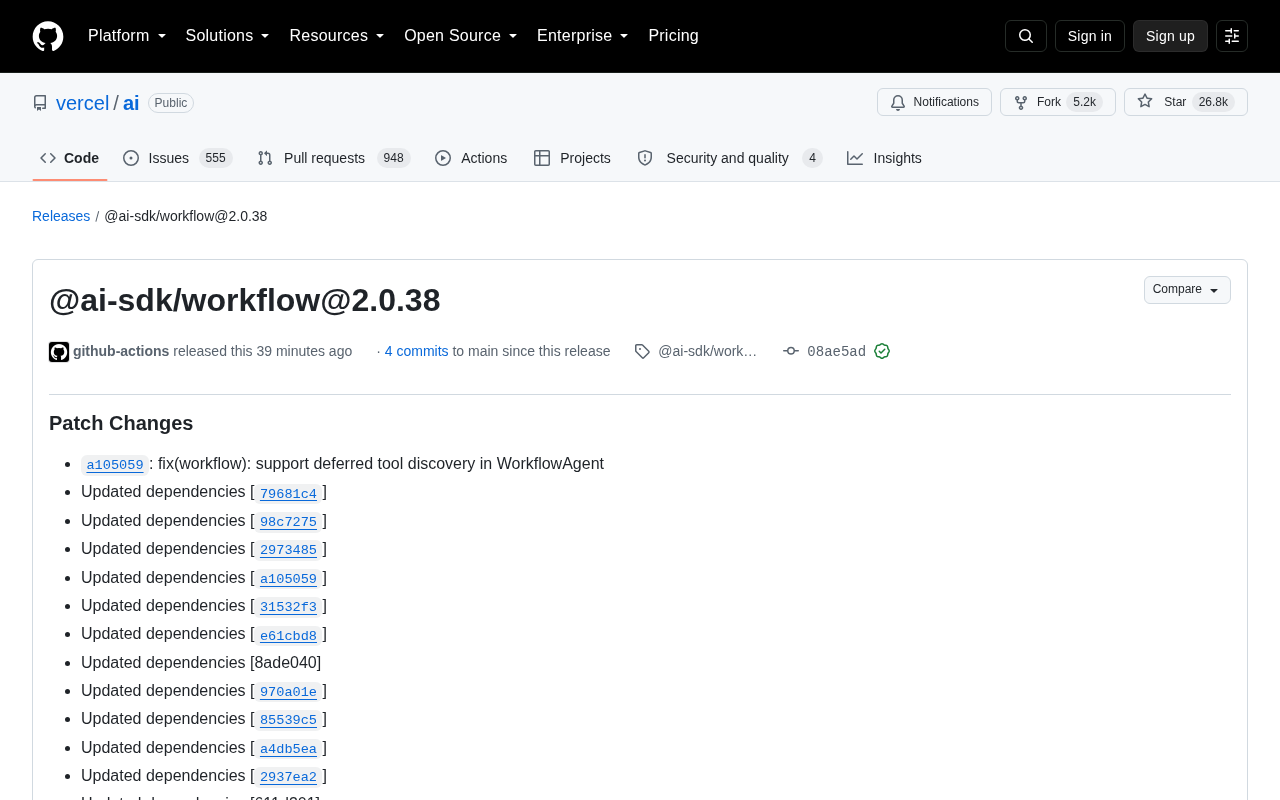
`@ai-sdk/workflow@2.0.38` is a patch-level update in the Vercel AI SDK ecosystem. Its core fix enables `WorkflowAgent` to properly support deferred tool discovery — allowing agents to dynamically resolve available tools at runtime rather than statically at initialization, which is critical for permission-driven or context-aware complex workflows. The update also advances core dependencies to `ai@7.0.107` and `@ai-sdk/provider-utils@5.0.45`, incorporating over ten upstream fixes. As a non-breaking patch release, the upgrade risk is low and developers affected by the issue are encouraged to update.
Vercel's open-source AI SDK ecosystem has received another minor update. @ai-sdk/workflow@2.0.38 has been officially released as a patch release, with its core change being a fix for deferred tool discovery support in WorkflowAgent, along with a series of upstream dependency updates. While this is only a patch-level update, it's still worth understanding what these changes mean for developers building agentic workflows with the AI SDK.
Core Change: Deferred Tool Discovery
The primary commit in this release (a105059) is tagged as fix(workflow): support deferred tool discovery in WorkflowAgent, meaning WorkflowAgent now better supports deferred tool discovery.
In agent architectures, "tool discovery" refers to the process of determining at runtime which tools an agent can call. "Deferred discovery" typically means the tool set doesn't need to be fully determined at agent initialization — it can be dynamically resolved and loaded during execution. This is especially important for complex workflow scenarios where available tools need to be determined dynamically based on context, user permissions, or external state. This capability previously had a defect in WorkflowAgent, which this version fixes.
From a technical implementation standpoint, deferred tool discovery is typically achieved by changing the tool list from a static array to an async function (or Promise). The agent calls this function before each reasoning loop to dynamically retrieve the currently available set of tools. This mechanism is particularly critical in scenarios such as: multi-tenant systems where different users have different permissions corresponding to different tool sets; tools that need to be dynamically loaded through an external registry (such as an MCP Server); or workflows where prior steps affect the range of tools available to subsequent steps. Static tool discovery, by contrast, requires all available tools to be determined at agent instantiation, limiting flexibility. This fix indicates that WorkflowAgent previously had a timing or assignment defect when handling async tool resolution, causing dynamically loaded tools to fail to register correctly into the reasoning context.
Extensive Dependency Sync Updates
Beyond the fix to the workflow package itself, version 2.0.38 also includes a large-scale synchronization of underlying dependencies, spanning more than ten upstream commits. Most notably, the core runtime versions have been bumped:
ai@7.0.107@ai-sdk/provider-utils@5.0.45
These dependency updates reference multiple commits including 79681c4, 98c7275, 2973485, 31532f3, and others. In a monorepo-structured SDK project, this kind of cascading update is very common — the workflow package depends on the core ai package and provider utilities, and upstream fixes are often propagated downstream in the form of patches. For users, this means upgrading the workflow package automatically brings in multiple improvements and fixes from the core library.
Monorepo (single repository) is a common architectural pattern for managing multi-package SDK projects. Vercel AI SDK uses pnpm workspaces to organize dozens of sub-packages. In this structure, @ai-sdk/workflow's dependencies on the ai core package and @ai-sdk/provider-utils are explicitly declared, with version locks pinned to the patch level. When an upstream package publishes a fix, maintainers need to manually or via automation scripts (such as Changesets) synchronize the dependency version numbers to the downstream packages' package.json files and then publish them together. This is why a seemingly simple workflow fix comes bundled with over ten upstream commit references — those commits represent upstream changes already released separately, and this update locks the corresponding versions together in the workflow package's dependency manifest, ensuring users get a consistent, verified dependency combination upon installation.
Vercel AI SDK's Position and Ecosystem
Vercel's AI repository currently has approximately 26.8k stars and 5.2k forks on GitHub, making it one of the mainstream toolkits for building AI applications in the JavaScript/TypeScript ecosystem. It provides a unified interface for connecting to different model providers and encapsulates common capabilities such as streaming responses, tool calling, and structured output.
@ai-sdk/workflow is a relatively newer piece of this ecosystem, focused on organizing AI capabilities into orchestratable workflows. Compared to single model calls, the Workflow and Agent abstractions are better suited for handling complex, multi-step tasks that require tool collaboration. This fix for deferred tool discovery in WorkflowAgent is precisely about improving the robustness of this layer of capability.
What Developers Should Take Away
As a patch release, 2.0.38 introduces no breaking changes, making the upgrade low-risk. If you're using WorkflowAgent and have encountered issues where tools couldn't be correctly discovered at runtime, this update is worth applying promptly.
For projects that depend on the AI SDK core library, syncing the upgrade to ai@7.0.107 will also bring in the cascading upstream fixes. It's recommended to review the complete changelog and individual upstream commit notes before upgrading to assess whether any changes are relevant to your use case.
It's worth noting that the release notes themselves are fairly minimal — the official release only lists the core fix and dependency changes, without more detailed feature demonstrations or migration guides. Developers looking to dive deeper into the specifics of deferred tool discovery usage will still need to consult the official documentation and source code.
Related articles

Chain of Thought Isn't Just for AI: How Humans Can Use CoT to Improve Thinking Quality
Chain of Thought isn't just a prompt trick for large models. Starting from a Hacker News discussion, this article analyzes why CoT works for human thinking too, breaks down actionable ways to transfer it, and highlights the key differences between human CoT and machine CoT.
Cloudflare Teams Up with OpenAI: Closi…
Cloudflare Teams Up with OpenAI: Closing the Loop from Vulnerability Discovery to Defense with AI
Cloudflare uses OpenAI Daybreak to investigate security vulnerabilities and generate reviewable remediation plans, while developers use Codex to boost coding efficiency and quality.

Orca Multi-Agent Orchestration in Practice: A Guide to Parallel Collaboration with Claude and Codex
Orca is Stable AI's free open-source agent workbench supporting 34 agents like Claude Code and Codex in parallel. Learn its Git worktree isolation, multi-model orchestration, and mobile management.