Vercel AI SDK Releases @ai-sdk/workflow 2.0.39 Patch Update

Vercel AI SDK's workflow module releases v2.0.39, a low-risk patch syncing the core ai package to 7.0.108.
The `@ai-sdk/workflow` module in the Vercel AI SDK has released version 2.0.39 — a patch-level update focused on dependency syncing with no new features or breaking changes. The key change is aligning the core `ai` package dependency to 7.0.108, referencing several upstream commits. The release was automated via GitHub Actions with a GPG-verified signature. Following SemVer conventions, this backward-compatible patch is safe to upgrade, though developers should ensure the `ai` package is synced accordingly and validate in a test environment first. The Vercel AI SDK currently has around 27,000 GitHub stars and maintains a high-frequency release cadence.
Vercel's widely adopted AI SDK ecosystem has released @ai-sdk/workflow@2.0.39. This is a patch-level release focused on dependency updates, targeting developers who use the Vercel AI SDK to build AI workflows.
What's in This Update
According to the GitHub Releases page, @ai-sdk/workflow@2.0.39 is a patch update (Patch Changes), with core changes centered on syncing upstream dependencies rather than introducing new features or breaking changes.
The release notes indicate that this update syncs multiple upstream dependency changes, referencing commits 3f6852a, 6317504, 3cb2dcd, and ccf98e7. The core ai package has also been bumped to 7.0.108. This means the workflow package update is primarily aimed at maintaining version alignment with the main SDK.
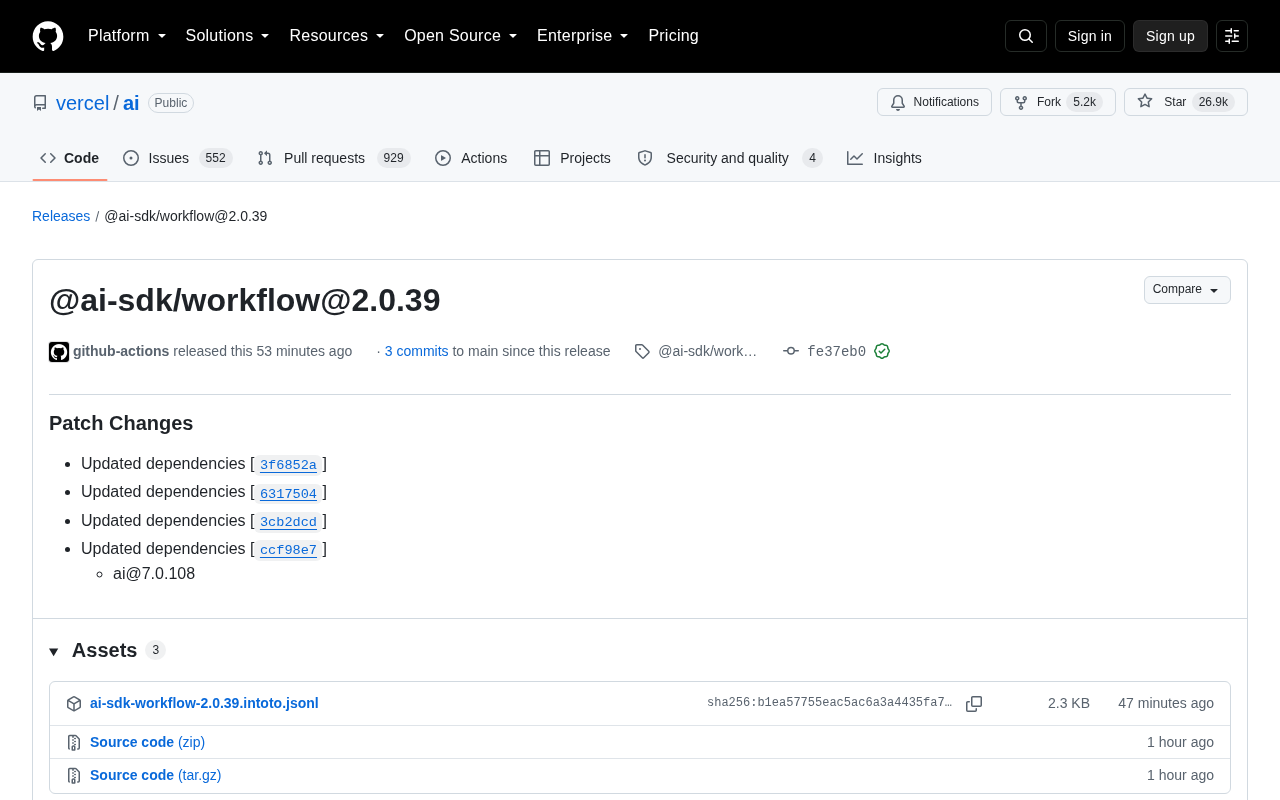
This version was automatically published on September 21st via GitHub Actions and signed with GitHub's verified GPG key (ID: B5690EEEBB952194), ensuring the integrity and trustworthiness of the release artifact.
What a Patch Update Means
For projects following Semantic Versioning (SemVer), an increment in the patch version number (from 2.0.x to 2.0.39) typically represents backward-compatible fixes or dependency syncs. Developers can generally upgrade with confidence, without worrying about API-level compatibility issues.
@ai-sdk/workflow is the module within the Vercel AI SDK responsible for orchestrating AI workflows. In practice, it is often used alongside the core ai package. Since this update explicitly documents a dependency sync against ai@7.0.108, teams actively using these capabilities are encouraged to upgrade both packages together to avoid potential issues caused by mismatched dependency versions.
The SemVer specification defines version numbers in a
MAJOR.MINOR.PATCHstructure: MAJOR changes indicate breaking API modifications, MINOR changes introduce new backward-compatible features, and PATCH changes include only backward-compatible bug fixes or internal dependency syncs. For frequently iterated ecosystem packages like@ai-sdk/workflow, PATCH updates are often used to pin upstream dependencies to a validated version combination, preventing runtime errors caused by inconsistencies across sub-packages. This "dependency pinning" mechanism is especially common in monorepo-style projects — and the Vercel AI SDK is indeed managed as a monorepo. The workflow module and the coreaipackage share a tight version coupling, making it standard practice to follow the main package with patch releases to maintain ecosystem consistency.
The Vercel AI SDK Ecosystem
Vercel's AI repository currently has approximately 27,000 stars and 5,200 forks on GitHub, making it one of the go-to toolchains for building AI applications in the JavaScript/TypeScript ecosystem. The frequent release cadence — with continuous commits to the main branch prior to this release — reflects a high-frequency maintenance pace from the team.
For developers, this rapid iteration brings continuous capability enhancements, but also means keeping an eye on changelogs and syncing dependencies in a timely manner. Patch releases like this one are a routine mechanism for keeping the entire SDK ecosystem in version harmony.
The Vercel AI SDK, which includes
@ai-sdk/workflow, is an open-source framework for JavaScript/TypeScript that addresses the engineering challenges of integrating large language models (LLMs) in environments like Next.js and Node.js. It abstracts the differences between model providers such as OpenAI, Anthropic, and Google through a unified Provider interface, and offers out-of-the-box capabilities including streaming responses, structured output, and tool calling. The@ai-sdk/workflowmodule specifically focuses on orchestrating multi-step AI tasks, allowing developers to define data flows and conditional branching between nodes in a declarative way — well-suited for building RAG pipelines, agent loops, and other complex scenarios. The rapid star growth and high release velocity reflect a community in a fast adoption phase, with the toolchain itself continuously expanding alongside evolving model capabilities.
Recommendations for Developers
If your project is currently using @ai-sdk/workflow, you can upgrade directly to 2.0.39 via your package manager, and make sure the ai package is synced to 7.0.108. Since this is a patch update, the upgrade risk is low — but it's still recommended to validate in a test environment before deploying to production.
Note that the release notes for this update do not disclose specific issues that were fixed; they only list the commit references for dependency updates. If you need more granular details on what changed, you can look up the corresponding commit hashes directly in the repository.
Related articles

Python 3.15 New Feature: Is the sentinel Type Better Than None?
Python 3.15 adds the sentinel type, using named unique sentinel objects to replace None and bare object(), resolving confusion among missing values, explicit emptiness, and invalid input while avoiding type hint failures.

Deep Learning's Three Architectures and the Universal Approximation Theorem: A Complete Guide to MLPs, CNNs, and Transformers
Explaining the inductive bias differences among MLP, CNN, and Transformer, the existence meaning of the Universal Approximation Theorem (UAT), and the role of Taylor expansion in approximation analysis, while clearing up common misconceptions.

GitLab Emergency Patch Release: Analysis of Critical Security Fixes
GitLab releases critical patch 19.5.1, sparking 355 points of discussion on Hacker News. This article analyzes the background, upgrade steps for self-hosted instances, and verification points to help DevOps teams respond quickly to security updates.