Vercel AI SDK Releases @ai-sdk/workflow 2.0.43 Patch Update

Vercel AI SDK releases @ai-sdk/workflow 2.0.43, a low-risk patch update syncing core dependencies.
Vercel AI SDK's `@ai-sdk/workflow` module has released version 2.0.43, a typical dependency-cascade patch update driven by upstream upgrades to `ai@7.0.112`, `@ai-sdk/provider@4.0.18`, and `@ai-sdk/provider-utils@5.0.46`, with no breaking changes. Published via GitHub Actions and verified with a GPG signature, the update is safe for production use. The `@ai-sdk/workflow` module enables developers to build multi-step, composable AI workflows for complex LLM chaining and tool-use scenarios. Following SemVer, patch updates carry minimal risk and require only routine regression testing before deployment.
Update Overview
Vercel's AI SDK project has released @ai-sdk/workflow@2.0.43. This is a patch-level update focused primarily on syncing upstream dependencies, with no breaking changes introduced. For developers building AI applications with this workflow module, this is a routine upgrade you can apply with confidence.
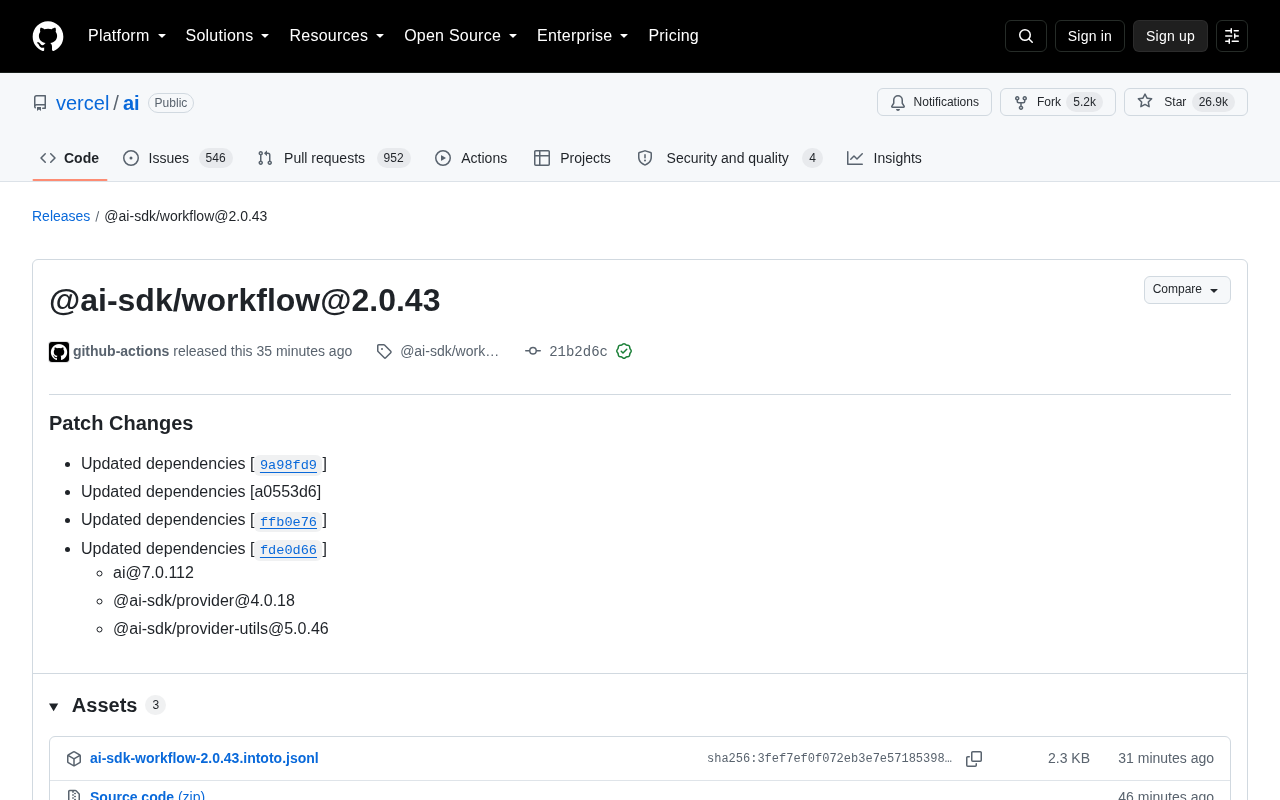
As a popular open-source project with approximately 27,900 stars and over 5,200 forks on GitHub, every release in the Vercel AI ecosystem draws attention from a large number of frontend and full-stack developers. This update was published via GitHub Actions automation and signed with a verified GPG key (ID: B5690EEEBB952194), ensuring the authenticity of the release artifacts.
What's Included in This Update
According to the release notes, 2.0.43 is a classic "dependency cascade" update. The specific patch changes originate from synced upgrades across multiple upstream dependencies, corresponding to commits 9a98fd9, a0553d6, ffb0e76, and fde0d66.
The following core dependencies were also updated alongside this release:
ai@7.0.112— the core runtime package of the AI SDK@ai-sdk/provider@4.0.18— the model provider abstraction layer@ai-sdk/provider-utils@5.0.46— provider utility functions
This design reflects the monorepo architecture adopted by the AI SDK: core packages and feature modules maintain version alignment, so any fixes or improvements at the lower level propagate upward to modules like workflow as patches, ensuring consistency across the entire toolchain.
Background: Monorepo Architecture A monorepo (single repository, multiple packages) is a common code organization pattern for large JavaScript/TypeScript projects, and Vercel AI SDK uses exactly this structure — housing dozens of packages such as
ai(core runtime),@ai-sdk/provider(model provider abstraction), and@ai-sdk/workflow(workflow orchestration) in a single repository. The main advantage is that cross-package changes can be committed atomically in a single PR with clear, traceable dependency relationships. The tradeoff is that any version change in a lower-level package triggers cascading releases in dependent packages, leading to rapidly incrementing version numbers.@ai-sdk/providerdefines a unified interface for integrating with different LLM providers like OpenAI, Anthropic, and Google, while@ai-sdk/provider-utilsprovides shared utilities such as request retrying and stream parsing — together forming the foundational infrastructure that enables the SDK to work across providers.
The Role of the workflow Module
@ai-sdk/workflow is a relatively new orchestration module in the Vercel AI SDK ecosystem, designed to help developers build multi-step, composable AI workflows. Compared to making a single model generation call directly, the workflow module is better suited for complex scenarios that require chaining multiple LLM calls, tool usage, and conditional branching.
The 2.0.x version number indicates the module is still in an actively evolving stage. Frequent small patch releases are a sign of a healthy open-source infrastructure project, and mean that upstream fixes can quickly reach production applications.
Background: Workflow Orchestration In AI application development, workflow orchestration addresses the challenge of "how to combine multiple AI capabilities in an ordered, structured way." Typical use cases include: first using an LLM call to extract user intent, then routing to different tool calls based on that intent, and finally aggregating results to generate a response.
@ai-sdk/workflowprovides declarative primitives to describe these kinds of flows, so developers don't need to manually manage async call chains, error retries, or intermediate state passing. It's conceptually similar to LangChain's Chain/Agent abstractions, Microsoft's AutoGen, or Dify's workflow canvas — but deeply integrated into the Vercel AI SDK's TypeScript ecosystem. It can directly reuse primitives likestreamTextandgenerateObjectfrom theaicore package, and has native support for frameworks like Next.js and Nuxt.
What Developers Should Do
For teams already running the AI SDK in production, patch updates are generally low-risk. Under Semantic Versioning (SemVer), patch-level changes are guaranteed not to break existing APIs, so upgrading to 2.0.43 typically requires only standard regression testing.
Developers are encouraged to review the full changelog for the core ai@7.0.112 package, since this workflow update is fundamentally a response to those underlying changes. If your project also uses provider-related features, simultaneously upgrading @ai-sdk/provider and @ai-sdk/provider-utils will help avoid potential version mismatch issues.
Overall, this is a solid maintenance release that reflects the Vercel team's ongoing commitment to polishing the AI SDK toolchain.
Related articles

Chain of Thought Isn't Just for AI: How Humans Can Use CoT to Improve Thinking Quality
Chain of Thought isn't just a prompt trick for large models. Starting from a Hacker News discussion, this article analyzes why CoT works for human thinking too, breaks down actionable ways to transfer it, and highlights the key differences between human CoT and machine CoT.
Cloudflare Teams Up with OpenAI: Closi…
Cloudflare Teams Up with OpenAI: Closing the Loop from Vulnerability Discovery to Defense with AI
Cloudflare uses OpenAI Daybreak to investigate security vulnerabilities and generate reviewable remediation plans, while developers use Codex to boost coding efficiency and quality.

Orca Multi-Agent Orchestration in Practice: A Guide to Parallel Collaboration with Claude and Codex
Orca is Stable AI's free open-source agent workbench supporting 34 agents like Claude Code and Codex in parallel. Learn its Git worktree isolation, multi-model orchestration, and mobile management.