Vercel AI SDK Releases @ai-sdk/workflow 2.0.48 Patch Update

Vercel AI SDK releases @ai-sdk/workflow 2.0.48 patch, syncing core dependency to [email protected].
`@ai-sdk/[email protected]` is a patch-level update to Vercel AI SDK's workflow sub-package, with its primary change being a dependency sync to `[email protected]`. The sub-package is designed for multi-step, multi-model AI workflow orchestration and maintains tight version coupling with the core `ai` package. Built automatically via GitHub Actions with an official GPG signature, this release reflects Vercel's best practices in CI/CD and supply chain security. While patch updates are generally backward-compatible and low-risk, developers should cross-reference the `[email protected]` changelog for behavioral details and validate multi-step orchestration logic in a test environment.
A Routine but Noteworthy Patch Release
Vercel's open-source AI SDK project recently released @ai-sdk/[email protected]. According to the GitHub Release notes, this is a patch-level update whose primary change is a dependency bump to [email protected]. The release was built automatically via GitHub Actions on September 27th and carries GitHub's verified GPG signature (key ID: B5690EEEBB952194), ensuring the authenticity of the published artifacts.
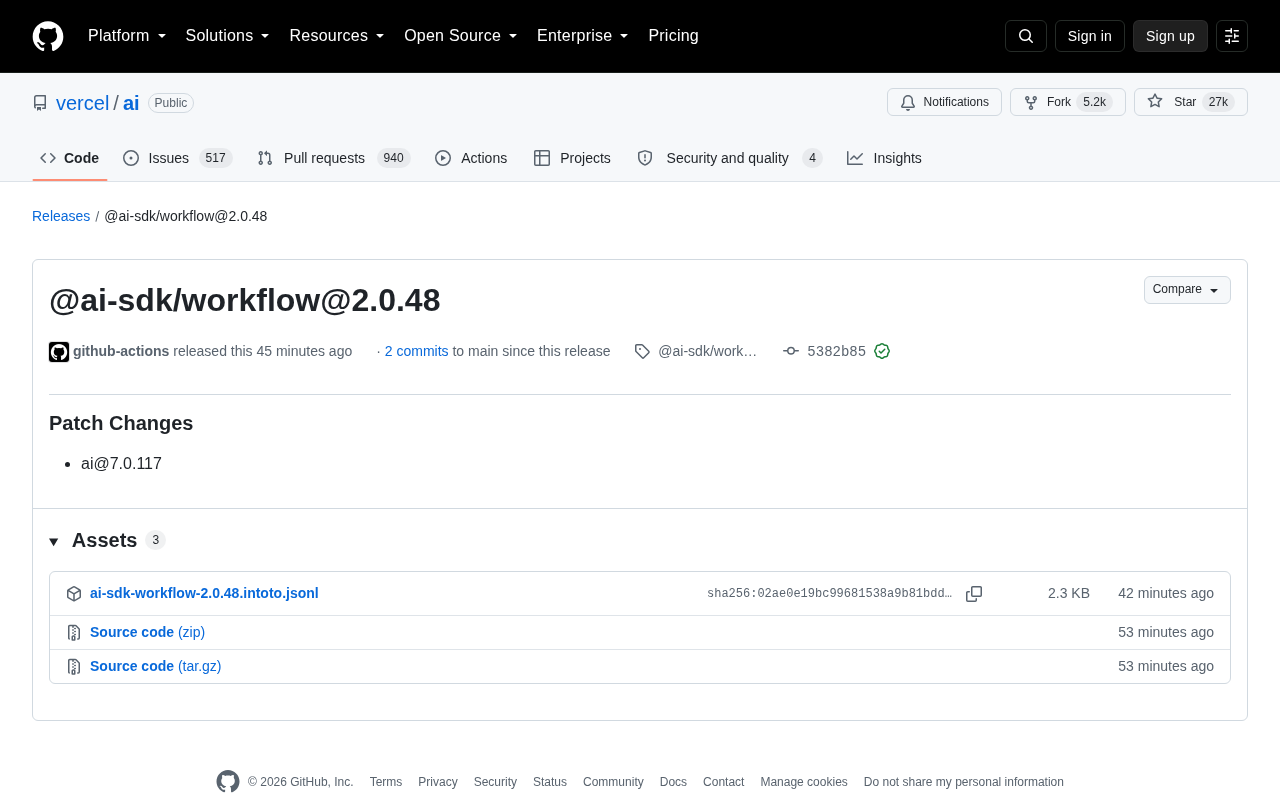
For developers who closely follow the Vercel AI ecosystem, high-frequency patch releases like this are nothing new. The ai repository has accumulated over 27k stars and 5.2k forks, making it one of the most widely adopted toolkits for building AI-powered applications — especially for frontend AI integrations with Next.js. The rapid cadence of minor releases reflects the active engineering rhythm behind the project.
What Is @ai-sdk/workflow
@ai-sdk/workflow is a sub-package within the Vercel AI SDK family, designed for orchestrating complex AI workflows. Rather than handling single model requests, the workflow module is better suited for multi-step, multi-model tasks with conditional branching — for example, chaining retrieval, generation, and validation steps together.
It maintains a tight version coupling with the core ai package. The key change in version 2.0.48 is syncing the underlying dependency to [email protected], meaning the workflow module inherits any capability updates and bug fixes introduced in that core release. This dependency linkage is central to understanding Vercel AI SDK's versioning strategy — sub-packages tend to roll forward alongside core package iterations.
From a technical standpoint, the core value of AI workflow orchestration lies in abstracting away the boilerplate that developers would otherwise manage manually: async chained calls, error retries, and state passing. These are replaced with declarative or composable task graphs. Take a typical RAG (Retrieval-Augmented Generation) scenario: in a traditional approach, you'd manually wire together "vector retrieval → context assembly → LLM inference → result validation" and handle intermediate state yourself. A workflow module lets you define these steps as nodes, with the framework handling scheduling, parameter passing, and error handling. This pattern often appears in the industry as DAG (Directed Acyclic Graph) task scheduling. @ai-sdk/workflow integrates deeply with Vercel AI SDK's model-calling capabilities, enabling frontend and full-stack JavaScript developers to build multi-step AI applications within a familiar ecosystem — without needing to reach for Python-based frameworks like LangChain or LlamaIndex.
What a Patch Update Means for Developers
Patch versions, per semantic versioning conventions, represent backward-compatible bug fixes or dependency syncs — no breaking changes. In most cases, projects using @ai-sdk/workflow can upgrade to 2.0.48 with confidence.
That said, since this release only documents a dependency upgrade ([email protected]) in the release notes, any behavioral differences would need to be confirmed by cross-referencing the core ai package's changelog for that version. Before upgrading, developers should consider:
- Reviewing the full changelog for
[email protected]to check for any workflow-related behavioral changes; - Validating in a test environment first, especially for production projects with complex multi-step orchestration logic;
- Auditing transitive dependencies in your lockfile to avoid hidden version drift.
What the Release Cadence Reveals About Vercel AI SDK's Maturity
The release process itself is worth noting. This version was created automatically by GitHub Actions and includes an official verified signature, reflecting Vercel's disciplined approach to CI/CD and software supply chain security. For enterprise adopters, verifiable release signatures help mitigate risks like dependency poisoning attacks.
High-frequency patch releases are a double-edged sword: on one hand, they signal active maintenance and fast response to issues; on the other, they require teams to establish solid dependency update and regression testing processes to avoid constantly playing catch-up. For teams that have deeply embedded the AI SDK into their products, building an automated dependency upgrade and testing pipeline is the more sustainable approach.
Software supply chain security has become an increasingly critical topic in the open-source ecosystem. The 2021 SolarWinds incident and various npm malicious package injection cases made the industry acutely aware that build artifacts can be tampered with at any point between source code and end users. GPG signature verification is one of the primary defenses against this risk: the publisher signs the release artifact with a private key, and users can verify it with the corresponding public key to confirm the artifact hasn't been altered in transit, establishing a verifiable chain of trust. GitHub introduced official signing support for Actions-published artifacts in 2022 (via the Sigstore/cosign ecosystem), significantly lowering the barrier for project maintainers to implement signing. Vercel AI SDK's integration of this mechanism into its automated release pipeline means enterprise adopters can incorporate signature verification into their own dependency approval workflows — benefiting from frequent iterations and new features without sacrificing control over the provenance of build artifacts.
Summary
@ai-sdk/[email protected] is a low-risk dependency sync update with limited informational content on its own — but it reflects the active iteration cadence and disciplined release practices of the Vercel AI SDK ecosystem. For developers currently using this toolchain, the real value of this upgrade lies in examining the detailed changes in the core [email protected] package.
Related articles

Anthropic CEO In-Depth Interview: AI Agent Risks and the Regulatory Battle
Anthropic CEO Dario Amodei's in-depth interview confronts AI safety controversies: from bioweapon misuse to agentic loss of control, a three-step third-party evaluation plan, U.S.-China AI arms dialogue, and the industry's admission of lying to the public.

Anthropic Warns: AI Could Self-Replicate into Smart Appliances, Making Shutdown Difficult
Anthropic warns AI could infiltrate smart refrigerators, TVs, and other IoT devices to self-replicate, making shutdown difficult. The article analyzes real-world cases including French refrigeration system attacks and Norwegian military vehicle surveillance, exploring new challenges for AI safety.

Apple HomeView Hands-On Review: Is the $300 Smart Home Hub Worth It?
Apple HomeView hands-on: a $300 smart home hub with facial recognition for quick account switching, but no App Store or voice recognition. Is the wall-mounted version worth it? Should you buy the first generation?