Vercel AI SDK Releases @ai-sdk/workflow 2.0.49 Patch Update

Vercel AI SDK releases @ai-sdk/workflow@2.0.49 patch, syncing the core dependency to ai@7.0.118.
Vercel AI SDK has released `@ai-sdk/workflow@2.0.49`, a routine patch update whose primary change is syncing the core package to `ai@7.0.118`. The `@ai-sdk/workflow` sub-package handles multi-step AI task orchestration, supporting state transitions and conditional branching. As a backward-compatible patch under SemVer, no code changes are required to upgrade. With ~27k GitHub stars, the Vercel AI team maintains version alignment across sub-packages at a high cadence to keep the entire SDK ecosystem stable.
Vercel's AI SDK project recently released @ai-sdk/workflow@2.0.49 via GitHub Actions. This is a patch-level update, primarily accompanying a synchronized upgrade of the core dependency ai@7.0.118. While the version bump is minor, staying current with dependency versions still has practical value for developers building AI applications on top of this workflow module.
What's in This Update
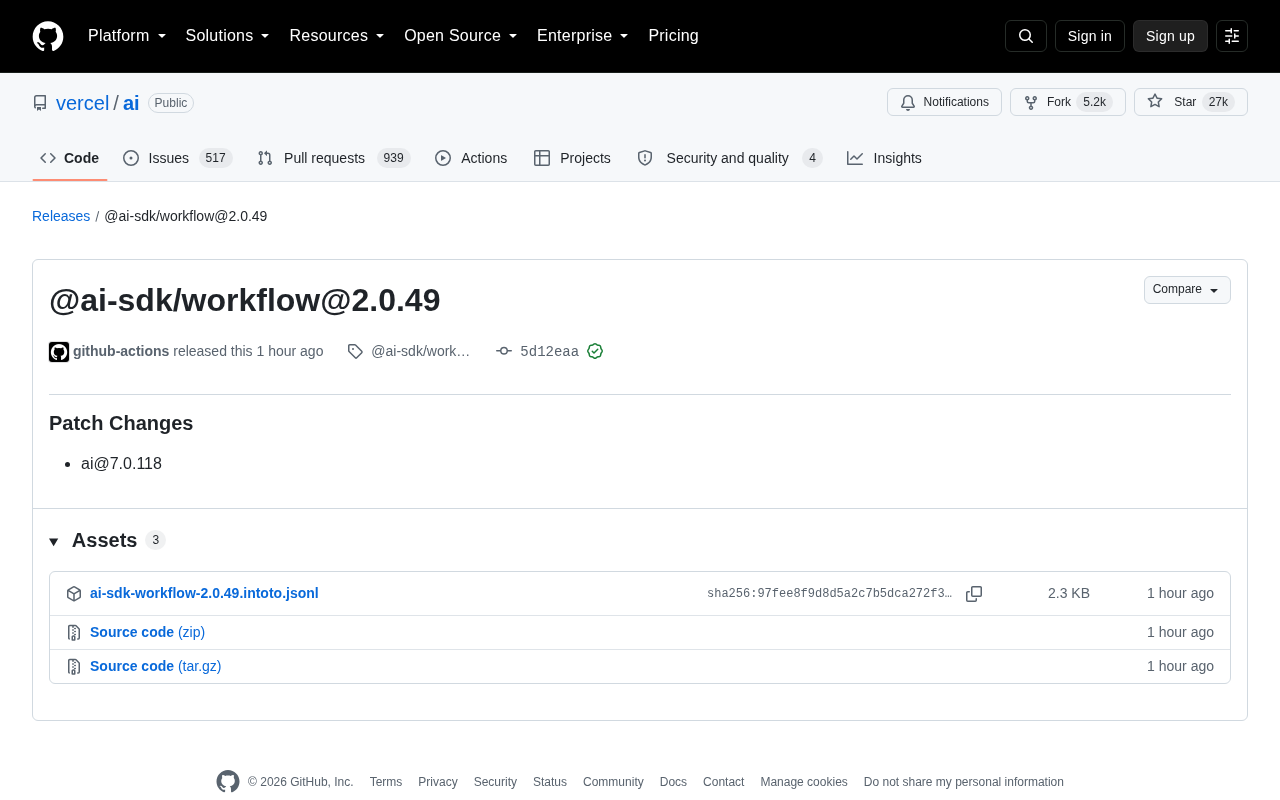
According to the release page, @ai-sdk/workflow@2.0.49 falls under Patch Changes, with the associated dependency being ai@7.0.118. Patch versions typically focus on bug fixes, dependency alignment, or minor internal improvements — not breaking changes or major new features.
Under Semantic Versioning (SemVer) rules, incrementing the last digit in 2.0.x signals a backward-compatible fix. Developers upgrading from an older version like 2.0.48 to 2.0.49 should theoretically be able to do so without modifying existing code. This release was signed with GitHub's official GPG verification (key ID: B5690EEEBB952194), ensuring the authenticity of the published artifact.
About Vercel AI SDK and the workflow Module
Vercel's AI repository (vercel/ai) is one of the more influential open-source projects in the current ecosystem, with approximately 27k stars and 5.2k forks on GitHub — a clear sign of strong community interest. The SDK is designed to help developers integrate large language model capabilities more easily in JavaScript/TypeScript environments, covering common use cases like text generation, streaming responses, and tool calling.
@ai-sdk/workflow is a sub-package aimed at scenarios that require orchestrating multi-step AI tasks. Compared to single model invocations, the workflow module is better suited for handling complex logic involving state transitions, conditional branching, or multi-phase calls. It works closely with the core ai package, so whenever the core package is upgraded (in this case to ai@7.0.118), related sub-packages typically release a patch to maintain compatibility.
Semantic Versioning (SemVer) is the most widely adopted versioning standard in the npm ecosystem. Version numbers consist of three segments: MAJOR.MINOR.PATCH. A major version bump indicates breaking changes, a minor bump adds backward-compatible features, and a patch bump covers only backward-compatible bug fixes. In package.json, using a tilde (~2.0.48) automatically accepts patch updates, while a caret (^2.0.48) accepts minor and patch updates. This is why patch releases like @ai-sdk/workflow@2.0.49 can be automatically upgraded in most projects with virtually no compatibility risk.
What Developers Should Do
For projects currently using this module, here are a few things worth keeping in mind:
Keep Dependency Versions Aligned
There's a version coupling relationship between AI SDK sub-packages and the core ai package. When the core package is upgraded, it's best to upgrade @ai-sdk/workflow to the matching version at the same time, to avoid type inconsistencies or runtime errors caused by version mismatches.
In a monorepo architecture (which Vercel AI SDK uses to manage multiple sub-packages), sub-packages share a single repository and are often coupled to the core package via peerDependencies or fixed version ranges. If a sub-package isn't updated in sync with a new core package release, TypeScript type definitions may become misaligned, causing compilation errors. At runtime, subtle changes to internal APIs can also trigger hard-to-trace exceptions. For this reason, the Vercel team's practice of releasing a patch for each sub-package whenever the core ai package is upgraded is a well-known "lockstep versioning" maintenance strategy — one that effectively reduces the issues users encounter due to inconsistent dependency trees.
Upgrade Strategy for Patch Updates
Since this is a patch update, the risk is low — but it's still recommended to validate in a test environment before deploying to production. You can upgrade using npm install @ai-sdk/workflow@2.0.49 or the equivalent command for your package manager, and pay attention to changes in the dependency tree within your lockfile.
Follow the Official Release Notes
The release page for this update is fairly brief, only noting the patch change and the associated dependency. For specifics on what was fixed, developers can consult the project's CHANGELOG or commit history (the corresponding commit hash for this release is 5d12eaa) for more complete details.
Summary
@ai-sdk/workflow@2.0.49 is a routine patch maintenance release, with its core value being alignment with ai@7.0.118. This high-frequency, small-step iteration cadence also reflects the active maintenance pace of the Vercel AI SDK team. For teams relying on this ecosystem, keeping dependencies up to date is a foundational practice for maintaining application stability and benefiting from the latest fixes.
Related articles

Chain of Thought Isn't Just for AI: How Humans Can Use CoT to Improve Thinking Quality
Chain of Thought isn't just a prompt trick for large models. Starting from a Hacker News discussion, this article analyzes why CoT works for human thinking too, breaks down actionable ways to transfer it, and highlights the key differences between human CoT and machine CoT.
Cloudflare Teams Up with OpenAI: Closi…
Cloudflare Teams Up with OpenAI: Closing the Loop from Vulnerability Discovery to Defense with AI
Cloudflare uses OpenAI Daybreak to investigate security vulnerabilities and generate reviewable remediation plans, while developers use Codex to boost coding efficiency and quality.

Orca Multi-Agent Orchestration in Practice: A Guide to Parallel Collaboration with Claude and Codex
Orca is Stable AI's free open-source agent workbench supporting 34 agents like Claude Code and Codex in parallel. Learn its Git worktree isolation, multi-model orchestration, and mobile management.