Vercel AI SDK Releases @ai-sdk/workflow@2.0.50 Patch Update

Vercel AI SDK ships @ai-sdk/workflow@2.0.50 patch to sync upstream dependencies and maintain toolchain compatibility.
`@ai-sdk/workflow@2.0.50` is a routine patch update in the Vercel AI SDK ecosystem, primarily syncing upstream dependencies including `ai@7.0.119`, `@ai-sdk/provider-utils@5.0.50`, and `@ai-sdk/provider@4.0.19` with no breaking changes. Vercel AI SDK — a leading framework for frontend and full-stack LLM integration with ~27k GitHub stars — provides a unified interface across model providers. The `@ai-sdk/workflow` sub-package handles workflow orchestration for complex use cases like Agents and multi-step reasoning. The release was automated via GitHub Actions with GPG signing, reflecting mature CI/CD and supply chain security practices.
Vercel's widely-used AI development framework, the AI SDK, recently released @ai-sdk/workflow@2.0.50. This is a patch-level update focused primarily on dependency upgrades. While the changes are minor in scope, they offer a window into the iteration cadence of this active open-source project.
Update Overview
According to the GitHub Release page, @ai-sdk/workflow@2.0.50 was automatically published by github-actions as a typical patch update (Patch Changes). The core of this release is a synchronized upgrade of several upstream dependency packages, including:
ai@7.0.119@ai-sdk/provider-utils@5.0.50@ai-sdk/provider@4.0.19
The release notes list multiple "Updated dependencies" commits (such as 33e94ba, 34d869e, e3605f6, def4df8, 525efc5), indicating this update primarily tracks version alignment with changes in the core ai package and the provider layer.
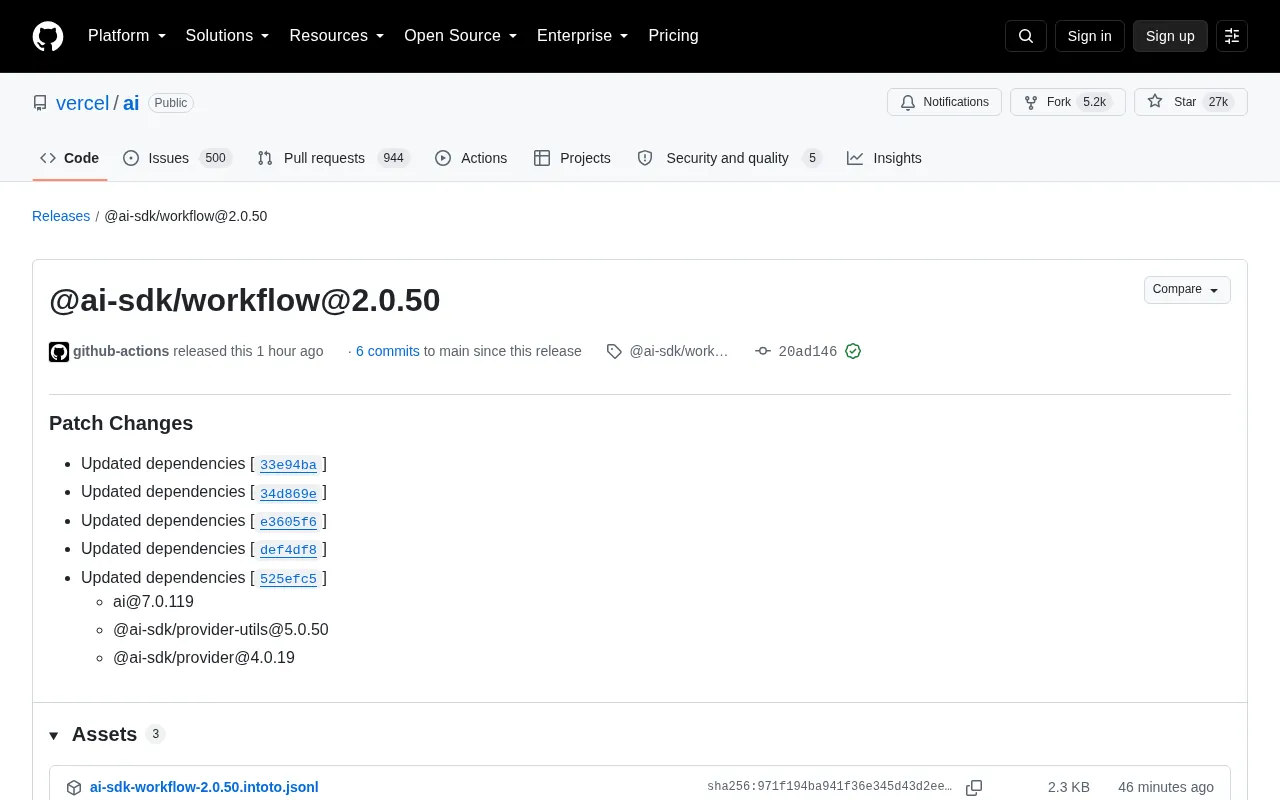
For modules like workflow that depend on lower-level SDK capabilities, this kind of dependency synchronization is standard practice for maintaining toolchain compatibility and stability. It introduces no breaking changes, so developers can upgrade with confidence.
Why Vercel AI SDK Is Worth Following
Vercel's AI SDK is one of the most popular tools for frontend and full-stack developers to integrate large language model capabilities. Based on GitHub metrics, the project has earned approximately 27k stars and 5.2k forks, reflecting a highly active community. It provides a unified interface for connecting to different model providers (LLMs), so developers don't need to write custom adapter code for each service.
@ai-sdk/workflow, as a sub-package within this ecosystem, focuses on workflow orchestration — helping developers organize multiple AI call steps into manageable pipelines. This capability is especially valuable when building Agents, multi-step reasoning flows, task decomposition, and other complex applications.
Engineering Practices Behind a Patch Update
The version number 2.0.50 paired with ai@7.0.119 as a dependency reveals just how frequently Vercel AI SDK ships releases. High-frequency small-version updates are a hallmark of modern open-source toolchains.
Why Dependency Synchronization Matters
The workflow package is tightly coupled to core packages like ai and @ai-sdk/provider. When changes occur in the underlying provider layer, the workflow package must follow suit to ensure consistent API behavior and avoid runtime issues caused by version mismatches. This "ripple effect" style of dependency management is a common pattern in monorepo projects.
What is a Monorepo?
A monorepo (monolithic repository) is a project structure where multiple related sub-packages are managed together in a single Git repository. Vercel AI SDK uses this structure —ai,@ai-sdk/provider,@ai-sdk/workflow, and other packages all live in the same repo, sharing build scripts and test pipelines. The advantage is that interface changes across sub-packages can be synchronized within a single PR, reducing cross-repo coordination overhead. The tradeoff is that any release of a lower-level package may trigger version bumps across dependent packages, even if those packages haven't changed themselves. This explains why@ai-sdk/workflow's patch version has already reached 50 — the vast majority of updates are passive version follows of upstream dependency changes, not workflow-specific feature work. Tools like Nx, Turborepo, and pnpm workspaces are the most popular solutions for managing monorepos today.
Automated Release Pipeline
This release was automatically triggered and published by github-actions, complete with GitHub's verified GPG signature (key ID: B5690EEEBB952194). This reflects the investment mature open-source projects make in CI/CD and supply chain security — automation reduces the risk of human error, while signature verification gives downstream users a trusted source guarantee.
What is GPG Signing?
GPG (GNU Privacy Guard) signing is a digital signature mechanism based on asymmetric encryption. On GitHub, a "verified" badge means the commit or tag was signed by a known GPG key whose public key has been uploaded to GitHub and can be verified by anyone. For open-source supply chain security, this mechanism helps guard against "phantom dependency" attacks — where an attacker publishes a maliciously named package to trick developers into installing malware. Combined with mechanisms like npm provenance, signature verification is a key component of modern software supply chain security. When using third-party packages, prioritizing projects with signature verification and transparent release logs is a practical way to reduce supply chain risk.
Guidance for Developers
For teams currently using the AI SDK, here's how to approach this type of patch update:
- Since it's a Patch version, it's generally backward compatible and safe to upgrade
- Pay attention to the synchronized upgrade of core packages like
ai@7.0.119and ensure your overall version set stays aligned - Before upgrading in production, it's still advisable to validate your workflow logic in a test environment first
Overall, @ai-sdk/workflow@2.0.50 is a routine maintenance update aimed at preserving stability. It doesn't introduce new features, but it reflects the healthy, active development state of the Vercel AI SDK ecosystem. It's worth continuing to track how this project evolves its AI workflow orchestration capabilities going forward.
Related articles

Turning AI Intruders Against Themselves: A Hands-On Look at AgentCapture
AgentCapture is an AI countermeasure honeypot platform that integrates with existing networks and reverse proxies, using lossless deployment, AI agent identification, attacker profiling, and session replay to turn automated intruders against themselves.

WorkBuddy In-Depth: The Leap from Conversational AI to Office Automation
What is WorkBuddy? Tencent's AI agent desktop tool understands Chinese commands and directly operates computer files, handling office automation from resume sorting to scheduled reports. This article analyzes its fundamental differences from conversational AI like ChatGPT, its core capabilities, and applicable scenarios.

WorkBuddy for Absolute Beginners: From Web Chat to AI Agent Productivity in Practice
Still using web-based AI chat and feeling more exhausted? This article breaks down the essential difference between chat and AI Agents, and explains how WorkBuddy, as a ready-to-use desktop tool, helps beginners turn AI from an advisor into an executor for real productivity gains.