Vercel AI SDK Releases @ai-sdk/workflow@2.0.51 Patch Update

Vercel AI SDK releases @ai-sdk/workflow@2.0.51 patch, syncing internal deps and upgrading to ai@7.0.120.
Vercel AI SDK has released `@ai-sdk/workflow@2.0.51`, a routine patch update that syncs two internal dependencies and aligns with the core package `ai@7.0.120`. The `@ai-sdk/workflow` sub-package handles complex multi-step AI workflow orchestration, enabling reusable pipelines of model calls, tool executions, and conditional branching. This update introduces no breaking changes and carries minimal upgrade cost, reflecting the project's high-frequency, well-structured maintenance cadence. With ~27k GitHub stars and a mature CI/CD pipeline, Vercel AI SDK remains one of the most prominent AI development toolkits in the TypeScript/JavaScript ecosystem.
Vercel's widely followed AI SDK project (with approximately 27k stars and 5.2k forks on GitHub) has recently released @ai-sdk/workflow@2.0.51. This is a patch-level update focused primarily on dependency synchronization.
Update Overview
According to the GitHub Releases page, @ai-sdk/workflow@2.0.51 is a typical patch update, with core changes centered on dependency version alignment. The key changes listed in the release notes include:
- Updated two internal dependencies (corresponding to commits
b032d70ande21b98b) - Synced with
ai@7.0.120
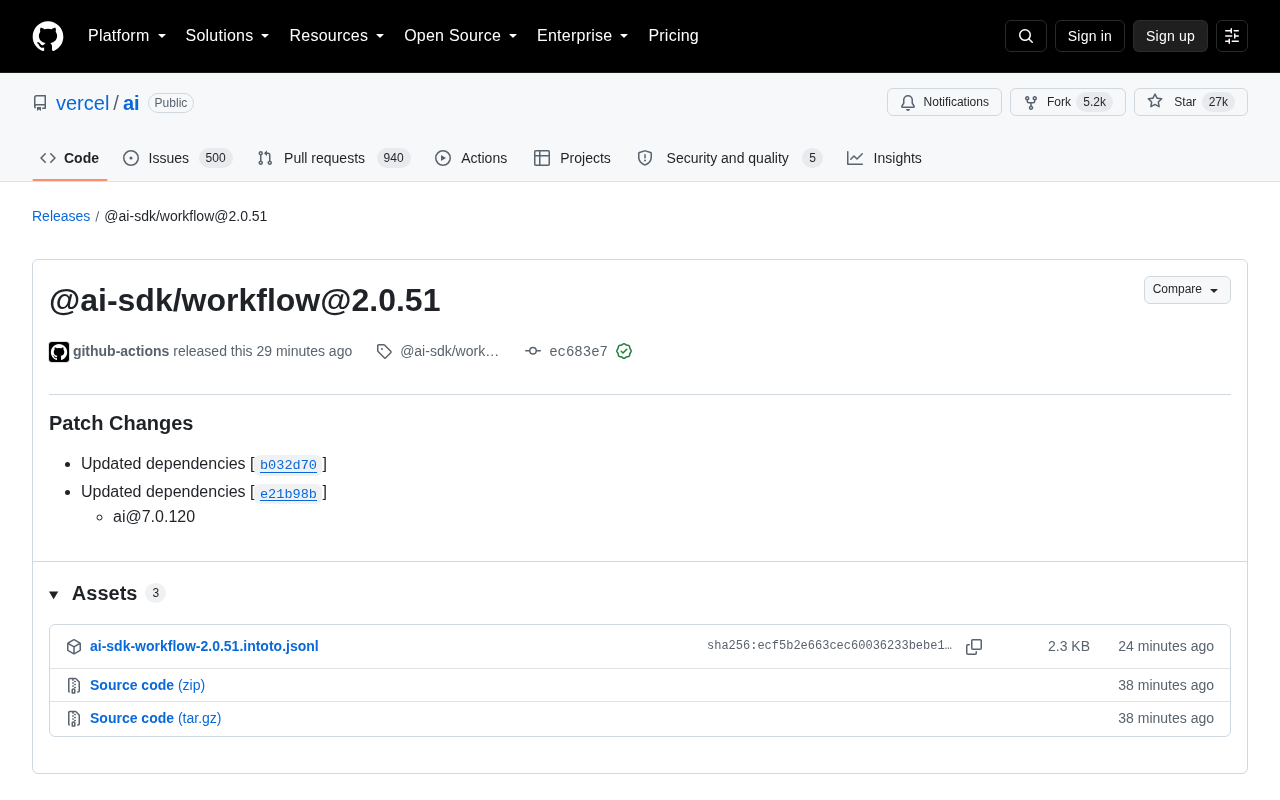
In terms of versioning conventions, 2.0.51 is a small incremental step along the 2.0.x mainline. Patch versions typically introduce no breaking changes and no major new features — they primarily address bug fixes, dependency syncing, or compatibility adjustments. For developers currently using this module, updates of this nature are generally safe to apply.
About @ai-sdk/workflow
@ai-sdk/workflow is a sub-package within the Vercel AI SDK ecosystem. The Vercel AI SDK is one of the most widely used AI application development libraries in the TypeScript/JavaScript community, providing a unified interface for calling various large language models, building streaming responses, and managing tool calls.
The workflow-related module is designed for more complex orchestration scenarios — for example, organizing multiple model calls, tool executions, and conditional branching into reusable workflows. The fact that this update is synchronized with the core package ai@7.0.120 reflects how closely this sub-package tracks the main SDK's release cadence.
One of the Vercel AI SDK's core design philosophies is model agnosticism: developers can call large language models from different providers — including OpenAI, Anthropic, Google Gemini, and Mistral — through a unified API interface, without writing separate adapter code for each provider. Building on this foundation, @ai-sdk/workflow addresses the challenge of multi-step orchestration — when an AI application needs to call multiple models in sequence, intersperse tool executions (such as search or database queries), and determine the next step based on the previous result, manually managing these async chains is both tedious and error-prone. The workflow module allows these steps to be defined declaratively as structured processes, making complex AI Agent logic easier to debug and reuse.
What This Means for Developers
This release is light on details, but it reflects the Vercel AI SDK team's high-frequency, stable iteration cadence. Frequent patch updates indicate:
- Healthy dependency management: Internal dependencies are continuously aligned, reducing the risk of version conflicts
- Active maintenance: The automated release pipeline via GitHub Actions demonstrates a mature CI/CD and signature verification process (this commit was verified with GitHub's verified signature)
- Low upgrade cost: Patch updates typically have minimal impact on existing integrations
For teams already relying on this SDK in production, it's recommended to validate the update in a test environment before rolling it out. If you're using a locked versioning strategy (such as package-lock.json or pnpm-lock.yaml), consider aligning the upgrade with your own release cycle.
Semantic Versioning (SemVer) is the most widely adopted version naming convention in the npm ecosystem, formatted as MAJOR.MINOR.PATCH. An increment in the PATCH version (the third number) conventionally promises "backward-compatible bug fixes" with no breaking API changes. The jump from 2.0.50 to 2.0.51 in @ai-sdk/workflow is exactly this kind of PATCH-level change. For projects using a compatibility range like ^2.0.0, package managers (npm/pnpm/yarn) will automatically resolve to the latest PATCH version during installation — meaning many developers can receive the dependency fixes from this update without any manual action.
Summary
@ai-sdk/workflow@2.0.51 is a routine dependency-sync patch, released alongside ai@7.0.120. While the scope of any single update is modest, it reflects the sustained maintenance capability and engineering discipline that make Vercel AI SDK a leading AI development framework. Developers can follow the official Releases page to stay up to date with future versions.
Related articles

Chain of Thought Isn't Just for AI: How Humans Can Use CoT to Improve Thinking Quality
Chain of Thought isn't just a prompt trick for large models. Starting from a Hacker News discussion, this article analyzes why CoT works for human thinking too, breaks down actionable ways to transfer it, and highlights the key differences between human CoT and machine CoT.
Cloudflare Teams Up with OpenAI: Closi…
Cloudflare Teams Up with OpenAI: Closing the Loop from Vulnerability Discovery to Defense with AI
Cloudflare uses OpenAI Daybreak to investigate security vulnerabilities and generate reviewable remediation plans, while developers use Codex to boost coding efficiency and quality.

Orca Multi-Agent Orchestration in Practice: A Guide to Parallel Collaboration with Claude and Codex
Orca is Stable AI's free open-source agent workbench supporting 34 agents like Claude Code and Codex in parallel. Learn its Git worktree isolation, multi-model orchestration, and mobile management.