Vercel AI SDK Releases @ai-sdk/xai 3.0.137 Patch Update
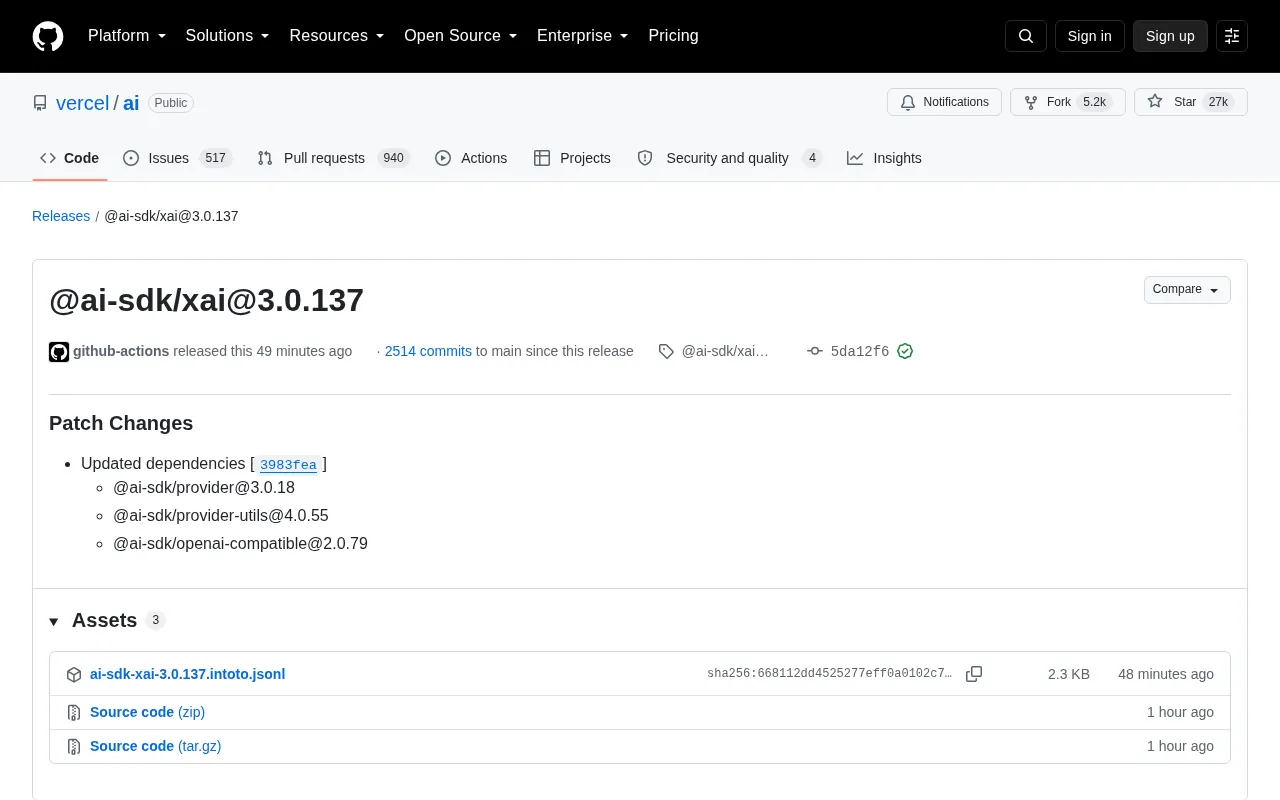
Vercel AI SDK releases xAI provider patch 3.0.137, syncing core upstream dependencies.
`@ai-sdk/xai@3.0.137` is a dependency maintenance patch that synchronizes three upstream packages: `@ai-sdk/provider@3.0.18`, `@ai-sdk/provider-utils@4.0.55`, and `@ai-sdk/openai-compatible@2.0.79`. Since the xAI provider is built on the OpenAI-compatible layer, upstream fixes automatically benefit all developers using Grok models. No breaking changes are introduced, making this a low-risk update suitable for routine dependency maintenance.
Vercel's AI SDK ecosystem has recently released @ai-sdk/xai@3.0.137. This is a patch release focused primarily on dependency synchronization, aimed at developers working with xAI (Grok series models). While the version bump is minor, keeping up with this update ensures compatibility with the underlying libraries for any project relying on this provider.
Update Overview
According to the GitHub Releases page, @ai-sdk/xai@3.0.137 is a patch-level update whose core changes center on syncing dependency versions. The release notes indicate that the following upstream dependencies were updated in lockstep:
@ai-sdk/provider@3.0.18@ai-sdk/provider-utils@4.0.55@ai-sdk/openai-compatible@2.0.79
The dependency list reveals that the xAI provider is built on top of Vercel AI SDK's generic provider abstraction layer, and reuses the openai-compatible compatibility layer. This means xAI's interface implementation stays consistent with the OpenAI-compatible format, giving developers a unified calling experience when switching between model providers.
The openai-compatible layer is a general-purpose adapter module within the Vercel AI SDK, designed for third-party model providers whose API format closely mirrors the OpenAI API. xAI's Grok series models adopt a REST interface spec compatible with OpenAI, which means they can directly reuse this layer's request construction, response parsing, and streaming logic — no need to implement these from scratch. This design allows the xAI provider to inherit the stability built up by the OpenAI provider, and means that whenever the openai-compatible layer fixes a parsing bug or improves streaming response handling, all providers built on top of it — including xAI, Mistral, and others — benefit automatically, without needing independent fixes.
The Significance of Patch Updates
In semantic versioning, a patch update typically represents backward-compatible bug fixes or dependency synchronization, with no breaking changes introduced. For production projects, this type of update carries relatively low risk, though regression testing after upgrading is still recommended.
This update does not include any functional changes to the xAI provider itself — the real changes come from the upstream dependency updates referenced by commit 3983fea. When the underlying provider and provider-utils packages fix common issues, all providers built on them (including OpenAI, Anthropic, xAI, etc.) benefit accordingly. This cascading effect is a hallmark of monorepo-style management — the Vercel AI repository has accumulated over 2,500 commits and boasts approximately 27k stars and 5.2k forks, making it one of the most active AI application development frameworks today.
What is a Monorepo? A monorepo (single repository) is an engineering practice of managing multiple related packages or projects within a single Git repository. The Vercel AI SDK uses this structure to maintain dozens of npm packages — including
@ai-sdk/core, various provider packages, and utility libraries — in one place. The key advantage is that cross-package changes can be completed atomically in a single commit, and when a low-level dependency is upgraded, all higher-level packages can be tested and released together. This avoids version drift and interface inconsistencies that commonly arise in multi-repo setups. The3983feamentioned above refers to a specific commit hash in that repository, meaning the root cause of changes in this xAI release can be precisely traced back to that underlying commit — a demonstration of the strong traceability that monorepo management provides.
Recommendations for Developers
If your project is using xAI's Grok models, consider upgrading @ai-sdk/xai to this version to gain the stability improvements from upstream dependency fixes. Upgrading is straightforward:
npm install @ai-sdk/xai@3.0.137
Since all AI SDK providers share the same underlying dependencies, it's worth confirming that @ai-sdk/provider and @ai-sdk/provider-utils are also synced to the correct versions when upgrading, to avoid type or runtime issues caused by version mismatches. For teams using pnpm/yarn workspaces, it's also a good idea to check the lockfile resolution results.
Summary
@ai-sdk/xai@3.0.137 is a typical dependency maintenance update — no flashy new features, but it reflects the Vercel AI SDK team's ongoing commitment to ecosystem consistency and stability. For developers relying on xAI, these frequent, low-risk patch updates are worth incorporating into a regular dependency maintenance workflow.
Related articles

Bin's Live Stream Highlights: Hilarious Interactions from "You Came at the Right Time" to "I'll Support You From Now On"
Bin's hilarious live stream highlights: from "You came at the right time" to "I'll support you from now on," featuring Championship skins, wigs, and other game memes that showcase Bilibili's unique streaming culture.

Hunter Rescues Educated Youth: The Mountain-Chasing System Launches a New Warm-Hearted Viral Drama Formula
Bilibili's early-access period short drama *Everyone Thinks I'm a Poor Hunter* opens with a snowy-night rescue of an educated youth. Hunter Chen Shan activates the mountain-chasing system, using realistic hypothermia first-aid details and mutual-probing character dynamics to deliver a warm-hearted period drama without the sleaze.

Riemann Hypothesis Proven by AI? The Truth Has Nothing to Do With Your Reality
34-year-old mathematician Levent Alpöge claims to have proven the Riemann Hypothesis and Generalized Riemann Hypothesis with Claude, releasing 17 million lines of formal verification code. This article sorts out the facts, debunks myths about RSA collapse and new material revolutions, and analyzes the true significance of mathematics-AI collaboration.