Vercel AI SDK Releases @ai-sdk/xai 3.0.138 Patch Update

Vercel AI SDK releases a patch update for the xAI Provider, syncing upstream dependencies for improved stability.
`@ai-sdk/xai@3.0.138` is a maintenance patch update for Vercel AI SDK's xAI (Grok) Provider, syncing `@ai-sdk/provider-utils@4.0.56` and `@ai-sdk/openai-compatible@2.0.80` with no user-facing API changes. Since xAI's API is highly compatible with OpenAI's spec, the `openai-compatible` module handles critical low-level tasks like request construction and streaming parsing — meaning upstream fixes directly impact xAI integration behavior. This SemVer-compliant patch is safe to apply and recommended for production teams.
Vercel's AI SDK ecosystem has recently published @ai-sdk/xai@3.0.138. This is a patch-level update focused primarily on dependency synchronization. For developers integrating xAI (Grok series models) via this SDK, updates like this may seem minor, but they're a critical part of keeping your toolchain running reliably.
What's in This Release
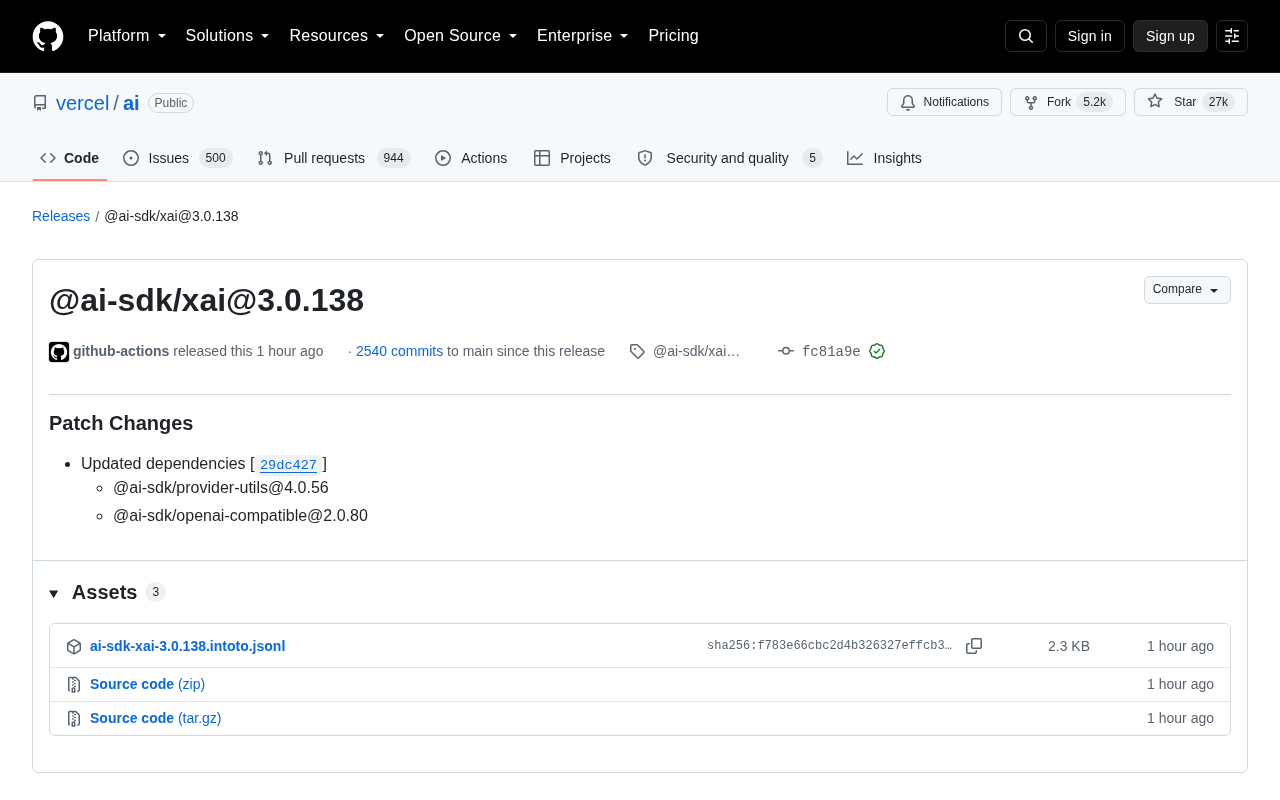
According to Vercel's official repository release records, @ai-sdk/xai@3.0.138 was automatically published by GitHub Actions on September 28th at commit hash fc81a9e, and passed GitHub's trusted signature verification (GPG key ID: B5690EEEBB952194).
The core of this update is a dependency upgrade (Patch Changes), specifically involving two upstream packages:
@ai-sdk/provider-utils@4.0.56@ai-sdk/openai-compatible@2.0.80
This means the release itself introduces no new user-facing features or API changes — it simply syncs underlying dependencies to ensure compatibility and stability.
Why Dependency Updates Matter
In modern AI application development, @ai-sdk/xai serves as the official Vercel AI SDK Provider for xAI models (like Grok). Its behavior depends heavily on two shared modules: provider-utils and openai-compatible.
@ai-sdk/openai-compatible handles the communication logic for OpenAI-compatible interfaces. Since xAI's API is deliberately designed to be highly compatible with OpenAI's specification, updates to this module directly affect low-level behaviors such as request construction and streaming response parsing. Meanwhile, provider-utils provides utility functions shared across all Providers.
So even though the xAI Provider itself has no code changes, fixes or improvements in upstream dependencies still flow down to end users through this patch — potentially delivering better error handling, more stable streaming output, or more precise type definitions.
The reason
@ai-sdk/openai-compatiblecan serve as the communication foundation for xAI is that Grok's API deliberately aligns with OpenAI's specification — including identical endpoint path structures, the same request body fields (such asmodel,messages, andstream), and the same Server-Sent Events (SSE) streaming format. This "OpenAI-compatible" strategy has become the mainstream approach in the LLM API ecosystem, adopted to varying degrees by Anthropic, Mistral, Together AI, and others, all with the goal of reducing migration costs for developers. By abstracting this shared logic into theopenai-compatiblepackage, Vercel AI SDK allows any OpenAI-protocol-compatible Provider to integrate with minimal code — and when streaming parsing bugs are fixed or error code handling is improved, all downstream Providers benefit simultaneously, without each one needing to apply patches independently.
Practical Impact for Developers
For teams that have already integrated Vercel AI SDK into their projects, upgrading to this patch version is generally a low-risk operation. Patch versions follow Semantic Versioning (SemVer) and, by definition, should contain no breaking changes — you can safely update through your package manager.
Here's what we recommend:
Check Dependency Tree Consistency
Since this update focuses on dependency synchronization, developers should ensure that @ai-sdk/provider-utils and @ai-sdk/openai-compatible are also upgraded to their corresponding versions to avoid potential issues caused by version mismatches. Use npm ls or pnpm why to quickly audit your dependency tree.
Semantic Versioning (SemVer) defines version numbers as
MAJOR.MINOR.PATCH, where a PATCH increment is used only for backward-compatible bug fixes, MINOR for backward-compatible new features, and MAJOR for potentially breaking changes. In monorepo ecosystems (such as the Turborepo architecture used by Vercel AI SDK), sub-packages often have strict version alignment constraints with each other. If you only upgrade the top-level Provider package without syncing its peer dependencies, Node.js's module resolution mechanism may result in two versions of an underlying package coexisting at runtime, causing type mismatches or inconsistent runtime behavior that can be difficult to diagnose.npm ls @ai-sdk/provider-utilsorpnpm why @ai-sdk/openai-compatiblecan visually display the actual resolved versions of each package in your current dependency tree, making them the go-to tools for troubleshooting these kinds of issues.
Keep Your Toolchain Up to Date
Vercel AI SDK iterates frequently — from the commit history alone, the main branch has accumulated over 2,540 commits since launch. The rapid cadence of small releases is a direct reflection of how active this ecosystem is, and staying current with patches reduces the migration cost when larger version upgrades eventually arrive.
Summary
@ai-sdk/xai@3.0.138 is a typical maintenance patch update — no flashy new features, but by syncing the provider-utils and openai-compatible dependencies, it provides a more solid foundation for xAI model integration. For production applications that rely on this SDK, these seemingly uneventful updates are precisely what ensures long-term stability.
Related articles

Chain of Thought Isn't Just for AI: How Humans Can Use CoT to Improve Thinking Quality
Chain of Thought isn't just a prompt trick for large models. Starting from a Hacker News discussion, this article analyzes why CoT works for human thinking too, breaks down actionable ways to transfer it, and highlights the key differences between human CoT and machine CoT.
Cloudflare Teams Up with OpenAI: Closi…
Cloudflare Teams Up with OpenAI: Closing the Loop from Vulnerability Discovery to Defense with AI
Cloudflare uses OpenAI Daybreak to investigate security vulnerabilities and generate reviewable remediation plans, while developers use Codex to boost coding efficiency and quality.

Orca Multi-Agent Orchestration in Practice: A Guide to Parallel Collaboration with Claude and Codex
Orca is Stable AI's free open-source agent workbench supporting 34 agents like Claude Code and Codex in parallel. Learn its Git worktree isolation, multi-model orchestration, and mobile management.