Vercel AI SDK Releases @ai-sdk/xai@3.0.139 Patch Update

Vercel AI SDK patches @ai-sdk/xai to sync two shared dependencies — fully backward compatible.
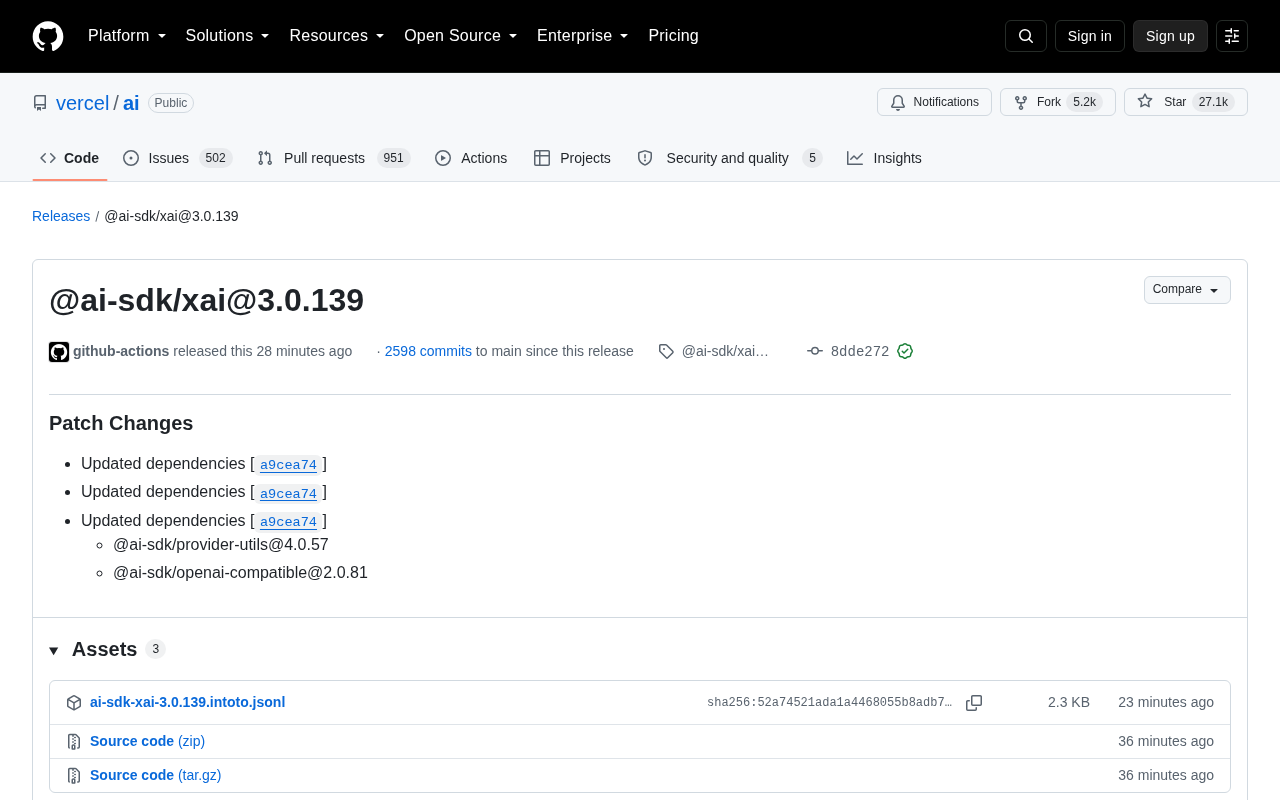
Vercel AI SDK released `@ai-sdk/xai@3.0.139`, a pure dependency sync patch that upgrades `@ai-sdk/provider-utils` to 4.0.57 and `@ai-sdk/openai-compatible` to 2.0.81. As the official provider for xAI's Grok models — which use an OpenAI-compatible API format — this package relies directly on the openai-compatible adapter layer. Thanks to the monorepo structure and SemVer compliance, this Patch-level update is fully backward compatible and can be applied with minimal effort, while also delivering stability improvements in request handling, error processing, and streaming response parsing. The release is GPG-signed for supply chain security.
Version Overview
Vercel's widely-used AI SDK has released a patch update for its xAI provider module: @ai-sdk/xai@3.0.139. This version was automatically published by GitHub Actions on September 30th. It's a dependency-update patch release focused on syncing underlying dependencies.
Vercel's ai repository is one of the most active AI development toolkits in the TypeScript/JavaScript ecosystem, boasting over 27,000 stars and 5,200 forks. It provides developers with a unified API for integrating with multiple LLM providers. @ai-sdk/xai is the official provider package for connecting to xAI's Grok series of models.
What's Changed
According to the release notes, version 3.0.139 is a pure dependency update that falls under Patch Changes — no new features or breaking changes are included. The update focuses on syncing two underlying shared dependency packages:
@ai-sdk/provider-utils@4.0.57@ai-sdk/openai-compatible@2.0.81
Both dependencies were updated as part of the same commit (a9cea74). provider-utils is a shared utility library used across all AI SDK provider modules, handling common logic like request processing and type validation. openai-compatible provides an adapter layer that conforms to OpenAI's API spec — and since xAI's Grok API uses an OpenAI-compatible format, @ai-sdk/xai depends directly on this adapter layer.
This kind of patch release is very common in the AI SDK's release cycle. Thanks to the monorepo structure and unified release workflow, when a shared dependency is updated, all related provider packages (such as xai, openai, anthropic, etc.) typically receive corresponding patch releases simultaneously to keep the dependency tree consistent.
What is a Monorepo? A monorepo (monolithic repository) is an engineering strategy where multiple related packages or projects are stored in a single Git repository. Vercel AI SDK uses a monorepo structure, meaning dozens of provider packages like
@ai-sdk/xai,@ai-sdk/openai, and@ai-sdk/anthropicshare the same build, test, and release pipeline. When a foundational shared package likeprovider-utilsis updated, all packages that depend on it — directly or indirectly — need to bump their version numbers and be republished, even if their own code hasn't changed at all. This "cascading release" pattern is common in monorepos and is typically automated by tools like Turborepo and Changesets to ensure version consistency across the dependency tree and prevent version drift between provider packages.
What This Means for Developers
For developers currently using the AI SDK to integrate with Grok models, this kind of patch update carries minimal upgrade cost. Since it follows Semantic Versioning (SemVer), a Patch-level update means the API is fully backward compatible — you can safely pull the latest version using npm update or pnpm update.
Keeping dependencies up to date ensures you benefit from bug fixes and stability improvements in the underlying utility libraries. In particular, updates to infrastructure-level packages like provider-utils and openai-compatible often touch critical areas such as request retrying, error handling, and streaming response parsing — all of which have a direct impact on production stability.
This release's commit carries a verified GitHub GPG signature (key ID: B5690EEEBB952194), guaranteeing the integrity and authenticity of the published artifact. This is consistent with Vercel's ongoing commitment to supply chain security.
About SemVer and Supply Chain Security Semantic Versioning uses the
MAJOR.MINOR.PATCHformat to communicate the scope of changes. PATCH is reserved for backward-compatible bug fixes; MINOR indicates backward-compatible new features; MAJOR signals breaking changes. For package managers, a range declaration like^3.0.139automatically allows any update within the same major version — which is why Patch updates are essentially "zero-cost upgrades" for most projects. No existing code needs to change; calling conventions, return types, and configuration options all remain the same. On the supply chain security front, GPG signature verification ensures that the artifact published to npm genuinely comes from an authorized publisher and hasn't been tampered with — an increasingly important safeguard given the rise of supply chain attacks targeting open-source packages in recent years.
Summary
@ai-sdk/xai@3.0.139 is a low-risk dependency sync patch. The core changes are upgrades to the two shared dependencies provider-utils and openai-compatible. For teams building Grok-powered applications on top of the Vercel AI SDK, it's worth upgrading as needed to keep the entire dependency chain healthy and secure. Developers looking for the full change details can visit Vercel's GitHub repository to review the corresponding release notes and commit history.
Related articles

JobRunner MCP Server: AI Agents Can Now Fix Failed Java Jobs
JobRunner launches an open-source MCP server enabling AI agents to view cluster status, diagnose failures, and recover Java jobs—incident response from any cloud coding environment or existing agent.

MLAI Digital Launches 9 Security Agents: MCP Server Safeguards the Full Lifecycle of Agentic AI
MLAI Digital launches Security MCP Server with nine built-in specialized security agents covering vulnerability discovery, attack simulation, prompt injection detection, API and infrastructure assessment, and accelerated remediation—embedding security validation across the full Agentic AI lifecycle from development to production.

Running Isaac Lab on H100 GPUs: Exploring Better Approaches
Exploring optimization methods for running Isaac Lab on NVIDIA H100 GPUs, including MIG configuration, mixed precision, TensorRT acceleration, and community experience to improve robotics simulation and reinforcement learning efficiency.