Vercel AI SDK Releases @ai-sdk/xai 4.0.59 Patch Update

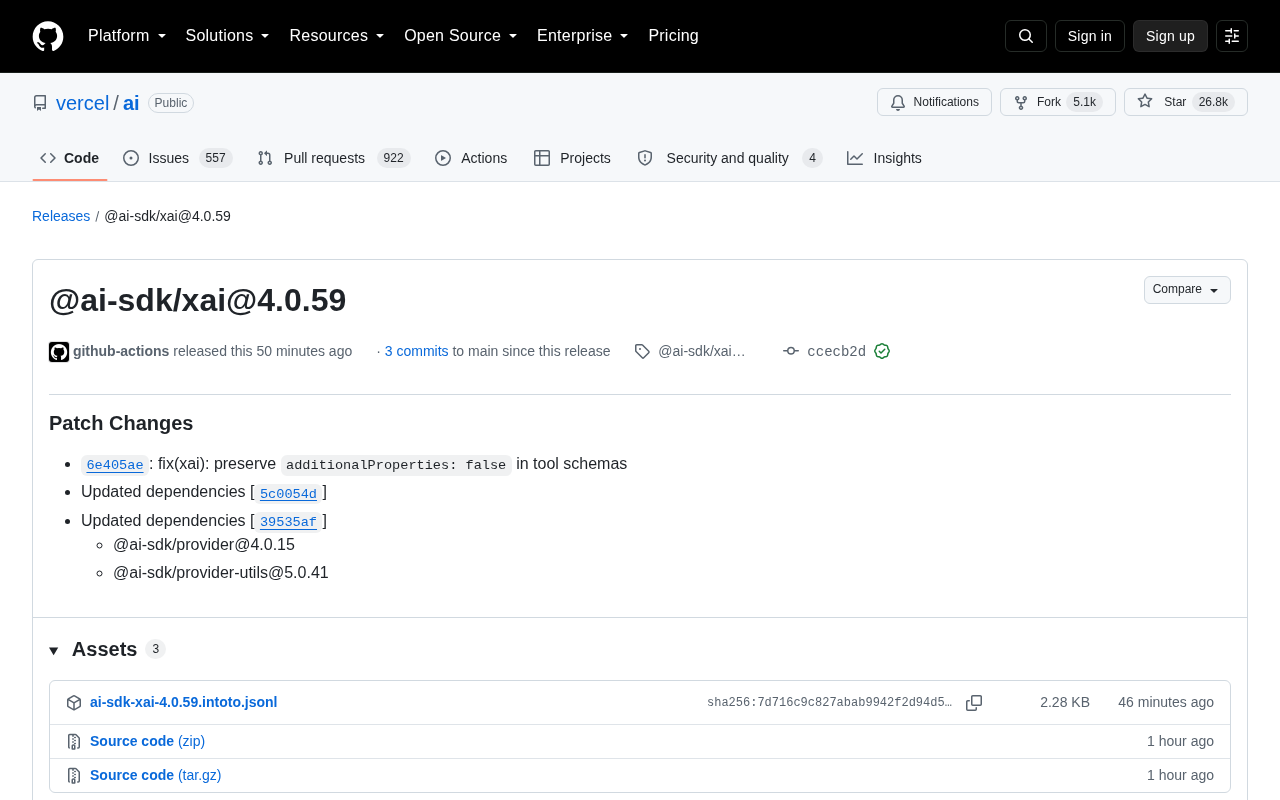
Vercel AI SDK patches xAI provider to correctly preserve additionalProperties:false in tool schemas.
@ai-sdk/xai 4.0.59 is a patch-level update for the xAI provider that fixes a bug where the `additionalProperties: false` constraint was silently dropped from tool schemas. This JSON Schema keyword prevents objects from containing undefined extra properties — a key mechanism for ensuring strict structured output in tool calling scenarios. The fix also coordinates updates to `@ai-sdk/provider@4.0.15` and `@ai-sdk/provider-utils@5.0.41`, reflecting Vercel AI SDK's monorepo cascade pattern. No breaking changes are introduced.
Vercel's AI SDK ecosystem has received a patch update for the xAI provider — @ai-sdk/xai@4.0.59. While the version bump is patch-level and the changes are minimal, the fix carries real significance for developers who rely on tool calling functionality.
Core Fix: Tool Schema Handling
The key change in this release addresses a behavioral issue with how the xAI provider processes tool schemas. Specifically, previous versions failed to correctly preserve the additionalProperties: false constraint when generating tool definitions. Version 4.0.59 corrects this.
fix(xai): preserve additionalProperties: false in tool schemas
additionalProperties: false is a critical constraint in JSON Schema — it specifies that an object must not contain any properties beyond those explicitly defined in the schema. In function/tool calling scenarios, this constraint helps models produce stricter, more predictable structured outputs by preventing them from adding unexpected fields, which in turn reduces the risk of downstream parsing errors. When this field was silently dropped, the strict constraints developers defined were never actually passed down to the underlying model. This fix restores that expected behavior.
JSON Schema is a standard specification for describing and validating JSON data structures, widely used in API definitions and config file validation. In AI tool calling (function/tool calling) contexts, developers use JSON Schema to describe each tool's parameter structure, and the model uses this to generate correctly formatted call arguments. additionalProperties: false is an important validation keyword: when set to false, no keys outside of those listed in the schema's properties field are permitted in the JSON object. For large models like GPT and Grok that support structured outputs, many providers — including OpenAI — explicitly require this field in tool definitions to enable strict mode structured output. This guarantees that model-returned JSON 100% conforms to the predefined structure, eliminating the need for defensive parsing logic in downstream code.
Dependency Updates and Version Coordination
Alongside the core fix, this release also updates two underlying dependency packages:
@ai-sdk/provider@4.0.15@ai-sdk/provider-utils@5.0.41
This kind of coordinated dependency update is a characteristic pattern of Vercel AI SDK's monorepo and changeset-based management approach. The xAI provider, as an adapter layer for a specific model service (xAI's Grok series), is built on top of the generic provider and provider-utils base packages. Schema handling logic adjustments in the base packages (corresponding to commits 5c0054d and 39535af) need to propagate to each concrete provider, which is why the xAI package is also being released with a new version.
For projects using multiple AI providers simultaneously, unified upgrades to these shared base packages help maintain consistent behavior — such as tool calling — across different model interfaces.
Monorepo is an engineering practice of storing multiple related packages or projects in a single repository. Vercel AI SDK follows this model. Changeset is a popular versioning and changelog tool used in monorepo setups: developers attach a "changeset file" alongside their commits, describing the change level (patch/minor/major) and content. The tool then automatically aggregates these descriptions, computes new version numbers for each package, and generates changelogs. This mechanism ensures that fixes in base packages like @ai-sdk/provider-utils cascade to all upstream provider packages in a traceable manner, keeping schema handling behavior consistent across the entire SDK ecosystem — preventing a fragmented state where some providers are fixed while others still have bugs.
Practical Impact for Developers
If you're using the AI SDK to integrate with xAI models and have defined tools or structured output schemas with strict property constraints, upgrading to 4.0.59 is recommended. The upgrade follows the standard npm dependency update workflow:
npm install @ai-sdk/xai@latest
As a patch release, 4.0.59 introduces no breaking changes, making the upgrade extremely low-risk. The update is most relevant for production applications that rely on strict schema validation in tool calling — the model's handling of additional properties may differ before and after the fix, and structured outputs will now more faithfully reflect the developer's original definitions.
Summary
Patch updates like this one — easy to overlook — reflect a real pain point in AI application engineering: the reliability of structured outputs and tool calling. As more applications treat LLMs as programmable function-calling engines, whether schema constraints are faithfully passed through directly affects system stability. Vercel AI SDK's continued attention to these details is one of the reasons it maintains its competitive edge in the TypeScript/JavaScript AI development ecosystem.
Related articles

LynnReal-Omni: 32B Unified Video Diffusion Model Goes Open Source with Multi-Task Coverage in Four Steps
LynnReal-Omni is a 32B unified video diffusion model on MiniMax H3, covering text-to-video, pose guidance, style transfer, restoration in 4 steps. Flash version generates 540p video in 377ms on one H100.

Anthropic Co-Founder: AI 'Kill Switch' May Need to Be Mandatory by Law
Anthropic's co-founder tells the BBC that AI 'kill switches' may need to be legally mandated. We analyze the industry logic, technical challenges, and the tension between regulation and innovation.

The AI Data Center Boom Is Colliding With Cities Scarred by Heavy Industry
The AI data center boom is clashing with post-industrial communities. Philadelphia's case reveals structural conflicts between AI growth, energy use, water, and environmental justice.