Vercel AI SDK Releases @ai-sdk/xai Version 5.0.12

Vercel AI SDK's official xAI provider package releases patch version 5.0.12 for Grok model integration.
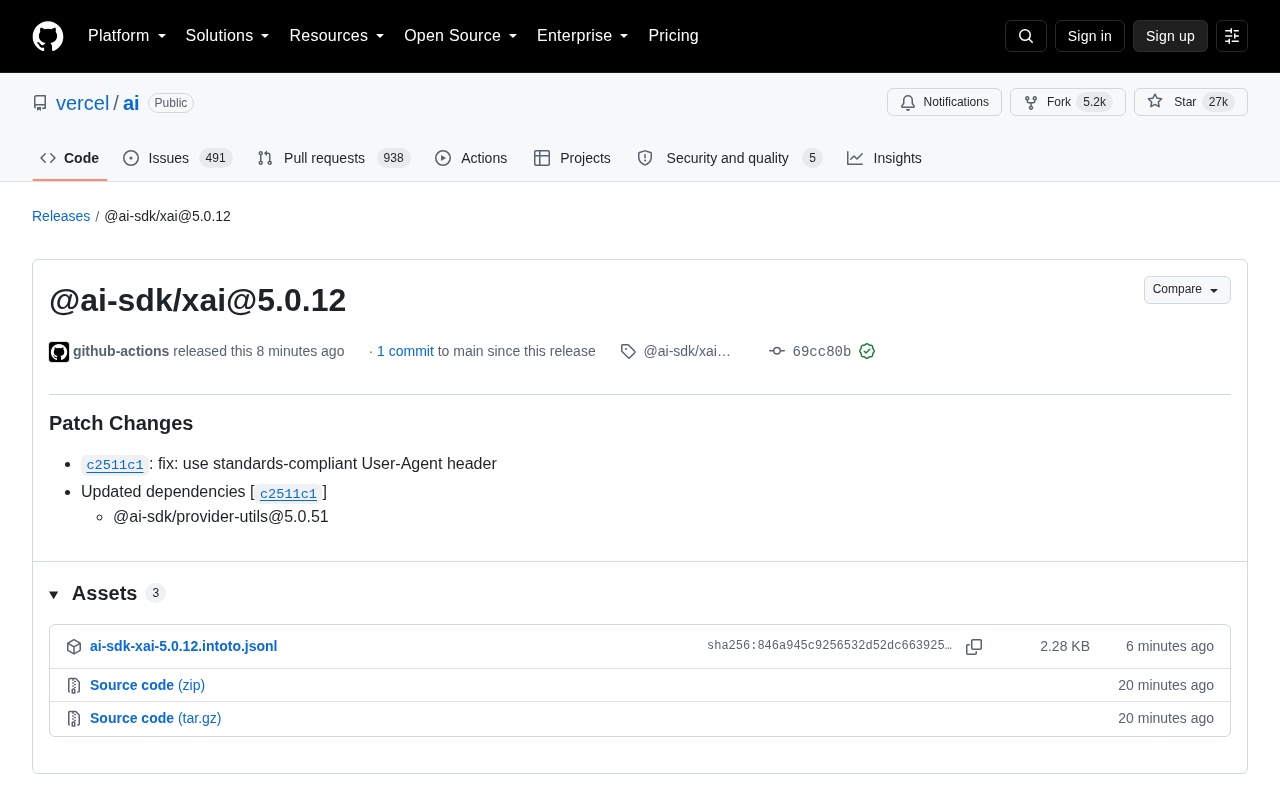
`@ai-sdk/xai` 5.0.12 is a routine patch update to Vercel AI SDK's official adapter for xAI's Grok models, published via GitHub Actions with a verified signature. The Vercel AI SDK (27k+ GitHub stars) uses a unified provider abstraction so developers can access OpenAI, Anthropic, xAI, and others through one consistent API, drastically reducing model migration costs. This patch likely covers API compatibility updates, streaming edge-case fixes, and version alignment with the core `ai` package.
Release Overview
Vercel's AI SDK ecosystem — widely followed by developers — has received another update, with the xAI provider package @ai-sdk/xai reaching version 5.0.12. This release was packaged through a GitHub Actions automated pipeline and includes an official GitHub verified signature (GPG key ID: B5690EEEBB952194), marked as Verified to ensure the integrity and trustworthiness of the published artifact.
As a patch-level update within the 5.0 major version series, 5.0.12 typically implies bug fixes, dependency synchronization, or minor adjustments — not breaking changes. For projects that have already integrated xAI models in production, this type of patch release is generally safe to upgrade to with confidence.
What Is @ai-sdk/xai
@ai-sdk/xai is the officially maintained xAI model provider adapter package within the Vercel AI SDK. The Vercel AI SDK is one of the most popular AI application development libraries in the JavaScript/TypeScript ecosystem, with over 27,000 stars and 5,200 forks on GitHub — a testament to its active community.
The SDK uses a unified provider abstraction design, allowing developers to access model services from OpenAI, Anthropic, Google, xAI, and others through a consistent API. @ai-sdk/xai is the official connector for xAI — the AI company founded by Elon Musk, known for its Grok series of models. Developers simply install the corresponding provider package to call Grok models for text generation, streaming output, and more — all within the same codebase.
The Value of Unified Abstraction
The core strength of the Vercel AI SDK lies in its model-agnostic design philosophy. When a team needs to switch between different model providers or run A/B tests across multiple models, only the provider package and a small amount of configuration need to change — business logic code remains virtually untouched. This decoupling significantly reduces the cost of model migration, which makes continuous updates to provider packages like @ai-sdk/xai especially important.
From an engineering perspective, Vercel AI SDK's unified abstraction is primarily implemented through standard interface protocols such as LanguageModelV1. Each provider package (e.g., @ai-sdk/xai, @ai-sdk/openai) implements the same interface specification, and the core ai package is agnostic to the underlying model at call time. This means top-level functions like generateText(), streamText(), and generateObject() work across all providers — when switching models, developers simply replace xai('grok-3') with something like openai('gpt-4o'), leaving the rest of the code unchanged. This plugin-style architecture also makes it easy for community developers to contribute provider packages for emerging model services without modifying the SDK core.
Technical Significance of This Update
The 5.0.12 release was tagged by GitHub Actions via a "Version Packages (#21666)" commit — a typical automated release flow for a monorepo setup. The Vercel AI SDK uses tools like changesets to manage multi-package versioning, with each provider package kept in sync with the main library's release cadence.
While the release notes don't list specific changelog entries, the value of a patch update typically manifests in a few areas: tracking interface changes on the xAI API side, fixing edge cases in streaming responses or tool calls, and ensuring version compatibility alignment with the core ai package. For applications relying on Grok models, staying current with updates helps avoid compatibility issues caused by upstream API evolution.
Upgrade Recommendations
For projects currently using @ai-sdk/xai, you can upgrade via your package manager:
npm install @ai-sdk/xai@5.0.12
Changesets is a widely used version management tool for monorepo projects, maintained by the Atlassian community. The workflow works as follows: when submitting a PR, developers include a .changeset file describing the change level (major/minor/patch) and a summary. The CI pipeline periodically merges accumulated changesets, automatically bumps version numbers for affected sub-packages, and generates CHANGELOGs. The Vercel AI SDK contains dozens of sub-packages (the core ai package, various provider packages, framework adapters, etc.). With changesets, you can precisely control which packages need a version bump for a given change, avoiding unnecessary version noise from blanket synchronization. The version number 5.0.12 is the result of multiple accumulated patch-level changesets processed by this automated pipeline.
# or
pnpm add @ai-sdk/xai@5.0.12
Before upgrading a patch version, it's a good idea to review the corresponding changeset records in the repository to confirm the scope of changes. Also pay attention to the version constraints between @ai-sdk/xai and the core ai package, keeping both in sync to avoid type or runtime mismatches.
Summary
@ai-sdk/xai 5.0.12 is part of the Vercel AI SDK ecosystem's routine maintenance. While it's a patch-level update, it reflects the SDK's ongoing commitment to a multi-model ecosystem — in an era where large model providers are iterating rapidly, keeping provider packages closely in step is key to preserving a great developer experience. For TypeScript developers focused on Grok model integration, staying current with SDK and provider package updates is a foundational practice for building stable AI applications.
Related articles

Workbuddy for Absolute Beginners: How a Desktop AI Agent Fits Into Real Workflows
A beginner's guide to the Workbuddy desktop AI agent: installation, claiming credits, file management, and building automated workflows—compared with CodeX for fit and cost, helping professionals shift from AI question-askers to AI managers.

OpenAI's New Agent Stack: Computer Use, Decisions API, and Ultra-Fast Workflows
OpenAI Dev Day unveiled a new agent stack: Computer Use outperforms humans, Decisions API delivers ultra-low-latency classification via Luna, Agents API opens the same Computer Use capabilities, and GPT-6.1 Sol costs only one-seventh of Astra. Core updates, benchmark data, and developer insights.

Liang Wenfeng Open-Sources DeepInfo Inference Framework, Takes On U.S. Ban
DeepSeek open-sources its DeepInfo inference framework after its models, featuring GPU/CPU cross-pipelining, small-model prediction with large-model verification, and full Huawei Ascend and NVIDIA chip support—facing the U.S. federal ban head-on. This article analyzes its significance for AI deployment and open-source strategy.