Vercel AI SDK Releases @ai-sdk/zai@2.0.8 Patch Update

Vercel AI SDK releases @ai-sdk/zai@2.0.8 patch to sync two core dependencies with no breaking changes.
`@ai-sdk/zai@2.0.8` is a routine patch update for the z.ai provider in the Vercel AI SDK ecosystem, syncing `@ai-sdk/provider-utils@4.0.56` and `@ai-sdk/openai-compatible@2.0.80`. This is a natural result of the monorepo architecture: when foundational libraries ship fixes, all dependent provider packages release corresponding patches to maintain ecosystem consistency. No new features or breaking changes are included — developers can upgrade directly without modifying business code.
Vercel's widely followed AI SDK project has released version 2.0.8 of the @ai-sdk/zai component. This is a patch release focused on dependency synchronization, targeting developers using this provider to integrate z.ai models.
Update Overview
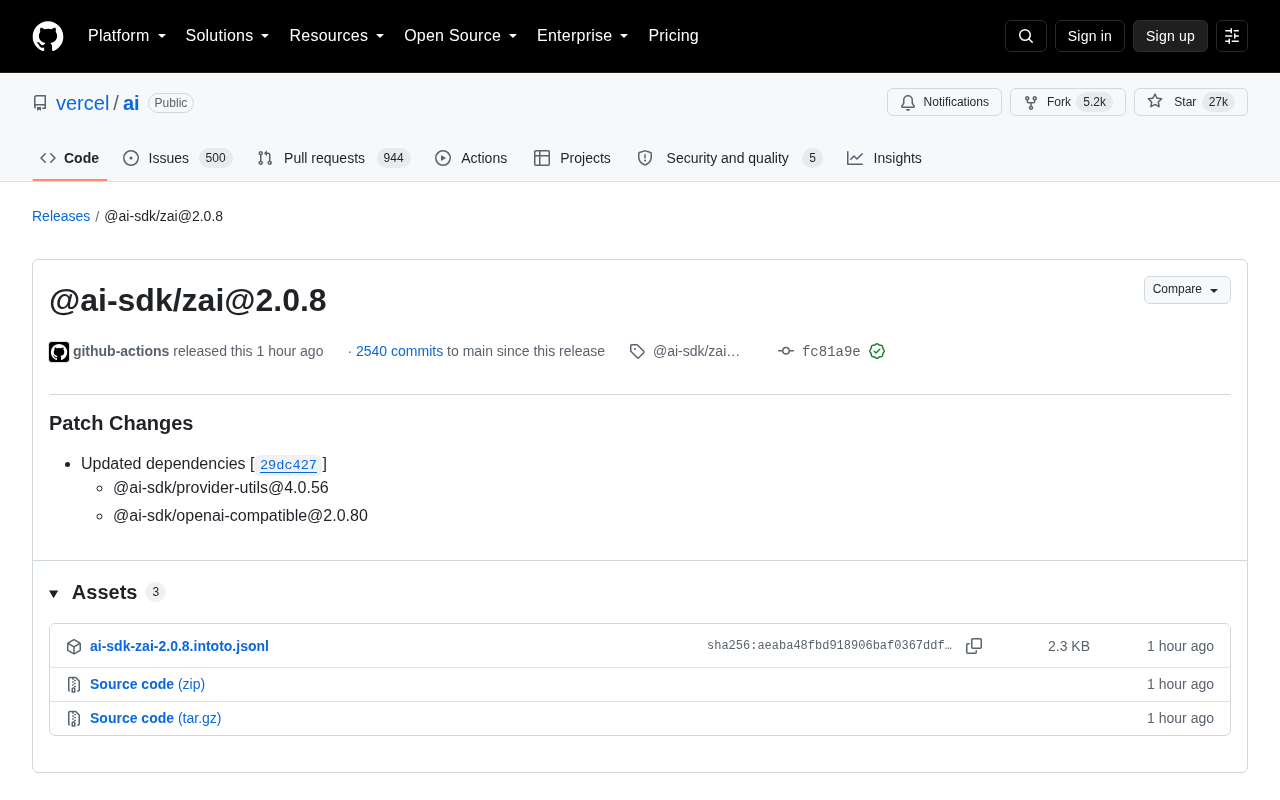
This @ai-sdk/zai@2.0.8 release is a patch-level iteration, with core changes centered on dependency upgrades. According to the release notes, this update includes:
- Updated dependency
@ai-sdk/provider-utils@4.0.56 - Updated dependency
@ai-sdk/openai-compatible@2.0.80
The version bump (2.0.7 → 2.0.8) indicates a typical patch update with no breaking changes or new API features introduced. For teams already using this provider in production, the upgrade risk is low.
@ai-sdk/openai-compatible is a general-purpose adapter layer provided by Vercel AI SDK, designed for third-party model services that are compatible with the OpenAI API specification. Since OpenAI's REST API format — including /chat/completions, SSE-based streaming responses, and function calling structures — has become the de facto industry standard, many model service providers (such as Together AI, Groq, Fireworks, and z.ai) offer compatible interfaces. By leveraging the openai-compatible middleware layer, developers building new providers don't need to implement request construction, stream parsing, error handling, and other common logic from scratch. They only need to provide an endpoint URL, authentication method, and a handful of provider-specific parameters — significantly lowering the integration barrier.
The Significance of Dependency Synchronization
@ai-sdk/zai is a provider package within the Vercel AI SDK ecosystem, responsible for integrating z.ai's model capabilities into the unified AI SDK interface. It depends on @ai-sdk/openai-compatible under the hood — a design that allows the zai provider to reuse the OpenAI compatibility layer's shared logic, requiring only minimal adaptation to connect to OpenAI API-compatible model services.
Synchronizing both provider-utils and openai-compatible in this update typically serves to pull in upstream bug fixes, type definition adjustments, or internal behavioral improvements. This kind of cascading update is a common pattern in monorepo-based dependency management: once a foundational utility library publishes a new version, all provider packages that depend on it release corresponding patch versions to maintain consistency across the entire ecosystem.
A monorepo (monolithic repository) architecture refers to a development model where multiple related packages or projects are managed together in a single code repository. Vercel AI SDK adopts this approach, housing
@ai-sdk/core,@ai-sdk/provider-utils,@ai-sdk/openai-compatible, and various provider packages (like@ai-sdk/zai) all in one repository. The key advantage: when a foundational library is updated, dependent packages can have their versions tracked and published in sync via automation tools like Changesets, ensuring no version mismatches exist across the ecosystem. This explains why a singleprovider-utilsfix can trigger a dozen provider packages to simultaneously release patch versions — it's an intentional design choice, not redundant work.
Practical Impact for Developers
For developers building applications with Vercel AI SDK, the approach to handling these patch updates is fairly straightforward. Since no functional changes are involved, the upgrade process typically only requires updating the version number in package.json and reinstalling dependencies — no changes to business logic are needed.
Also worth noting is the overall activity level of the Vercel AI SDK project itself. The repository has accumulated over 27,000 stars and 5,200 forks on GitHub, and maintains a high commit frequency (with 2,540 commits merged into the main branch at the time of this release). While individual minor version releases carry limited information, the overall pattern reflects an actively maintained open-source framework with a timely and healthy update cadence.
Summary
@ai-sdk/zai@2.0.8 is a routine dependency synchronization patch with no new features or breaking changes. Teams using the z.ai provider can upgrade with confidence to receive the latest fixes from the underlying utility libraries. These seemingly minor updates are, in fact, a daily reflection of what continuous iteration looks like in a healthy open-source project.
Related articles

Chain of Thought Isn't Just for AI: How Humans Can Use CoT to Improve Thinking Quality
Chain of Thought isn't just a prompt trick for large models. Starting from a Hacker News discussion, this article analyzes why CoT works for human thinking too, breaks down actionable ways to transfer it, and highlights the key differences between human CoT and machine CoT.
Cloudflare Teams Up with OpenAI: Closi…
Cloudflare Teams Up with OpenAI: Closing the Loop from Vulnerability Discovery to Defense with AI
Cloudflare uses OpenAI Daybreak to investigate security vulnerabilities and generate reviewable remediation plans, while developers use Codex to boost coding efficiency and quality.

Orca Multi-Agent Orchestration in Practice: A Guide to Parallel Collaboration with Claude and Codex
Orca is Stable AI's free open-source agent workbench supporting 34 agents like Claude Code and Codex in parallel. Learn its Git worktree isolation, multi-model orchestration, and mobile management.