Vercel AI SDK Releases @ai-sdk/zai@3.0.23 Patch Update

Vercel AI SDK releases @ai-sdk/zai@3.0.23 patch to sync internal dependencies with no feature changes.
Vercel AI SDK's Zhipu model adapter `@ai-sdk/zai` has released patch version 3.0.23, focused on syncing internal dependencies alongside upgrades to `@ai-sdk/provider`, `@ai-sdk/provider-utils`, and `@ai-sdk/openai-compatible`. Built on the OpenAI-compatible interface standard, `@ai-sdk/zai` is the official adapter for Zhipu's GLM model series. This patch follows SemVer conventions with no breaking changes, and can be safely adopted — though testing in CI/CD pipelines is still recommended.
Vercel's widely used AI SDK has released version @ai-sdk/zai@3.0.23. This is a patch-level update focused primarily on syncing dependency versions. For developers building AI applications with this toolkit, maintenance updates like this may not introduce new features, but they play a critical role in keeping projects stable and dependencies consistent.
What's in This Update
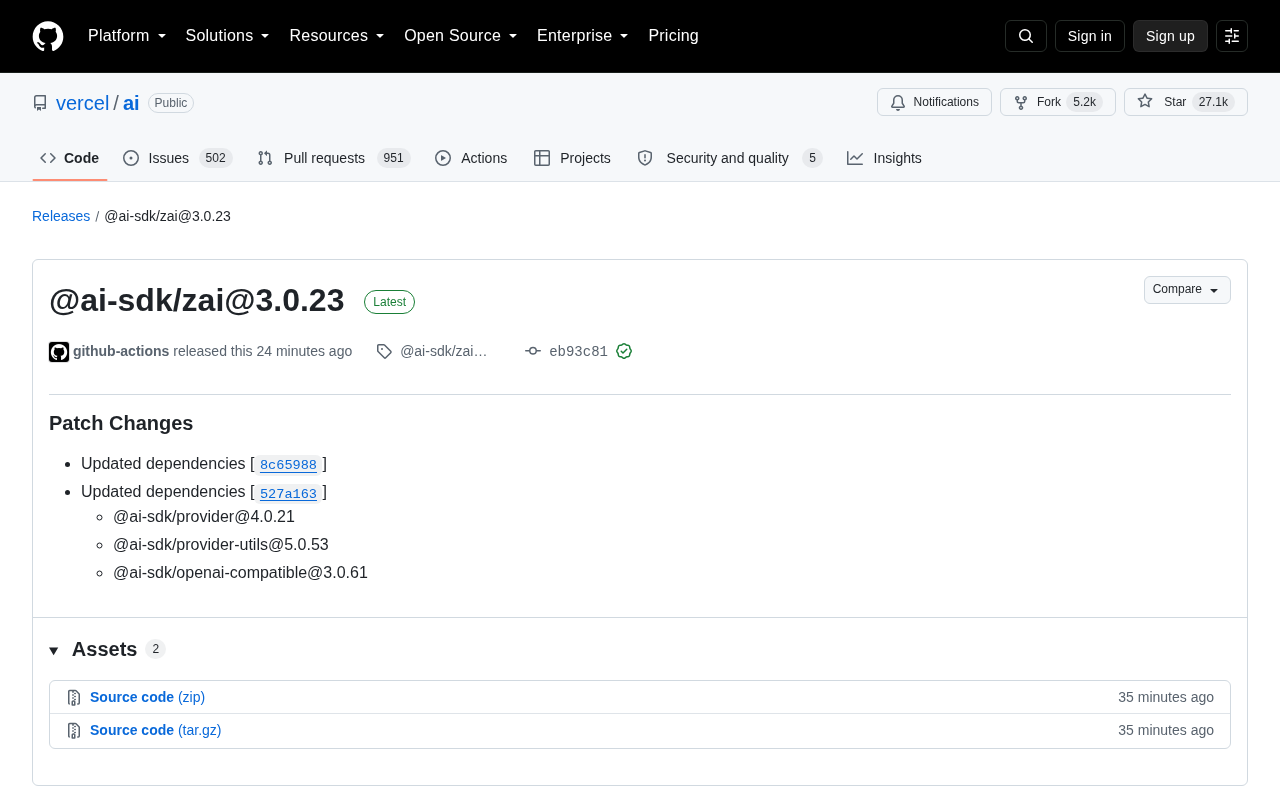
According to Vercel's release record on GitHub, @ai-sdk/zai@3.0.23 was automatically published on September 30 via GitHub Actions and verified with a GitHub GPG signature (key ID: B5690EEEBB952194), confirming the authenticity of the release artifact.
This update is a typical patch change, centered on version alignment following internal dependency adjustments. The changelog references two dependency updates (commits 8c65988 and 527a163) and bumps the following related packages:
@ai-sdk/provider@4.0.21@ai-sdk/provider-utils@5.0.53@ai-sdk/openai-compatible@3.0.61
These dependencies reveal that the zai provider is built on top of the AI SDK's standard provider abstraction layer and reuses the openai-compatible interface implementation. This modular dependency structure is a hallmark of the Vercel AI SDK ecosystem.
The Role of the zai Provider in AI SDK
@ai-sdk/zai is the official provider adapter within Vercel AI SDK for Z.ai (Zhipu AI / GLM model series). The AI SDK uses a unified provider mechanism that allows developers to call models from different vendors through a consistent API, and zai serves as the bridge for integrating Zhipu's models.
Because it depends on @ai-sdk/openai-compatible, this provider uses the OpenAI-compatible interface convention to connect with the underlying model service. This approach is quite common in multi-model adapter scenarios — it reduces maintenance overhead and standardizes the process of onboarding new models. When the underlying provider utility libraries are updated, concrete adapters like zai typically follow with patch releases to maintain compatibility.
Zhipu AI (Z.ai) is one of China's leading large model vendors. Its GLM series (e.g., GLM-4) are general-purpose large language models comparable to GPT-4. The API interface Zhipu provides closely follows OpenAI-compatible conventions, which is precisely what enables @ai-sdk/zai to be built efficiently on top of @ai-sdk/openai-compatible. The OpenAI-compatible interface has become a de facto standard for many LLM providers both in China and abroad (such as DeepSeekAd, Moonshot, Baichuan, etc.) — developers simply swap the Base URL and API key to switch between providers using the same codebase. Vercel AI SDK encapsulates this compatibility further through its provider abstraction layer, making model switching completely transparent to higher-level application code.
What This Means for Developers
For teams relying on Vercel AI SDK, patch updates like this can generally be adopted with confidence. Patch versions follow Semantic Versioning (SemVer) and, in principle, contain no breaking changes — they're intended for bug fixes, dependency syncs, and minor improvements.
In practice, there are a few things worth keeping in mind:
- Dependency consistency: If your project uses multiple
@ai-sdk/*packages, upgrading them together helps avoid potential compatibility issues. - Version locking: In production environments, use a lockfile to pin specific versions and upgrade in a coordinated manner after thorough testing.
- Changelogs: Even for patch updates, it's worth reviewing the changelog to confirm there are no subtle behavioral changes.
Vercel AI SDK currently has over 27,000 Stars and 5,200 Forks on GitHub, making it one of the mainstream open-source tools for building AI applications. Its frequent and regular release cadence reflects an actively maintained ecosystem.
Semantic Versioning (SemVer) defines version numbers in a MAJOR.MINOR.PATCH three-part structure: MAJOR indicates incompatible breaking changes, MINOR indicates backward-compatible new features, and PATCH indicates backward-compatible bug fixes only. The increment of the last digit in 3.0.23 is a PATCH-level change. That said, SemVer is a commitment rather than a technical guarantee — in practice, patch versions can occasionally introduce unexpected behavioral changes. Therefore, even for minor version upgrades, validating them with automated tests in your CI/CD pipeline remains a best practice.
Summary
@ai-sdk/zai@3.0.23 is a patch update focused on dependency synchronization. It introduces no new features or API changes, but it clearly contributes to the overall health of the AI SDK dependency chain. For developers using Zhipu model integrations, staying current with updates like this is a good habit for keeping projects stable.
Related articles

JobRunner MCP Server: AI Agents Can Now Fix Failed Java Jobs
JobRunner launches an open-source MCP server enabling AI agents to view cluster status, diagnose failures, and recover Java jobs—incident response from any cloud coding environment or existing agent.

MLAI Digital Launches 9 Security Agents: MCP Server Safeguards the Full Lifecycle of Agentic AI
MLAI Digital launches Security MCP Server with nine built-in specialized security agents covering vulnerability discovery, attack simulation, prompt injection detection, API and infrastructure assessment, and accelerated remediation—embedding security validation across the full Agentic AI lifecycle from development to production.

Running Isaac Lab on H100 GPUs: Exploring Better Approaches
Exploring optimization methods for running Isaac Lab on NVIDIA H100 GPUs, including MIG configuration, mixed precision, TensorRT acceleration, and community experience to improve robotics simulation and reinforcement learning efficiency.