Vercel AI SDK Releases @ai-sdk/zai Version 3.0.21

Vercel AI SDK's @ai-sdk/zai package releases a patch update to version 3.0.21 via automated GitHub Actions.
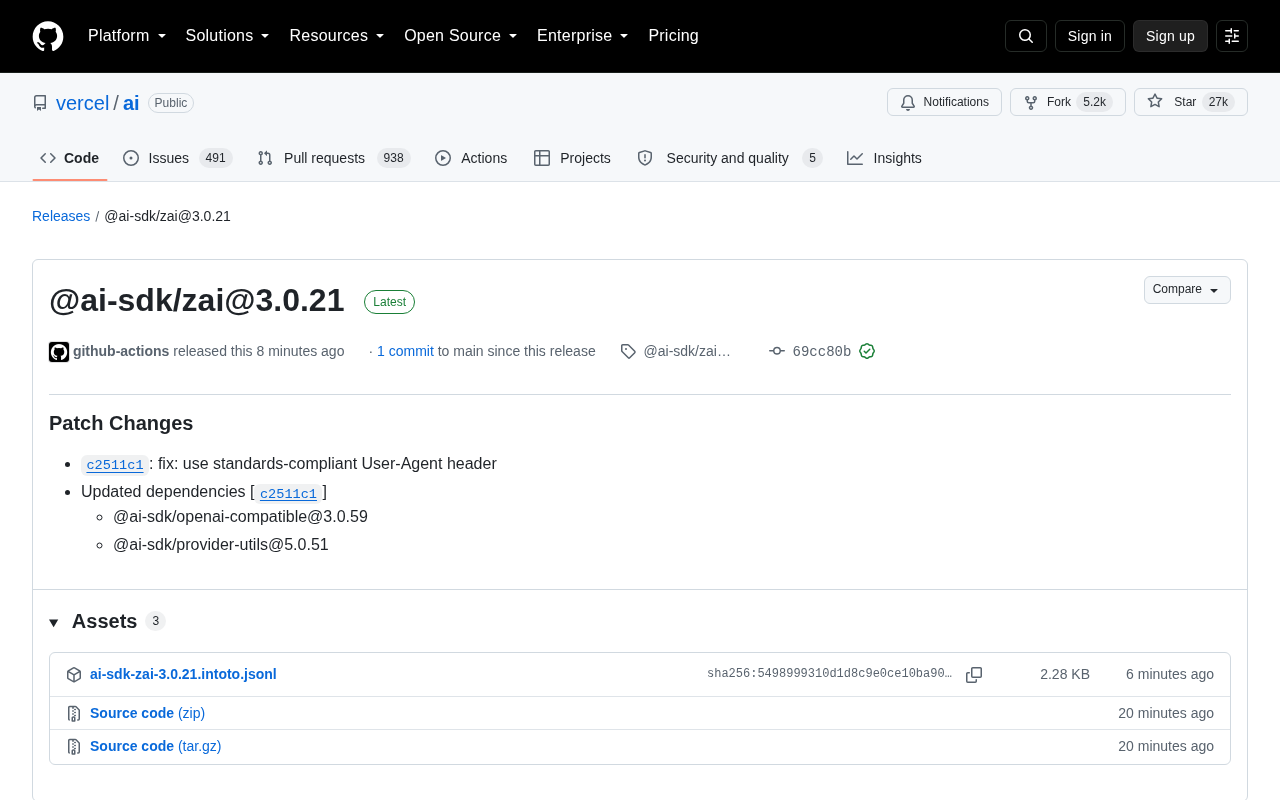
The `@ai-sdk/zai` package in the Vercel AI SDK ecosystem has released version 3.0.21 — a patch-level update automatically triggered by GitHub Actions using a changesets-based workflow, complete with a GitHub verified signature for supply chain security. Vercel AI SDK, one of the most widely used AI integration toolkits for frontend and full-stack development with ~27k GitHub stars, uses a multi-package monorepo architecture to let developers pull in only the model adapters they need. For developers in this ecosystem, patch updates are generally safe to adopt, though keeping all `@ai-sdk/*` sub-packages in sync remains an important maintenance consideration.
Vercel's AI SDK ecosystem has another update to note. The @ai-sdk/zai package recently released version 3.0.21, a routine version bump ("Version Packages") packaged and published via official GitHub Actions, complete with GitHub's verified signature.
While this particular update carries limited technical detail on its own, the broader Vercel AI SDK ecosystem behind it is well worth developers keeping on their radar.
About Vercel AI SDK
Vercel AI SDK is one of the most popular AI integration toolkits in the frontend and full-stack development space today. The project has accumulated approximately 27k stars on GitHub and over 5.2k forks, reflecting a highly active community and widespread real-world adoption.
The AI SDK follows a modular package management strategy, encapsulating adapters for different model providers as separate npm packages. @ai-sdk/zai is one such package — it gives developers the ability to connect to specific model services, making it easier and more standardized to call large language models within frameworks like Next.js.
What's in This Update
This 3.0.21 release was triggered by an automated GitHub Actions workflow, with the corresponding commit message reading "Version Packages (#21666)". This is a classic changesets-based version management pattern: once multiple PRs accumulate changesets, the CI pipeline automatically aggregates them, generates a version bump commit, and publishes a tagged release.
Looking at the version number, 3.0.21 is a patch-level update, which typically means bug fixes, dependency syncs, or minor optimizations — not breaking changes. For teams running this package in production, updates at this level are generally safe to adopt without major concern.
Also worth noting: this commit carries GitHub's verified signature (GPG key ID: B5690EEEBB952194) with vigilant mode enabled. This reflects Vercel's commitment to supply chain security best practices, ensuring the integrity and trustworthiness of published artifacts.
What is Changesets? Changesets is a version management tool designed specifically for monorepos, open-sourced by Atlassian and widely adopted in large-scale frontend projects. The core workflow goes like this: when submitting a PR, developers include a "changeset" file (
.changeset/*.md) describing the impact level (major/minor/patch) and a change summary. Once enough changesets accumulate, CI automatically runschangeset versionto consolidate all changes and update version numbers and CHANGELOGs across packages, then useschangeset publishto push the updated packages to the npm registry. This approach is especially well-suited to monorepos like Vercel AI SDK that contain dozens of sub-packages — it handles inter-package version dependencies automatically, significantly reducing the manual overhead and error risk of managing version numbers by hand.
What This Means for Developers
For developers building applications on top of Vercel AI SDK, keeping all @ai-sdk/* sub-packages in sync is an important part of routine maintenance. Because the AI SDK uses a monorepo + multi-package publishing architecture, the core package and various provider adapter packages often need to be upgraded together to avoid type mismatches or inconsistent API behavior.
It's recommended that developers review the corresponding CHANGELOG before upgrading to confirm whether the changes are relevant to their use case. For patch versions, folding the update into a regular dependency update cycle is usually fine; for major version jumps, more careful compatibility testing is warranted.
As the large language model provider ecosystem continues to expand, Vercel AI SDK's split-package approach lets developers pull in only the model adapters they actually need — keeping bundle sizes lean while improving the overall maintainability of the SDK. These seemingly minor version iterations are precisely what keeps a large open-source ecosystem running reliably.
What is a Monorepo? A monorepo (single repository) is an architectural pattern where multiple related packages or projects are managed together in a single Git repository, as opposed to the polyrepo approach of maintaining a separate repo per package. Vercel AI SDK uses a monorepo architecture, meaning dozens of npm packages —
@ai-sdk/core,@ai-sdk/openai,@ai-sdk/zai, and more — all share the same codebase. The advantage is that cross-package refactoring, interface synchronization, and integration testing become much more straightforward. However, there's a common gotcha: each sub-package has its own independent version number, and npm does not automatically guarantee compatibility between them. If you're using multiple@ai-sdk/*packages in a project, pay attention to whether their release dates align — a stale sub-package version can cause type definition conflicts or unexpected runtime behavior.
Related articles

JobRunner MCP Server: AI Agents Can Now Fix Failed Java Jobs
JobRunner launches an open-source MCP server enabling AI agents to view cluster status, diagnose failures, and recover Java jobs—incident response from any cloud coding environment or existing agent.

MLAI Digital Launches 9 Security Agents: MCP Server Safeguards the Full Lifecycle of Agentic AI
MLAI Digital launches Security MCP Server with nine built-in specialized security agents covering vulnerability discovery, attack simulation, prompt injection detection, API and infrastructure assessment, and accelerated remediation—embedding security validation across the full Agentic AI lifecycle from development to production.

Running Isaac Lab on H100 GPUs: Exploring Better Approaches
Exploring optimization methods for running Isaac Lab on NVIDIA H100 GPUs, including MIG configuration, mixed precision, TensorRT acceleration, and community experience to improve robotics simulation and reinforcement learning efficiency.