Vercel AI SDK Releases harness-github-copilot Patch Update

Vercel AI SDK releases [email protected] patch with dependency syncs and GPG signature.
Vercel's popular open-source project `ai` (approx. 27k stars) released `@ai-sdk/[email protected]`, a patch update focused on syncing upstream dependencies with no new features. It also bumps `@ai-sdk/[email protected]` and `@ai-sdk/[email protected]`. The harness layer acts as an adapter in Vercel AI SDK, unifying access to backends like GitHub Copilot under a standard interface. Published via GitHub Actions with GPG verification, the release exemplifies supply chain security best practices.
Update Overview
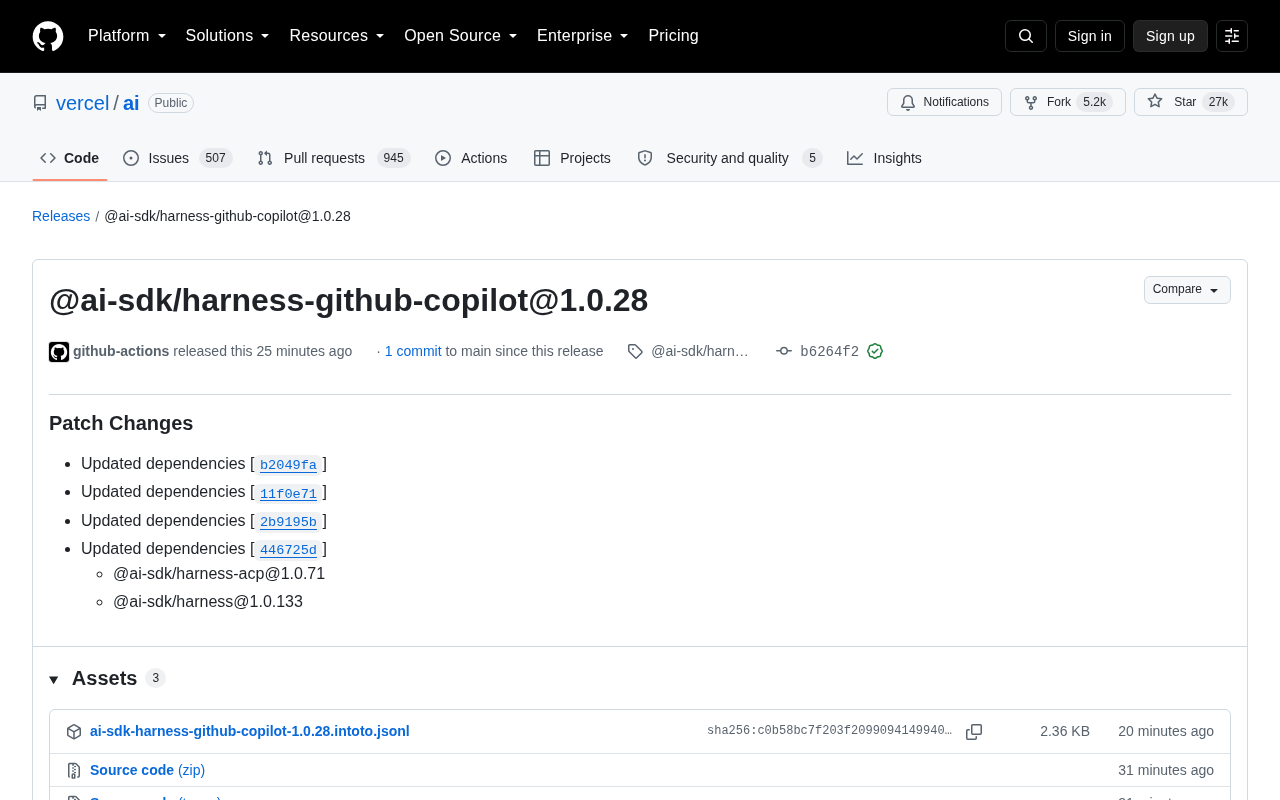
Vercel's open-source project ai (with approximately 27k stars and 5.2k forks on GitHub) recently released @ai-sdk/[email protected]. This is a patch-level update published via GitHub Actions automation, with authenticity guaranteed by GitHub's verified GPG signature (key ID: B5690EEEBB952194).
Based on the release notes, this update focuses on syncing dependency upgrades rather than introducing new features or behavioral changes. For developers building applications with the Vercel AI SDK, patch updates like this typically signal ongoing maintenance of underlying stability and compatibility.
What's in This Update
According to the release notes, @ai-sdk/[email protected] is a Patch Change, with the primary action being updates to several upstream dependencies across commits b2049fa, 11f0e71, 2b9195b, and 446725d.
Two related harness packages were also upgraded in tandem:
@ai-sdk/[email protected]@ai-sdk/[email protected]
This kind of cascading upgrade is common practice in monorepo projects — when the core harness package changes, adapter layers that depend on it (such as the GitHub Copilot harness) automatically bump their version numbers to keep the entire toolchain consistent.
What Is the AI SDK Harness
For readers unfamiliar with this module, here's a quick explanation of the harness layer's role in the Vercel AI SDK. A "harness" typically refers to a carrier or scaffolding layer that handles the integration logic for different AI model providers or tools. harness-github-copilot, as the name suggests, is an adapter component for GitHub Copilot scenarios, while harness-acp corresponds to another protocol or capability integration.
This layered design allows the Vercel AI SDK to interface with multiple AI backends through a unified API, so developers don't need to write repetitive glue code for each model provider. The frequent patch updates also reflect that this project is under active maintenance, with community feedback and dependency upgrades being absorbed quickly.
From an architectural standpoint, the Vercel AI SDK's harness layer follows the Adapter Pattern. The core @ai-sdk/harness package defines the standard interface contract, while specific harness implementations (such as harness-github-copilot) map the API behavior of particular providers to this unified interface. ACP (Agent Communication Protocol) is an emerging inter-agent communication protocol, and the existence of harness-acp indicates that Vercel AI SDK is expanding toward multi-agent collaboration scenarios. This package-splitting strategy in a monorepo also enables on-demand imports: projects that only use GitHub Copilot don't need to bundle adapters for other providers, reducing the final bundle size.
What This Means for Developers
Patch version updates may seem minor, but they are an important signal that an open-source toolchain is healthy and well-maintained. For teams using this SDK in production, here are a few points worth keeping in mind:
- Compatibility checks: Since this update includes a cascading upgrade to the core
@ai-sdk/harnesspackage, confirm compatibility with your existing code before upgrading. - Version pinning: Use appropriate version constraints in
package.jsonto avoid unexpected behavior caused by dependency drift. - Verify release signatures: This release was published with GitHub's verified signature, allowing developers to confirm the trustworthiness of the release source — a solid practice for supply chain security.
It's worth noting that Vercel AI SDK's approach of combining GitHub Actions automation with GPG signing provides a referenceable model for the open-source community when it comes to software supply chain security.
Dependency drift refers to the phenomenon where the actual installed package versions differ across environments or installation times due to loosely defined version range constraints. Common mitigation strategies include committing package-lock.json or yarn.lock to version control and using npm ci instead of npm install in CI/CD pipelines, ensuring every build is based on an identical dependency snapshot. GPG signature verification falls under Software Supply Chain Security: by signing releases with a key pair, consumers can verify that the package was genuinely published by a trusted party rather than tampered with by a man-in-the-middle — a concept closely related to npm's provenance attestation mechanism.
Conclusion
@ai-sdk/[email protected] is a routine dependency sync patch with no breaking changes. However, it reflects the consistent and well-structured maintenance cadence of Vercel AI SDK, one of the most popular open-source AI projects today. For developers building AI applications on this ecosystem, staying on top of these small version updates helps you benefit from under-the-hood improvements and avoid potential compatibility risks in a timely manner.
Related articles

Felix Rieseberg Personal Homepage
Felix Rieseberg's personal homepage sparks attention on Hacker News. This article covers the Slack engineer's technical background, the rise and fall of nativefier, and the value of a developer homepage as a tech calling card.

@ai-sdk/vue 3.0.306 Patch Release Syncs with [email protected] Update
@ai-sdk/vue 3.0.306 released, synced with [email protected]. A routine patch release for the Vercel AI SDK ecosystem with no public API changes; the Vue adapter layer stays version-aligned with the core package.

Gemini 4 Argon API Launches: The Era of Million-Token Output Begins
Google launches Gemini 4 Argon with sparse MoE architecture, up to 1M output tokens, and a 68.90% Vals Index score, available across API, AI Studio, and the Gemini app.