Vercel AI SDK Releases harness-pi 1.0.135 Patch Update

Vercel AI SDK's harness-pi releases patch 1.0.135, bumping the underlying harness dependency to 1.0.133.
`@ai-sdk/harness-pi@1.0.135` is a typical dependency-sync patch update in the Vercel AI SDK monorepo, introducing no breaking changes or new features. It upgrades the underlying `@ai-sdk/harness` to 1.0.133 and syncs four upstream dependency commits. The release was automated via GitHub Actions and verified with GPG signing, reflecting the engineering standards of a mature open source project. Developers can safely upgrade, but should be aware of monorepo cascading releases and use lockfiles with frozen install commands in production for consistency.
Vercel's AI SDK ecosystem continues its rapid iteration cycle, with @ai-sdk/harness-pi recently releasing version 1.0.135. This is a patch-level update focused primarily on dependency synchronization. While minor in scope, these kinds of updates are an important part of keeping projects built on this toolchain running smoothly.
Update Overview
According to the GitHub Releases page, @ai-sdk/harness-pi@1.0.135 falls under Patch Changes, with its core content being the synchronization of several upstream dependency updates. The release notes list four associated dependency commits (corresponding to commits b2049fa, 11f0e71, 2b9195b, and 446725d), and bump the underlying @ai-sdk/harness to 1.0.133.
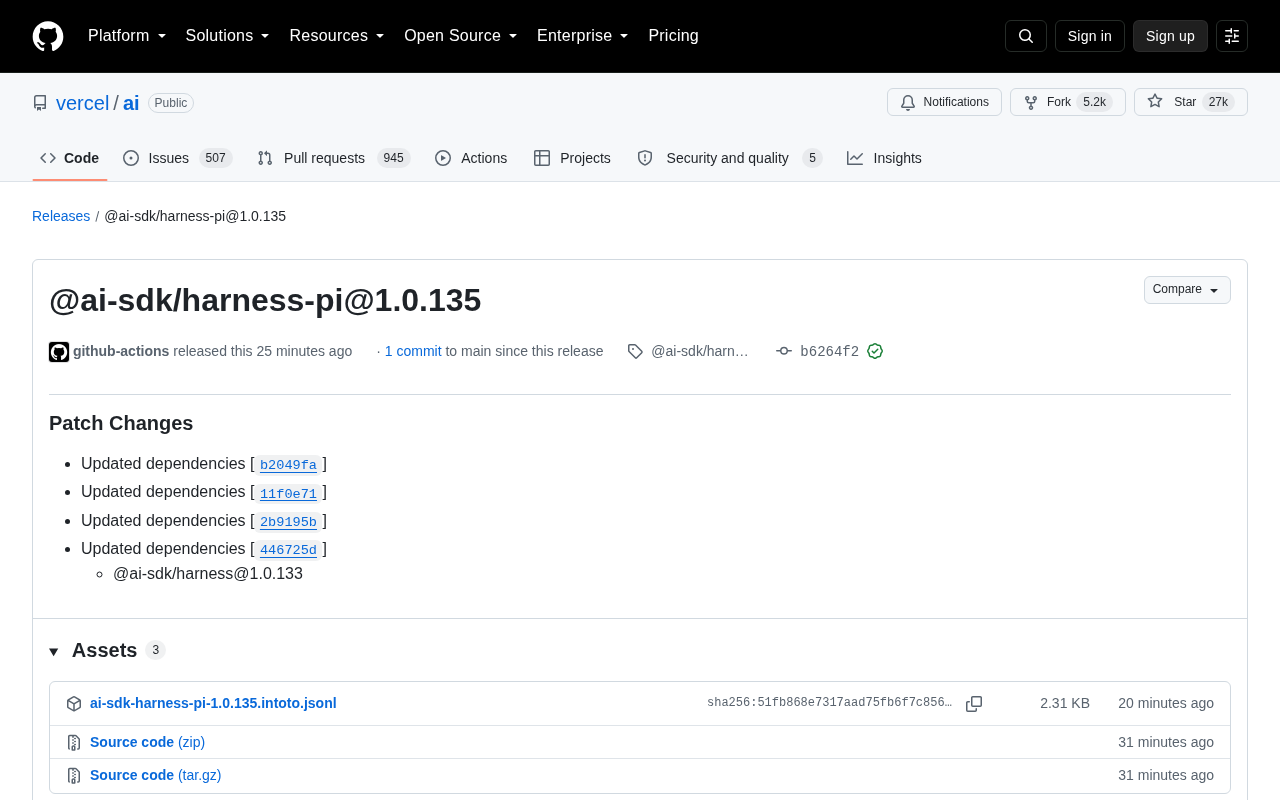
This version was published via GitHub Actions automation and verified with GitHub's trusted signing (GPG key ID: B5690EEEBB952194), consistent with the Vercel AI repository's standard automated release practices. This reflects the engineering maturity of well-maintained open source projects — releases no longer depend on manual intervention, but are instead automatically packaged, signed, and distributed through a CI/CD pipeline.
harness-pi's Role in the AI SDK
@ai-sdk/harness-pi is a sub-package within the Vercel AI SDK project. Based on its name and dependency relationship, it is tightly coupled with the core @ai-sdk/harness package and serves as a testing or runtime support component ("harness" in software engineering typically refers to a scaffolding layer for test frameworks or runtime environments).
Vercel's AI SDK is one of the more popular AI application development toolkits in the TypeScript/JavaScript ecosystem, having accumulated over 27k stars and 5.2k forks on GitHub with a vibrant community. The entire repository uses a monorepo structure to manage multiple sub-packages, with inter-package dependencies maintained through Semantic Versioning (SemVer). When the underlying harness package is updated, harness-pi publishes a corresponding patch release to sync its dependency — which is exactly how version 1.0.135 came to be.
What is a Monorepo? A monorepo is an engineering strategy that consolidates multiple related projects or packages into a single repository, as opposed to the Polyrepo model where each package has its own repository. Vercel AI SDK uses a monorepo structure, managed with tools like Turborepo or pnpm workspaces for unified build, test, and release workflows. The key advantage is that cross-package changes can be made atomically within a single Pull Request, dependency relationships are transparent, and CI pipelines can intelligently rebuild only the affected sub-packages. Semantic Versioning (SemVer) plays a critical role here — a Major version bump signals breaking API changes, a Minor bump introduces backward-compatible new features, and a Patch bump is reserved for bug fixes or dependency syncs. This release of
harness-piis a Patch version, representing the lowest risk level.
What Patch Updates Mean for Developers
For developers using the Vercel AI SDK, patch versions typically introduce no breaking changes and no new features — they exist primarily to fix issues, update dependencies, or improve stability. Upgrading to 1.0.135 is generally safe and can be done without worrying about API compatibility.
What's worth paying attention to is the pattern of "cascading dependency updates." In a monorepo architecture, a single change to a foundational package can trigger a chain of version releases across dependent sub-packages. Developers who pin dependency versions should watch for these indirect updates — especially in production environments, where it's recommended to use a lockfile (such as package-lock.json or pnpm-lock.yaml) to precisely control the dependency tree and avoid uncertainty introduced by automatic upgrades.
About Lockfiles A lockfile is a core safety net for frontend dependency management.
package-lock.json(npm),yarn.lock(Yarn), andpnpm-lock.yaml(pnpm) precisely record the exact version and integrity hash of every package in the dependency tree, ensuring a completely consistent snapshot across different developers, machines, and CI environments. In monorepo cascading update scenarios, even ifpackage.jsonspecifies a range like^1.0.0, as long as the lockfile exists and is committed to version control, the dependency tree won't silently change when upstream packages release new versions. For production deployments, it's strongly recommended to use "frozen install" commands likenpm ciorpnpm install --frozen-lockfilerather thannpm install, which can automatically update dependencies when the lockfile andpackage.jsonare out of sync — potentially introducing untested versions.
Summary
@ai-sdk/harness-pi@1.0.135 is a typical dependency-sync patch update that introduces no significant functional changes, but it reflects the healthy iteration cadence and well-standardized automated release process of the Vercel AI SDK project. For teams depending on this SDK, keeping up with patch releases like this helps maintain alignment between your development environment and the official published versions. Since the original release notes are limited in detail, developers are encouraged to follow the official GitHub Releases page and CHANGELOG for more comprehensive information on changes.
Related articles

Chain of Thought Isn't Just for AI: How Humans Can Use CoT to Improve Thinking Quality
Chain of Thought isn't just a prompt trick for large models. Starting from a Hacker News discussion, this article analyzes why CoT works for human thinking too, breaks down actionable ways to transfer it, and highlights the key differences between human CoT and machine CoT.
Cloudflare Teams Up with OpenAI: Closi…
Cloudflare Teams Up with OpenAI: Closing the Loop from Vulnerability Discovery to Defense with AI
Cloudflare uses OpenAI Daybreak to investigate security vulnerabilities and generate reviewable remediation plans, while developers use Codex to boost coding efficiency and quality.

Orca Multi-Agent Orchestration in Practice: A Guide to Parallel Collaboration with Claude and Codex
Orca is Stable AI's free open-source agent workbench supporting 34 agents like Claude Code and Codex in parallel. Learn its Git worktree isolation, multi-model orchestration, and mobile management.