Vercel AI SDK Releases Svelte 4.0.292 Patch Update

Vercel AI SDK releases a low-risk patch update for @ai-sdk/svelte, syncing with the core package.
Vercel AI SDK published `@ai-sdk/svelte@4.0.292` via GitHub Actions, alongside a synchronized upgrade of the core package `ai@6.0.292`. The `@ai-sdk/svelte` package is the official adapter layer that exposes streaming responses and conversation state management to Svelte developers in a framework-idiomatic way. Because different frameworks have distinct reactivity models, the SDK uses a split-package design with independently versioned adapters. This patch update simply aligns with the core dependency and introduces no independent features or breaking changes, making it safe to include in routine dependency maintenance. The `vercel/ai` project currently has around 27k GitHub stars and remains under active development.
Release Overview
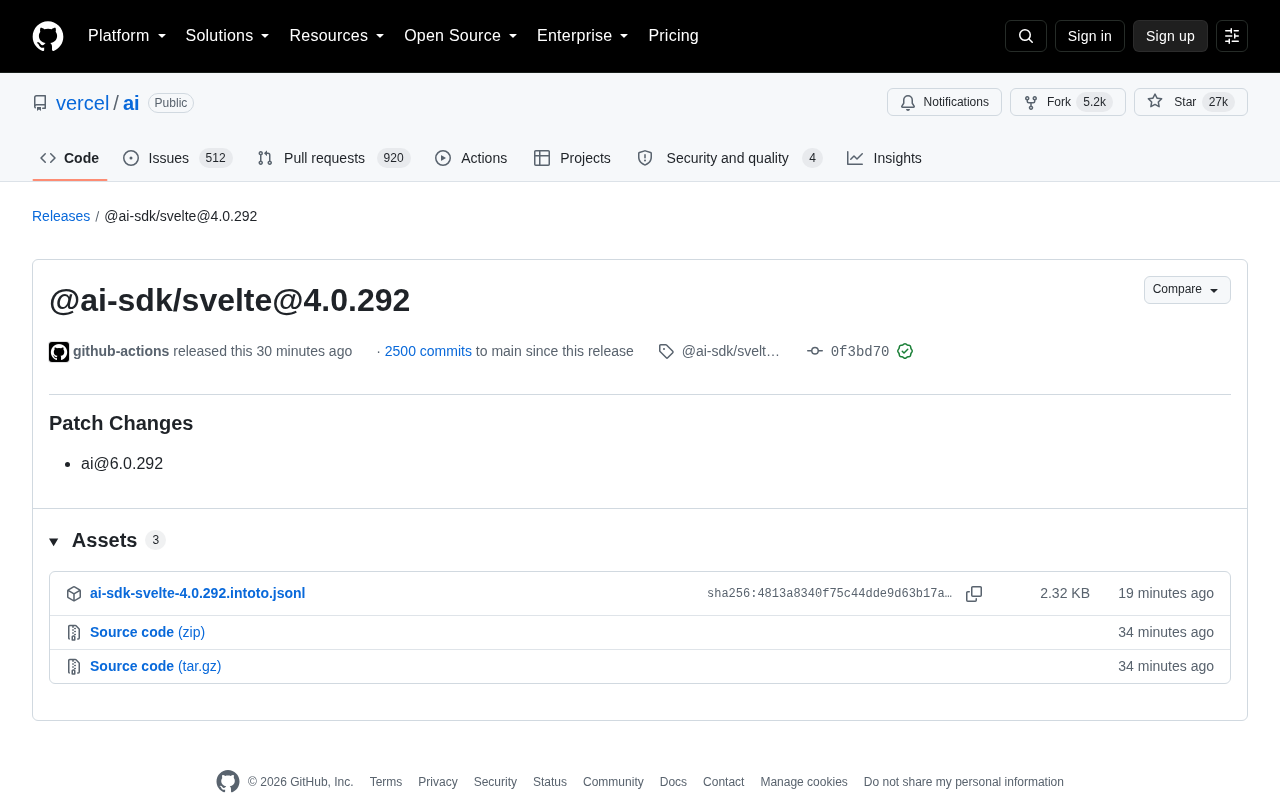
Vercel's AI SDK project has published @ai-sdk/svelte@4.0.292 on GitHub via an automated pipeline (github-actions). This is a patch-level update, released alongside a synchronized upgrade of the core package ai@6.0.292.
The release was pushed by GitHub Actions on September 25th, with commit hash 0f3bd70 and a GitHub-verified signature. At the time of release, the repository's main branch had accumulated approximately 2,498 commits. The vercel/ai project has around 27k stars and 5.2k forks on GitHub, making it one of the more prominent open-source libraries in the AI application development space.
What Is the AI SDK's Svelte Adapter
@ai-sdk/svelte is the official adapter layer that Vercel AI SDK provides for the Svelte frontend framework. The core goal of the Vercel AI SDK is to give developers a unified interface for integrating various large language models into their applications, while simplifying common needs like streaming responses and conversation state management.
Because different frontend frameworks (such as React, Vue, and Svelte) differ in their reactivity and state management mechanisms, the AI SDK uses a split-package design: core logic lives in the ai main package, while framework-specific bindings are separated into independent adapter packages. @ai-sdk/svelte serves as the bridge that allows Svelte developers to use chat, completion, and other AI capabilities in a way that feels natural within the framework.
Svelte is a compiler-based frontend framework created by Rich Harris. Its key distinction from React and Vue is that it compiles components into efficient native JavaScript at build time, rather than maintaining a virtual DOM at runtime. Svelte's reactivity system is based on static analysis by the compiler — state is declared using plain variables and assignment operators, with no need to explicitly call setState or ref(). This design is fundamentally different from React Hooks or Vue Composition API, which means common async state management tasks — such as token-by-token rendering of streaming AI responses and loading state tracking — require dedicated adapters. @ai-sdk/svelte internally wraps this state using Svelte's Store mechanism, allowing developers to subscribe to chat message streams directly in templates using the $store syntax, without manually handling ReadableStream or managing intermediate state.
What Changed in This Update
Based on the release notes, 4.0.292 is a typical patch update (Patch Changes), with changes primarily driven by the dependency on ai@6.0.292. This means the Svelte adapter itself introduces no independent feature changes — it simply syncs with the core package version to maintain compatibility.
This type of patch release is very common in actively maintained open-source libraries. They typically address bug fixes, update internal dependencies, or align with the main package's interface, and generally do not introduce breaking changes. For projects already using this SDK, these updates carry low upgrade risk and can be folded into a routine dependency maintenance workflow.
Semantic Versioning (SemVer) is a widely adopted version numbering convention in the open-source ecosystem, formatted as MAJOR.MINOR.PATCH. A patch version increment is reserved for backwards-compatible bug fixes; a minor version increment signals new backwards-compatible features; and a major version increment represents a significant upgrade with breaking changes. In this release, the last number increments from 291 to 292 in 4.0.292, which is a classic patch change. It's worth noting that the ai main package is versioned at 6.0.292 while the adapter is at 4.0.292 — the differing major versions indicate that each sub-package maintains its own version line independently. Major version alignment is not required; patch number alignment is the real signal for compatibility.
What This Means for Developers
For developers building AI applications with Svelte, keeping @ai-sdk/svelte aligned with the ai core package version helps avoid compatibility issues caused by interface drift. The frequent minor iterations also reflect that the Vercel AI SDK is under active development, meaning the community can expect timely maintenance and support.
It's worth noting that this release is primarily changelog-focused and does not disclose more specific feature details. Developers who want to understand the exact changes in the ai@6.0.292 core package should consult the corresponding release notes and official documentation to determine whether an immediate upgrade is warranted.
Related articles

Chain of Thought Isn't Just for AI: How Humans Can Use CoT to Improve Thinking Quality
Chain of Thought isn't just a prompt trick for large models. Starting from a Hacker News discussion, this article analyzes why CoT works for human thinking too, breaks down actionable ways to transfer it, and highlights the key differences between human CoT and machine CoT.
Cloudflare Teams Up with OpenAI: Closi…
Cloudflare Teams Up with OpenAI: Closing the Loop from Vulnerability Discovery to Defense with AI
Cloudflare uses OpenAI Daybreak to investigate security vulnerabilities and generate reviewable remediation plans, while developers use Codex to boost coding efficiency and quality.

Orca Multi-Agent Orchestration in Practice: A Guide to Parallel Collaboration with Claude and Codex
Orca is Stable AI's free open-source agent workbench supporting 34 agents like Claude Code and Codex in parallel. Learn its Git worktree isolation, multi-model orchestration, and mobile management.