Vercel AI SDK Releases Voyage 2.0.54 Patch Update

Vercel AI SDK releases @ai-sdk/voyage@2.0.54 patch, syncing core dependencies with no breaking changes.
@ai-sdk/voyage@2.0.54 is a routine patch update to Vercel AI SDK's Voyage embedding and reranking integration, with core changes limited to syncing dependencies `@ai-sdk/provider@4.0.22` and `@ai-sdk/provider-utils@5.0.54`. This is a typical monorepo pattern where downstream adapter packages bump versions to maintain compatibility when shared base packages update. Voyage AI's high-quality embeddings and reranking models make it popular for RAG use cases, and the `@ai-sdk/voyage` package enables developers to access these capabilities through a unified API in frameworks like Next.js. Upgrading is low-risk and straightforward via standard package manager commands.
Update Overview
Vercel's AI SDK project has recently released @ai-sdk/voyage@2.0.54. This is a patch-level update focused primarily on dependency synchronization, with no breaking changes or major new features introduced. For developers integrating Voyage embedding models, this is a low-risk, routine maintenance release that can be safely upgraded.
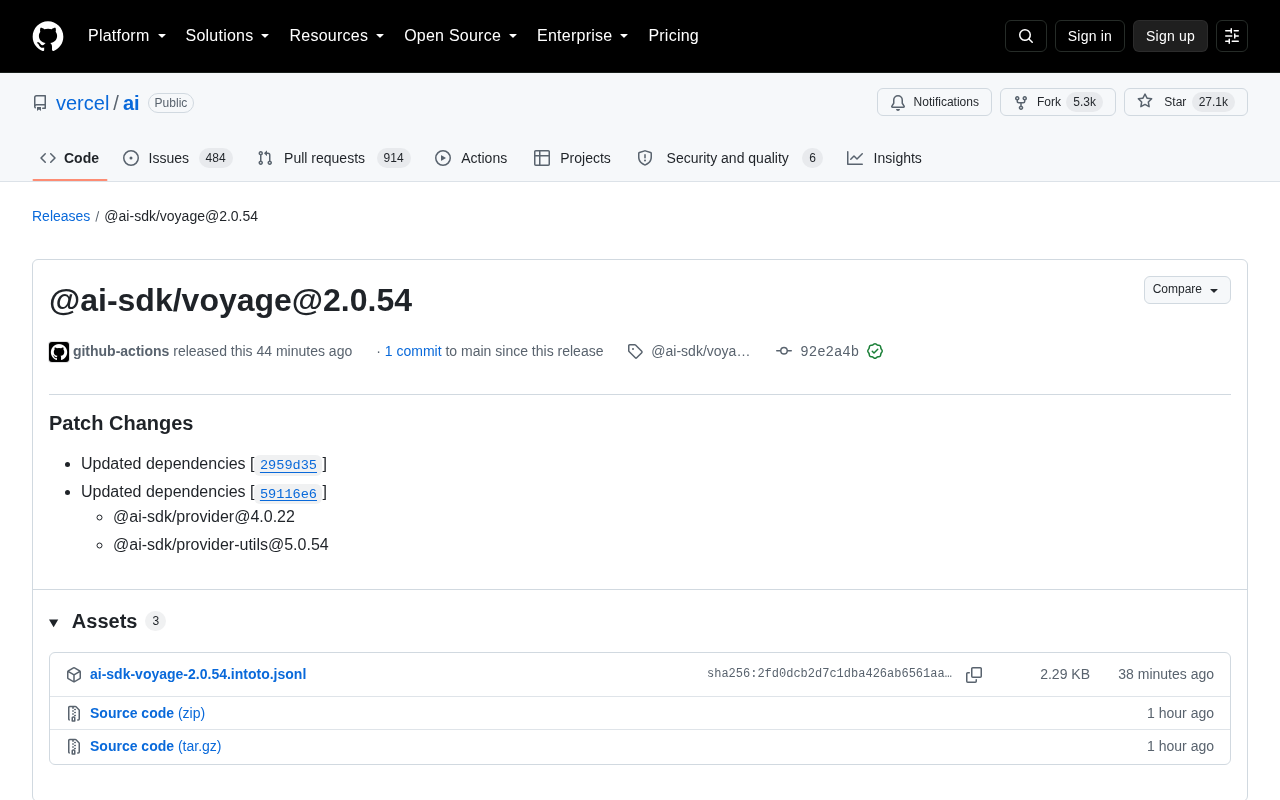
According to the GitHub release history, this version was published via github-actions automation and carries GitHub's Verified signature, ensuring the trustworthiness of the release source. Vercel's ai repository has accumulated over 27.1k stars and 5.3k forks, making it one of the most widely followed AI application development frameworks in the JavaScript/TypeScript ecosystem.
What's Changed in This Update
According to the release notes, version 2.0.54 falls under Patch Changes, with core changes focused on underlying dependency updates:
- Updated dependency
@ai-sdk/provider@4.0.22 - Updated dependency
@ai-sdk/provider-utils@5.0.54
These two dependencies serve as the core abstraction layer and utility toolkit for the AI SDK. The provider package defines the unified interface specification for integrating various model providers, while provider-utils handles common utility logic such as request processing and data transformation. As a downstream adapter, the Voyage package follows these two core packages' iterations with synchronized upgrades — a typical dependency chain maintenance pattern.
This update pattern reflects the engineering characteristics of AI SDK's monorepo approach to managing multiple providers. When the underlying abstraction layer changes, specific model integration packages (such as Voyage, OpenAI, Anthropic, etc.) update their version numbers accordingly to maintain overall compatibility.
What is a Monorepo? A monorepo (single repository) is an engineering pattern where multiple related packages are managed under the same Git repository. Vercel AI SDK adopts this structure to uniformly manage dozens of model provider adapter packages. The key advantage: when a shared base package (like
@ai-sdk/provider) undergoes interface changes, all downstream packages can be updated and tested together in a single PR, avoiding compatibility fragmentation caused by version drift.@ai-sdk/providerdefines standard interface contracts across providers (such as streaming response formats and error types), while@ai-sdk/provider-utilsprovides reusable utilities like fetch wrappers, JSON Schema validation, and retry logic. Specific adapter packages like Voyage, OpenAI, and Anthropic depend on these two foundational packages — when the base packages advance versions, adapters must release new versions to declare compatibility with the updated base, even if their own logic hasn't changed. This is the fundamental reason for the 2.0.54 patch release.
Voyage's Role in the AI SDK
Voyage AI is known for its high-quality text embedding and reranking models, and is widely used in Retrieval-Augmented Generation (RAG) scenarios. The @ai-sdk/voyage package integrates Voyage's model capabilities into Vercel AI SDK's unified calling interface, allowing developers to invoke embedding models with a consistent API style.
For teams building semantic search, knowledge base Q&A, and similar applications, the quality of Voyage's embedding vectors directly impacts retrieval recall performance. Through the AI SDK abstraction, developers can quickly integrate vectorization capabilities into frameworks like Next.js without worrying about the underlying HTTP request details.
A Closer Look at Embeddings and RAG Text embedding converts natural language text into high-dimensional floating-point vectors, placing semantically similar texts closer together in vector space. In a RAG (Retrieval-Augmented Generation) architecture, the embedding model plays the central role in the "retrieval" step: user queries and knowledge base documents are each converted into vectors, and the system uses cosine similarity or dot product operations to find the most relevant document snippets, which are then fed as context to a large language model to generate the final answer. Voyage AI's differentiated advantage lies in its domain-specific models trained for areas like code, legal, and finance — these typically outperform general-purpose embedding models in retrieval precision for those vertical scenarios. Reranking models are an optional enhancement in the RAG pipeline: after an initial retrieval of candidate documents, a cross-encoder scores and re-ranks each "query-document" pair for finer granularity, improving the quality of context sent to the LLM and significantly boosting answer accuracy at relatively low cost.
How Developers Should Respond
Since this is a patch-only update, the upgrade cost is minimal. Simply run a standard update command with your package manager to get the latest version:
npm install @ai-sdk/voyage@2.0.54
# or
pnpm add @ai-sdk/voyage@2.0.54
When upgrading, it's worth verifying that the accompanying core dependency versions are also updated correctly to avoid type or runtime issues from version mismatches. For production environments, it's still recommended to run a regression test after upgrading to confirm that the input/output behavior of embedding calls meets expectations.
Overall, frequent minor version iterations are a healthy signal for an active open-source project, reflecting Vercel's sustained investment in the AI SDK ecosystem and its ability to respond quickly. Teams following this project can subscribe to updates via the GitHub Releases page to stay current with future changes.
Related articles

Chain of Thought Isn't Just for AI: How Humans Can Use CoT to Improve Thinking Quality
Chain of Thought isn't just a prompt trick for large models. Starting from a Hacker News discussion, this article analyzes why CoT works for human thinking too, breaks down actionable ways to transfer it, and highlights the key differences between human CoT and machine CoT.
Cloudflare Teams Up with OpenAI: Closi…
Cloudflare Teams Up with OpenAI: Closing the Loop from Vulnerability Discovery to Defense with AI
Cloudflare uses OpenAI Daybreak to investigate security vulnerabilities and generate reviewable remediation plans, while developers use Codex to boost coding efficiency and quality.

Orca Multi-Agent Orchestration in Practice: A Guide to Parallel Collaboration with Claude and Codex
Orca is Stable AI's free open-source agent workbench supporting 34 agents like Claude Code and Codex in parallel. Learn its Git worktree isolation, multi-model orchestration, and mobile management.