Vercel AI SDK Releases Vue Patch Update: @ai-sdk/vue@3.0.339 Syncs with Core ai@6.0.339
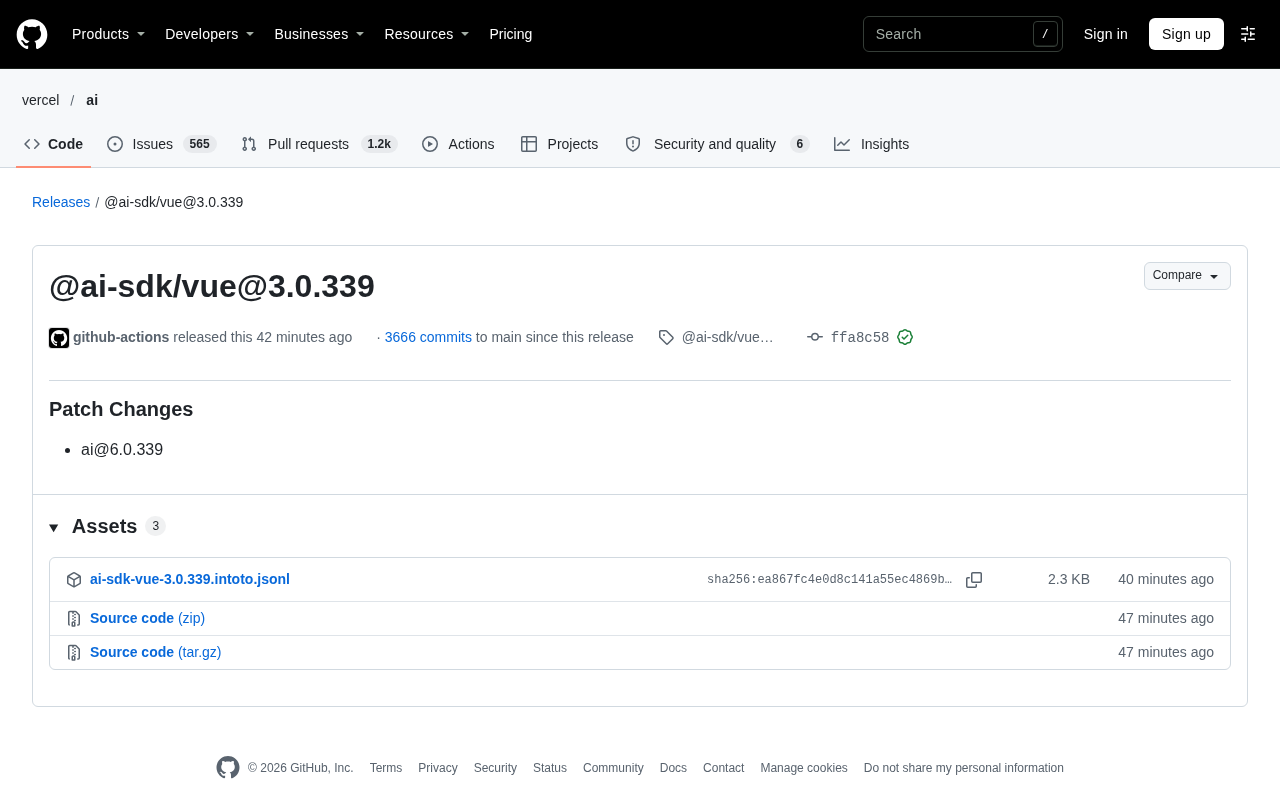
Vercel releases @ai-sdk/vue@3.0.339 patch, syncing with core package ai@6.0.339.
Vercel's AI SDK project released the Vue adapter patch version @ai-sdk/vue@3.0.339, auto-built by GitHub Actions after 3,666 commits on main and syncing core package ai@6.0.339. Under SemVer, patch updates usually only fix bugs and align dependencies without breaking API changes, so upgrade risk is low. The article covers AI SDK as a unified multi-model toolkit and how @ai-sdk/vue provides Vue 3 composables for managing conversation state and streaming output. The release chain is GPG-verified and traceable. Upgrade advice: validate streaming and chat cases in a small scope and check whether the core package is upgraded too.
Vercel's AI SDK project has released a new patch version of its Vue adapter, @ai-sdk/vue@3.0.339. This version was automatically built by GitHub Actions after accumulating 3,666 commits on the main branch, and it also brings a synchronized update to the core package ai@6.0.339. For developers integrating large model capabilities into Vue applications, this is a maintenance release worth noting.
What a Patch Version Means
Judging from the "339" in the version number and the "Patch Changes" label in the release notes, this is a patch-level update. Under semantic versioning, patch versions are typically used for bug fixes, dependency alignment, or minor adjustments, and do not involve breaking API changes.
This means teams already using @ai-sdk/vue in their projects can upgrade with relatively low risk. The release notes also list synchronized changes to the core dependency ai@6.0.339, indicating that the Vue adapter and the core SDK stay aligned in their release cadence.
Semantic Versioning (SemVer) is a widely adopted version numbering convention with the format major.minor.patch. A major version change indicates incompatible API modifications, a minor version change indicates backward-compatible feature additions, and a patch version change indicates backward-compatible bug fixes. Package managers like npm default to the ^ version range, which allows automatic upgrades at the minor and patch levels—precisely because of this convention. For a library like @ai-sdk/vue in its 3.x stage, a patch number like 339 shows that the project releases very frequently—almost every merged commit can trigger an automated release—so the absolute patch number does not directly correspond to the scale of changes.
How the Vue Ecosystem Connects to AI SDK
AI SDK is an open-source toolkit from Vercel designed to unify the way different language model providers are called and to provide capabilities such as streaming responses and tool calling. Its ecosystem covers official adapters for multiple frontend frameworks including React, Svelte, and Vue; @ai-sdk/vue is the wrapper for Vue 3.
With this adapter, Vue developers can use composables directly in components to manage conversation state and handle streaming output, without writing boilerplate code to integrate with each provider's model API. This layered design allows framework adapters and the core SDK to iterate independently while ensuring compatibility through version alignment.
Composables are the core organizational pattern of Vue 3's Composition API, typically named with a use prefix, such as useChat. It is essentially an ordinary function that can internally call reactive primitives like ref, computed, and watch, and returns a set of reactive state and methods for components to destructure. Compared with Vue 2's Options API, composables package "state + logic" into reusable units, making them naturally suited for encapsulating stateful, cross-component capabilities like streaming conversations. AI SDK's framework adapters leverage this mechanism to consolidate interaction with model APIs, assembly of streaming chunks, and management of loading and error states into a single function—developers only need to call it in setup to get a reactive message list.
Release Process and Traceability
The release metadata also reveals the project's engineering practices. The version was automatically published by the github-actions bot at 23:26 on the 27th; commit ffa8c58 carries a GitHub verified signature with GPG key ID B5690EEEBB952194. For enterprise teams that care about supply chain security, this verifiable release chain is one factor to consider when assessing dependency trustworthiness.
The release page's assets section lists 3 files, but some loading areas on the page showed error messages and did not fully display all content. If you encounter behavioral differences after upgrading, it is recommended to check the changelogs of both the core ai package and the @ai-sdk/vue repository.
GPG-signed commits refer to developers generating a cryptographic signature for the Git commit object using their private key; others can use the corresponding public key to verify that the commit was indeed created by the private key holder and that its contents have not been tampered with. GitHub displays a Verified badge next to such commits. Against the backdrop of frequent open-source supply chain attacks, signed commits—combined with protected main branches and trusted CI release pipelines—form a verifiable chain from code to artifact. For enterprise users, this means they can confirm that the artifact on npm genuinely comes from a specific commit in the upstream repository, rather than being replaced at an intermediate step. Note, however, that signing only guarantees provenance and integrity; it is not equivalent to a security audit of the code.
Upgrade Recommendations
Since this is not a major version jump, the usual practice is to first update dependencies in a small-scope environment, run existing conversation and streaming output test cases, and confirm that the composable API's behavior has not changed. For teams pinning older versions, you can migrate using the package manager's patch upgrade command, and watch whether the core ai package is also bumped to 6.0.339.
As AI SDK continues to iterate rapidly, tracking patch versions helps you get fixes and compatibility improvements in a timely manner. If there are feature-level changes in the future, they will typically be reflected in minor version number changes.
One-line Summary
Vercel releases @ai-sdk/vue@3.0.339 patch version, syncing with core package ai@6.0.339.
Paragraph Summary
Vercel's AI SDK project has released the Vue adapter patch version @ai-sdk/vue@3.0.339, automatically built by GitHub Actions after 3,666 commits on the main branch and synchronously updating the core package ai@6.0.339. Under semantic versioning, patch-level updates typically involve only bug fixes and dependency alignment, with no breaking API changes, so upgrade risk is low. The article explains AI SDK's positioning as a unified toolkit for calling multiple models, and how @ai-sdk/vue provides Vue 3 developers with composable wrappers that allow components to directly manage conversation state and streaming output. The release chain carries a GPG verified signature and is traceable. The upgrade recommendation is to first validate streaming and conversation use cases in a small-scope environment, and to watch whether the core package is upgraded alongside it.
Related articles

Satirical Viral Hit "Rich Girl's Christmas Haul": A Consumption Frenzy or an Isolated Case?
A Bilibili satirical rich-girl Christmas haul video sparks debate. This article breaks down the consumption symbols in its gift list, analyzes the blurred line between showing off and gratitude, and explores the narrative template of wealth-flaunting content on platforms and its impact on teenagers' wealth perception.

Before You Get Your Ears Pierced: A Professional Piercer Explains Placement, Pain, and Aftercare
A professional piercer explains the full ear piercing process: why a max of three per session, pain ratings and healing times by location, 18K gold vs. pure silver, hollow needles vs. piercing guns, and aftercare.

Follow the Light: How Light-Triggered ASMR Commands Your Attention
Analyzing Bilibili creator Veda's command-based ASMR video: how pen light and otoscope use visual tracking commands to command attention, upgrading sound relaxation into an interactive attention game, and what it means for immersive content creation.