Vercel AI SDK Releases workflow-harness 1.0.117 Patch Update

Vercel AI SDK releases a workflow-harness patch update focused on internal dependency version alignment.
Vercel AI SDK has released `@ai-sdk/workflow-harness@1.0.117`, a patch update whose core change is syncing the internal `@ai-sdk/harness` dependency to the same version. This is a routine version alignment operation common in monorepo architectures and introduces no breaking changes, making it safe to upgrade. The release was automated via GitHub Actions and verified with a GPG trusted signature, reflecting the project's mature software supply chain security practices. At version 1.0.117, the project is clearly in a high-frequency iteration state — a strong signal for teams building agent workflows on the AI SDK.
Vercel's AI SDK project has released @ai-sdk/workflow-harness@1.0.117. This is a patch-level update, primarily syncing the internal dependency @ai-sdk/harness@1.0.117 to the same version. As an active open-source project with over 26,800 stars and 5,200 forks on GitHub, every release of the AI SDK is worth examining for the engineering direction it reflects.
What's in This Update
According to the release notes, workflow-harness@1.0.117 falls under Patch Changes. The core change is upgrading the internal dependency @ai-sdk/harness to the matching 1.0.117 version. This kind of version alignment is common in projects using a monorepo to manage multiple packages — keeping all sub-package version numbers in sync helps users avoid dependency conflicts.
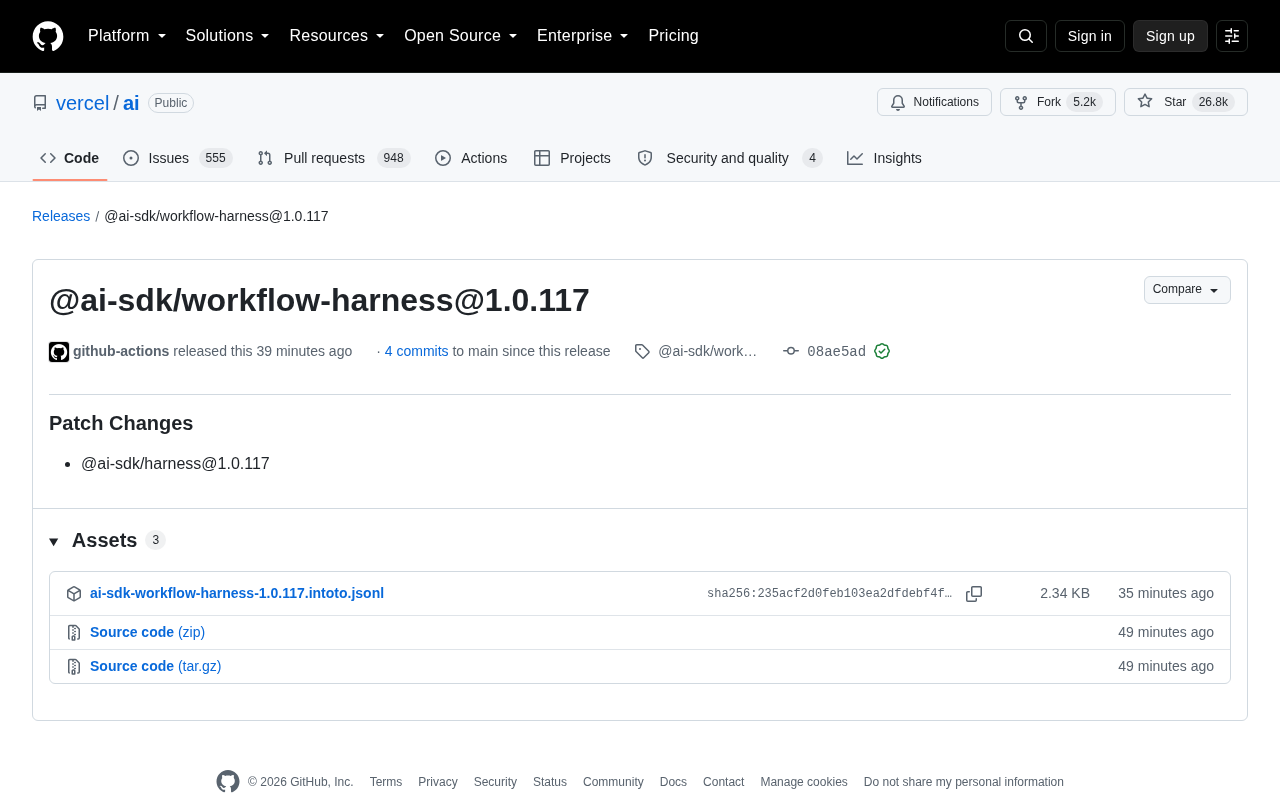
This release was completed via GitHub Actions automation and verified with GitHub's verified signature mechanism, using GPG key ID B5690EEEBB952194. This indicates the project has a mature automated release and security signing workflow in place, ensuring the trustworthiness of the software supply chain from an engineering standards perspective.
About Monorepos: A monorepo is a code management strategy where multiple related projects or packages are stored in a single repository, as opposed to a polyrepo where each package lives in its own repo. Vercel AI SDK uses a monorepo architecture — managing dozens of sub-packages like
@ai-sdk/core,@ai-sdk/openai, and@ai-sdk/workflow-harnessvia pnpm workspaces or similar tooling. In this setup, sub-packages share the same CI/CD pipeline and release tooling (such as Changesets), and unified version bumping is standard practice — even if a sub-package has no functional changes of its own, it may still get a new release as part of a dependency chain update. The upside of this "version alignment" strategy is reduced friction from peer dependency incompatibilities; the downside is higher release frequency with minimal changelogs per update, requiring developers to trace individual commits for substantive changes.
What Is workflow-harness
Within the AI SDK ecosystem, a "harness" typically refers to a runtime scaffold used to host and execute specific logic. workflow-harness, as the name suggests, is a runtime framework built around workflow scenarios, providing the underlying infrastructure for developers to orchestrate multi-step AI tasks.
As AI applications evolve from single-turn Q&A toward multi-step, orchestratable agent workflows, this kind of infrastructure has become increasingly important. Developers need a stable framework to manage task scheduling, state passing, and execution result validation — and harness-type components are the key pieces that fulfill this role.
About the term "harness": In software testing and runtime contexts, "harness" originates from the hardware concept of a wire harness — infrastructure that "bundles" components together to work in coordination. In AI agent workflow scenarios, the responsibilities of a workflow-harness typically include: defining input/output contracts for tasks, managing context passing across multi-step executions, providing retry and error-handling mechanisms, and capturing or mocking intermediate step results in test scenarios. This is conceptually similar to LangChain's Chain or LlamaIndex's Pipeline — all aimed at providing structured orchestration for sequences of LLM calls. The distinction is that Vercel AI SDK places greater emphasis on deep integration with frontend frameworks like Next.js and end-to-end type safety through the TypeScript type system.
Why Patch Updates Are Worth Watching
For users in production environments, a Patch version typically means backward-compatible bug fixes or internal optimizations with no breaking changes. This means most users can upgrade safely without worrying about API-level adjustments.
Also worth noting is the AI SDK's iteration cadence. The version number 1.0.117 shows the project has gone through over a hundred patch iterations under the 1.0 major version — a testament to the Vercel team's sustained investment and high-frequency maintenance. For teams building products on top of the AI SDK, this level of activity is itself an important factor in technology selection: high-frequency, well-structured updates often translate to faster bug fixes and better long-term maintenance.
Practical Recommendations for Developers
If you're using Vercel AI SDK to build AI applications or agent workflows, keep the following in mind:
- Version alignment: When upgrading
workflow-harness, ensure related packages like@ai-sdk/harnessare pinned to the same version to avoid potential dependency mismatches. - Patch upgrades are generally safe: Patch-level updates are typically low-risk, but it's still good practice to validate in a staging environment before pushing to production.
- Track release notes continuously: The AI SDK iterates frequently — subscribing to GitHub Releases helps you stay on top of security fixes and feature enhancements as soon as they land.
Since the release notes for this update are brief and don't disclose specific fix details, developers who need to understand the exact changes in this patch can consult the project's changelog or the corresponding commit (08ae5ad).
About GPG verified signatures: GPG (GNU Privacy Guard) signature verification is a critical part of software supply chain security. When a Git commit or release tag carries a verified GPG signature, it cryptographically confirms the commit genuinely originated from the account holding the corresponding private key (in this case, the GitHub Actions bot) and was not tampered with or forged. Against the backdrop of increasing supply chain attacks on open-source ecosystems (such as the xz-utils backdoor incident), verifying the integrity of release pipelines has become an engineering standard for mature open-source projects. When evaluating the trustworthiness of an npm package, beyond download counts and star ratings, it's worth checking whether the release process includes automated signing and provenance attestation mechanisms.
Summary
@ai-sdk/workflow-harness@1.0.117 is a routine patch update focused on dependency version alignment and internal maintenance. While the information in a single update is limited, it reflects the maturity of Vercel AI SDK's engineering practices — including automated releases and security signing — and speaks to the continued evolution of AI workflow infrastructure. For developers relying on this toolchain, staying current with versions remains the prudent choice.
Related articles

Python 3.15 New Feature: Is the sentinel Type Better Than None?
Python 3.15 adds the sentinel type, using named unique sentinel objects to replace None and bare object(), resolving confusion among missing values, explicit emptiness, and invalid input while avoiding type hint failures.

Deep Learning's Three Architectures and the Universal Approximation Theorem: A Complete Guide to MLPs, CNNs, and Transformers
Explaining the inductive bias differences among MLP, CNN, and Transformer, the existence meaning of the Universal Approximation Theorem (UAT), and the role of Taylor expansion in approximation analysis, while clearing up common misconceptions.

GitLab Emergency Patch Release: Analysis of Critical Security Fixes
GitLab releases critical patch 19.5.1, sparking 355 points of discussion on Hacker News. This article analyzes the background, upgrade steps for self-hosted instances, and verification points to help DevOps teams respond quickly to security updates.